Venezuela’s Election Leaves Unexpectedly Narrow Margin of Victory
Courtesy of: Reuters
Millions of Venezuelans headed to the polls on Sunday to elect a new president for the second time in six months. Though expectations were low heading into the vote – especially among the country’s opposition – an unexpectedly close race has reignited tensions, uncertainty and indeed, hope.
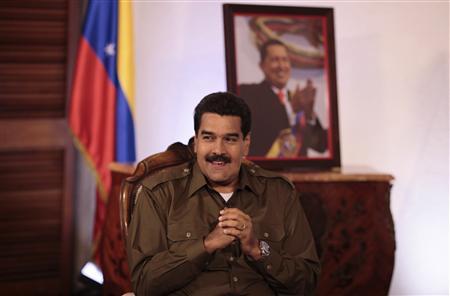
Though Venezuelans had elected Hugo Chávez just last October, a new election was triggered after the former president lost a long battle to cancer in March. The government positioned Nicolás Maduro, the country’s vice-president and Chávez’s handpicked successor, as their new candidate. The opposition once again chose their leader and former candidate, Henrique Capriles.
Nicolas Maduro, in his capacity as acting president, enjoyed a de facto three month head start on the campaign. Capriles, on the other hand, was forced to campaign only during the formal period, which totaled 10 days. Meanwhile, the Venezuelan government did all it could to ensure Hugo Chávez’s memory was never far from the campaign trail. Maduro and the government invoked his image, name and voice in every single rally, trying to seize on the sympathy vote and keep open the subliminal connection with the powerful “Comandante.” Capriles and the opposition sought to draw a distinction between Chávez and Maduro, reminding Venezuelans that Chávez’s supposed “successor” is little more than an un-charismatic and power-hungry former underling of Chávez himself.
Maudro’s control over the country’s media and public resources proved to be an enormous advantage over this short campaign. While Maduro enjoyed more than 65 hours of state media coverage, Capriles received a paltry 23 minutes. In addition, during the auditing of voting machines, the opposition uncovered evidence that the government party had access to the secret codes needed to sabotage the voting process. International observers spoken out against the unfair playing field, also noting the egregious conflict of interest posed by the “independent” National Electoral Council composed of five officials – four who publicly support Maduro.
Given these advantages, analysts and pollsters favored Maduro to win Sunday’s vote by a significant margin. However, in a later than expected announcement, election authorities stunned Venezuelans, announcing Maduro as the winner, but with a margin of victory of only 1.59 percent or around 235,000 votes. The body announced around midnight that Maduro had received 50.6 percent of the vote and Capriles 49.1 percent.
Immediately after, Maduro took the stage to declare victory. The votes, however, clearly reflected the country’s serious doubts about the acting president’s ability to govern. In a brief, 10-day campaign, Capriles, who was predicted to lose by a similar margin as in October of 2012, managed to recover nearly all of 1.5 million votes he lost to Chávez just six months ago. The narrow margin – along with thousands of documented irregularities in the voting process – prompted Capriles and the opposition to call for a full recount of the votes. Maduro announced he would accept the full recount. One must bear in mind, however, that this recount will be conducted by the Maduro-friendly National Electoral Council.
If the recount suggests a closer margin or reveals that Capriles was actually the winner, Venezuelans can expect a tumultuous time ahead. However, if electoral council upholds the reported results, the task ahead for Maduro is indeed daunting. He already faces a devastated country – left behind by 14 years of socialist rule – with a budget deficit of roughly 15 percent of annual economic output, inflation of almost 30 percent, extreme shortages, violent crime rates among the worst in the world, regular power outages, and a sclerotic state oil industry.
The results will also embolden the political opposition and undermine Maduro’s stature within Chávez’s former supporters. As a result, the political situation within the ruling socialist party will become more tempestuous. Maduro already lacks Chávez’s emotional connection with the nation’s poor; any fiscal retrenchment, therefore, could create a political backlash for the new president. Furthermore, this weak political mandate may spur divisions within the government’s political party. As memories of Chávez fade, other powerful figures like Assembly President Diosdado Cabello may challenge Maduro for primacy within the party.
Maduro’s narrow win has been termed by many a “Pyrrhic victory,” as does nothing to avoid the economic and political reckoning Venezuela’s ruling socialist party are heading for. Most analysts believe Venezuela has less than a year before the festering economic problems turn into a full-blown crisis. With a sinking economy, a divided political party, and a confident and growing opposition, Venezuela seems set for contentious – and pivotal – days ahead.