Jun
30
2010
Posted by
admin
Comments

Chávez to fine street peddlers to control inflation…

Article originally posted by AP

In its latest bid to brake soaring inflation, Venezuela’s government said Tuesday it will make street vendors freeze their prices, threatening violators with fines, confiscations and even jail.

President Hugo Chavez has been struggling to contain the surge in consumer prices, now running at an annual rate of 31.2 percent, the highest in Latin America.

Venezuelans who survive hawking goods on city sidewalks won’t be able to sell more than 20 different products that fall under price controls once the rules take affect in 30 days, according to regulations published in the Official Gazette.

Chavez imposed price controls in 2003, but the rules applied only to formal businesses. The new regulations extend the controls to warehouses where peddlers store their goods.

Johan Medina, a 22-year-old who sells cheese in gritty downtown Caracas, warned that the change could make business difficult for vendors who often struggle to find wholesale products at discount prices and sell them at a modest profit.

“If you buy a product with unregulated prices, you have to sell it at a higher price,” Medina said.

The government doesn’t count how many informal vendors sell regulated products, but a stroll down a couple blocks of any of Venezuela’s bustling cities will find hundreds — if not thousands — of vendors hawking wares.

Analysts doubt the measure will help significantly reduce inflation.

“I don’t think this decision is going to have a dramatic effect on the economy,” said Luis Vicente Leon, an economist at the local Datanalisis polling firm.

Authorities are already struggling to supervise formal businesses and are going to find it tough also enforcing the regulations on vendors, he predicted.

Economists like Leon contend inflation is running in double digits because the South American nation’s farms and food production companies aren’t producing enough and because the government isn’t providing sufficient U.S. dollars to importers to satisfy domestic demand.

Chavez blames the shortages on private businesses. He accuses them of intentionally reducing production as a means of undermining his efforts to revive the economy and shift Venezuela to a more socialist society.
 
Jun
30
2010
Posted by
admin
Comments

Venezuela in more trouble than Greece

Economy in VNZ Venezuela in more trouble than GreeceArticle originally posted by Bloomberg.

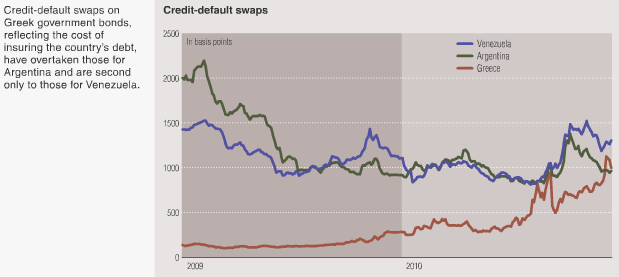
The cost of insuring Greek government debt is now second only to that of Venezuela, where Chavez has declared “economic war” against the “bourgeoisie.”
The CHART OF THE DAY shows that credit-default swaps on Greek government bonds, in red, have overtaken Argentina, which failed to pay more than $80 billion in December 2001. The Latin American nation still has more than $6 billion of defaulted securities outstanding after its second attempt to restructure.

“Greece isn’t Argentina,” said Niels Jensen, a portfolio manager at London-based investment firm Absolute Return Partners LLP, which oversees more than $300 million. “From an economist’s point of view, there’s no question that it’s much, much worse.”

Greece’s debt burden last year was equivalent to about 115 percent of gross domestic product, compared with a level of about 60 percent for Argentina when it defaulted. Credit swaps signal there’s a more than 67 percent chance the southern European nation won’t meet its commitments within the next five years.

Venezuela’s Chavez, a 55-year-old former army paratrooper who champions a socialist ideology, oversees an economy that may contract 2.5 percent this year, according to Bank of America Corp.

“You’ve declared an economic war against me, so I accept your challenge, stateless bourgeoisie,” Chavez said June 2 after business chambers criticized his handling of the economy. “I’m declaring an economic war with the help of the people and workers.”

Credit-default swaps pay the buyer face value in exchange for the underlying securities or the cash equivalent should an issuer fail to adhere to its debt agreements.

 
Jun
30
2010
Posted by
admin
Comments

PDVSA borrows $1.5 billion from banks

Article originally posted by Reuters

Venezuela’s state oil company PDVSA said on Tuesday it borrowed $1.5 billion from a group of banks, including the China Development Bank Corp [CHDB.UL] and Portugal’s Banco Espirito Santo.

PDVSA, short of cash because of lower global oil prices and a string of problems affecting output from its refinery network, said the loan was repayable in three years with a nine-month grace period.

“PDVSA, China Development Bank Corp, Banco Espirito Santo and other major banks have signed a syndicated credit agreement providing a $1.5 billion facility for the Venezuelan state oil company,” PDVSA said in a statement.

Beijing has good ties with Caracas, and Chinese companies are involved in projects to develop the Latin American OPEC member’s vast Orinoco heavy crude belt. The China Development Bank was seen lending in line with China’s policy goals.

PDVSA is ranked as the world’s fourth-largest oil company in an annual survey by industry publication Petroleum Intelligence Weekly. It is South America’s top oil exporter and an important supplier of crude to the United States.

The company said in January that its total debt had risen 42 percent to $21.4 billion in 2009 compared with the previous year after it borrowed heavily to pay off service company debts and intervene in currency markets. PDVSA, the financial engine of President Hugo Chavez’s socialist project, built up billions of dollars in debts to service companies after the 2008 collapse of oil prices.