Apr
19
2013
Posted by
admin
Comments

In Case You Missed It… Articles Roundup Week of 4/19/13

in5fjQpowmnM e1366405340981 In Case You Missed It… Articles Roundup Week of 4/19/13

Courtesy of: Agence France Presse

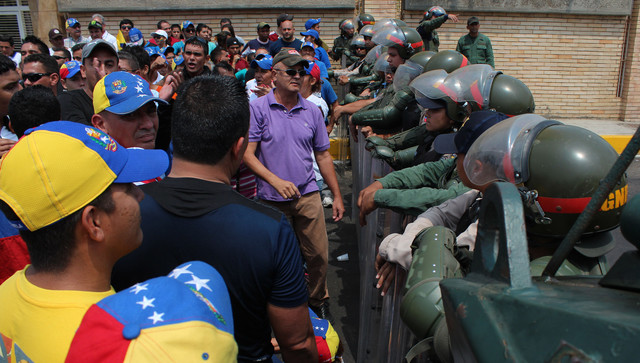
This week:  A narrow margin in the Venezuelan election by Hugo Chávez’s heir Nicolás Maduro spells uncertainty for the country; behind by less than two percent of the vote, opposition candidate Henrique Capriles challenges the election results and demands a full recount; tensions then rise after Venezuela’s government reneges on its promise to carry out the recount of the votes; government security forces and opposition protesters clash in Venezuela over election results; and the news of Maduro’s narrow victory in Venezuela causes bonds to fall and credit-default swaps to rise.  Capriles calls off a march planned to demand an election recount after Maduro and his government threaten a crackdown; U.S. Secretary of State John Kerry encourages a recount of the votes casted in Venezuela’s presidential election; amid post-election violence, Human Rights Watch reports that Venezuela’s government continues to limit citizens’ rights to speak freely and assemble peacefully; and protestors take to the streets with pots and pans to express dissatisfaction towards Maduro and the government’s handling of the election results. Several South American governments hold an emergency meeting to discuss Venezuela’s political crisis; Venezuela’s electoral committee finally agrees to audit – but not fully recount – the presidential vote after demands from the opposition; the aftermath of the presidential election in Venezuela continues to batter the country’s already struggling economy; and the slim election victory represents another sign of the many problems ahead for Maduro and Venezuela. Indeed, the election has further tainted the legitimacy of Maduro and of the government he would represent.

Tight win for Chavez’s heir spells uncertainty for Venezuela, Reuters

Late socialist leader Hugo Chavez’s chosen successor Nicolas Maduro won Venezuela’s presidential election by a whisker but now faces opposition protests plus a host of economic and political challenges in the OPEC nation.

Opposition candidate demands recount after Chavez’s heir Nicolas Maduro wins Venezuela presidency, Fox News

Hugo Chavez’s hand-picked successor, Nicolas Maduro, has officially won Venezuela’s presidential election by a stunningly narrow margin that highlights rising discontent over problems ranging from crime to power blackouts.

Tensions Surge in Venezuela After Vote, The Wall Street Journal

Tension in Venezuela rose sharply Monday after the government reneged on its promise to carry out a full recount of the bitterly contested presidential vote and declared acting President Nicolás Maduro as president-elect.

Protests in Venezuela as opposition disputes Nicolás Maduro’s victory, The Guardian

Venezuelan security forces quelled protests on Monday as Nicolás Maduro – the handpicked heir of Hugo Chávez – was proclaimed president after a wafer-thin and fiercely disputed vote.

Venezuelan Bonds Sink Most in 2 Months on Maduro’s One-Point Win, Bloomberg Businessweek

Venezuela’s bonds tumbled the most in two months and credit-default swaps rose after ex-President Hugo Chavez’s handpicked successor, Nicolas Maduro, won emergency elections by one percentage point over opposition candidate Henrique Capriles.

Capriles Calls Off Protest After Venezuela Threatens Crackdown, Bloomberg Businessweek

Venezuelan opposition leader Henrique Capriles Radonski took a step back from the brink of a mounting confrontation with the government by calling off a march planned for today to protest the results of the April 14 presidential election.

Kerry Encourages Venezuela Recount, The New York Times

Secretary of State John Kerry said Wednesday that Venezuela should hold a recount of votes cast in its presidential election, which the country’s electoral authorities say was narrowly won by a protégé of former President Hugo Chávez.

Venezuela: Respect Free Speech and Assembly, Human Rights Watch

The government of Venezuela should not limit citizens’ rights to freely express their views and assemble peacefully in response to the disputed presidential election, Human Rights Watch said today.

Stand against Venezuela’s new strongman, NY Daily News

There is a stirring sound echoing through Venezuela right now: that of the cacerolazo , a form of protest that involves participants taking to the streets banging pots and pans.

Venezuela dispute prompts urgent meeting of regional leaders, Reuters

Several South American presidents will hold an emergency meeting on Thursday in Lima to discuss the political crisis in Venezuela following the disputed election of President Nicolas Maduro, Peru’s foreign ministry said on Wednesday.

Conceding to opposition, election council to audit Venezuela vote, The Washington Post

Venezuela’s electoral council says it will audit the 46 percent of the vote not scrutinized on election night, a surprise concession that opposition candidate Henrique Capriles says will prove that he won the presidency.

Venezuela’s Election Downshifts Views on Economy, Debt, Wall Street Journal

We hear elections have consequences, which are usually obvious if the winner’s mandate is strong.

Analysis: Venezuela’s Maduro inherits tough economic problems, Reuters

Venezuelan President-elect Nicolas Maduro faces a difficult economic panorama of rising inflation and slowing growth, further complicated by his slim election victory that is being challenged by the opposition.

Maduro’s lousy start, The Economist

Hugo Chávez has been dead for more than a month, but visitors to Caracas could be forgiven for thinking that Venezuela’s bombastic former president was still alive and in power. His image plasters the streets; his speeches fill the airwaves. The blitz was ordered by his anointed successor, Nicolás Maduro, to harness Chávez’s popularity in order to win a landslide in an election on April 14th. The plan failed.
 
Oct
1
2012
Posted by
admin
Comments

Panel: Superior Capriles Campaign negates Unlevel Playing Field

South Americas October Surpise Panel: Superior Capriles Campaign negates Unlevel Playing Field

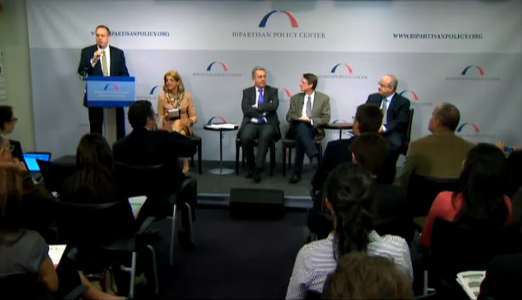
Screen Capture: Bipartisan Policy Center - South Americas October Surpise

Venezuela under Chávez does not meet the standards for a real democracy, according to statements made by former Colombian President Álvaro Uribe. The former leader told an audience at Washington’s Bipartisan Policy Center (BPC) that Chávez has failed to protect the security and freedoms of Venezuelan citizens during his rule and has not allowed their active participation in government.

Uribe participated in a BPC panel last week focusing on recent developments in Venezuela and Colombia, which include Venezuela’s tight presidential election, entitled “South America’s October Surprise?” The former Colombian president was joined by Dan Fisk of the International Republican Institute and Michael Shifter of the Inter-American Dialogue.

The panel discussed whether Venezuela’s upcoming elections can be considered fair as well as the likelihood that opposition candidate Henrique Capriles will defeat Chávez. Participants also tried to predict how the president will respond if he loses.

“There was a hemispheric consensus that elections [are] how you judge a democracy,” Fisk said of Venezuela’s upcoming vote. But he added that Chávez has manipulated the system to provide the appearance of a democracy while suppressing citizens’ democratic rights. “A lot of people have given [Chávez] credit that you can take away people’s freedom through a series of democratic processes.”

Uribe, though, had much stronger words. “I am against the Chávez dictatorship with or without elections,” he said. He further criticized the Chávez administration for failing to pursue the narco-terrorist organization FARC in Venezuelan territory. That failure has bled across Venezuela’s borders, undermining the stability of Colombia that the government of president Uribe worked hard to attain.

Fisk said that while the technical voting process in Venezuela appears to be fair, the real disparity – and the threat to democracy – lies in the campaign itself.

“The problem is not the machinery, it is the campaign process,” Fisk said. Venezuelan law allows the president to call mandatory national broadcasts, known as cadenas, at any time, and Chávez has abused this power to saturate Venezuela with campaign propaganda. Meanwhile, Capriles must pay for airtime, and lacks the resources to match the reach of the state media.

Chávez has also used the resources of the government, supplied by the country’s vast oil reserves, to finance his campaign. “In many ways PDVSA is the lubricant of the Chávez campaign,” Fisk said. Chávez has increased social spending, and then trumpeted that increased spending in his campaign rhetoric, giving Venezuelans the impression that it is he, not the government, who is giving them these benefits.

Despite all of this, Fisk says that this is the most competitive race that Chávez has ever faced. It remains to be seen if all of the electoral advantages Chávez enjoys can blunt the impact of his economic mismanagement, which has led to severe shortages and skyrocketing inflation, or make Venezuelans forget the recent refinery fires and one of the world’s highest crime rates.

Shifter added that the opposition has run an excellent campaign, and Capriles has refused to fall for tactics and provocations of Chávez. The opposition has stumbled in the past and has its best chance yet, in part because it has unified itself into one group. In addition, he did join the concerns of the other panelists, adding that “there is not a level playing field.”

In an encouraging bit of consensus, the panelists for the most part dismissed worries that Chávez would reject the results if the opposition wins. “It would be very hard in terms of politics in Venezuela and international pressure to deny [an opposition victory],” Shifter said. He warned, however, that the process may not be smooth. “We should be prepared for some amount of violence and instability. We have seen that in campaign stops in the past couple of days,” alluding to recent Chavista-incited violence at Capriles rallies.

Fisk added that the United States should be prepared to accept the results if the election appears credible, and that he believes that Venezuelans will peacefully accept the results as well.

 
Oct
1
2012
Posted by
admin
Comments

Capriles Rally Draws Thousands Against Chavez Ahead of Vote

Bloomberg News
October 01, 2012
By Nathan Crooks and Jose Orozco

henrique capriles radonski Capriles Rally Draws Thousands Against Chavez Ahead of Vote

Courtesy of: Juan Barreto / AFP / Getty Images

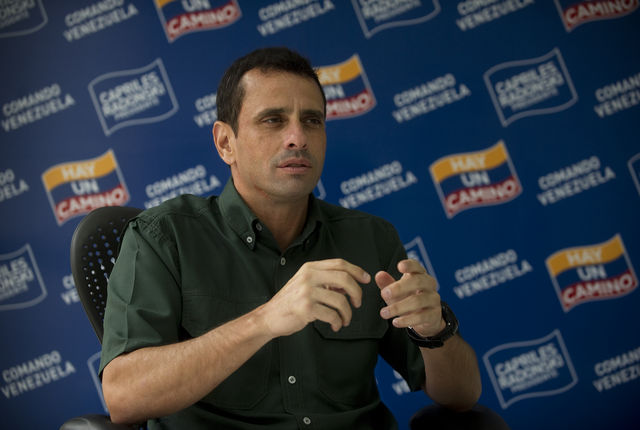
Venezuelan opposition candidate Henrique Capriles Radonski symbolically closed his Caracas campaign against President Hugo Chavez yesterday with a march attended by tens of thousands of supporters.

Capriles, dressed in a shirt styled with the three colors of Venezuela’s flag, promised to confront growing violence in the South American country after he said three supporters were shot and killed over the weekend in Barinas state. He asked voters to judge Chavez’s priorities after 13 years in power and decide if they were happy with their lives today.

“This government gives away resources to every other country,” Capriles said. “There is no gauze in the hospitals here, but they give money away to sponsor samba dancing at the carnival in Rio.”

Capriles, 40, has held large rallies across Venezuela over the past month to close his campaign and build momentum after making house-to-house visits to offer what he described as a message of unity, progress and private investment. He filled the stadium used by Chavez’s favorite baseball team on Sept. 27 in a rally to close his campaign in the central state of Carabobo.

“This has to be one of the largest marches in the history of Caracas,” Capriles said yesterday to a throng filling the length of Bolivar Avenue in downtown Caracas, a symbolic space often used by Chavez for campaign rallies, waving party flags, chanting, dancing to campaign music and blowing vuvuzelas.

Leopoldo Lopez, a member of Capriles’ campaign team, said on the Globovision television network Sept. 28 that he hoped as many as a million people would attend the march. The campaign didn’t provide an estimate on the size of the march afterward.

Three Dead

Shots were fired at a caravan of cars in eastern Barinas state on Sept. 29 when Capriles supporters tried to pass a checkpoint, the Primero Justicia political party said in a statement, adding that the barricade had been set up by “presumed” Chavez supporters.

Police have detained three suspects, the Venezuelan government said yesterday in an e-mailed statement, without providing additional details. Chavez, who spoke at a rally yesterday in western Zulia state, said the incident was “regrettable” and urged his supporters not to fall into “provocations.”

Chavez, who also spoke at a rally on Sept. 29 in central Miranda state, said he himself is one of the biggest critics of his government and that there were reasons for some people to be “discontent.”

Insecurity, Crime

“There have been failures and problems, but what is at stake on Oct. 7 is not about the small or medium problems including water or electricity problems,” said Chavez. “We’ll solve the problems of insecurity and crime.”

Andrea Thadino, who lives in Caracas slum of San Agustin where a cousin was killed by a gunfight three years ago, said she works at a street nail salon because she can’t get a job teaching at a public school after signing a petition against Chavez.

“Despite studying for five years, I have to work as a street vendor to survive,” she said in an interview at yesterday’s march while carrying her 2-year-old son. “I voted for Chavez the first time but not anymore. I think Capriles is a sincere man who is going to make a change.”

Fitness for Office

Capriles, a former governor of Miranda state, has played up his youth and fitness to offer a stark contrast to the condition of his 58-year-old opponent, who is coming off three operations related to an unknown cancer in the past 15 months. He is ahead in several polls while trailing by as much as 15 percentage points in others.

“There are two options here. One we already know and has been in power for 14 years,” Capriles said. “I lead the other option that aims to solve your problems.”

Capriles, who arrived on a truck with “Progress” written on its windshield, said Chavez had dashed the hopes of many Venezuelans.

“There was a lot of hope, wherever you went, there were rivers of people full of hope,” said Capriles, referring to the period after Chavez was first elected. “Almost 14 years later, you be the judge of who is in the process of change and who is sick with power. Because the man in Miraflores defrauded the Venezuelan people.”

After his speech, Capriles hugged his mother and tossed his trademark baseball caps with the Venezuelan colors into the crowd.

Middle Class Votes

Chavez, a self-professed socialist who is traditionally supported by the country’s poor, has spent his final days on campaign trying to attract middle class and rich voters.

“Those with a big house and two or three cars in the garage, a good job, their kids in a good school, the ones who go to the club on Friday night and take their plane to Miami or Margarita Island on Saturday, those people should vote for Chavez,” the former paratrooper said in an interview broadcast yesterday on the Televen television network. “We are the guarantee of tranquility. Think about it well. It’s not for me, it’s for you.”

Armando Briquet, head of the Capriles campaign, said the government is trying to make the vote difficult for the opposition with actions including the closing of Venezuela’s Miami consulate, which will require thousands of voters to travel to the nearest voting center in New Orleans.

“Even with all that, we are going to win by more than 10 percentage points,” Briquet said backstage after the rally, citing the campaign’s polling numbers.

“On Oct. 7, Chavez wins!” Chavez told supporters yesterday in Zulia state. “It will be a grand victory, I don’t have a doubt.”

To contact the reporters on this story: Nathan Crooks in Caracas at [email protected]; Jose Orozco in Caracas at [email protected].

To contact the editor responsible for this story: Joshua Goodman at [email protected].

To read this article on Bloomberg News, please click here.