Feb
21
2013
Posted by
admin
Comments

ICYMI: The homecoming

The Economist
February 23, 2013
By Fabiola Sanchez and Ian James
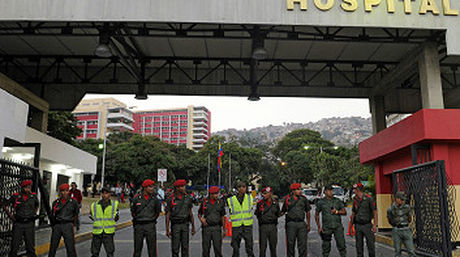
hospital chavistas celebraban presidente AFP NACIMA20130221 0259 19 ICYMI: The homecoming

Courtesy of: AFP

Ten weeks after flying to Cuba for his fourth cancer operation since June 2011, President Hugo Chávez returned to Venezuela in the early hours of February 18th. But the manner of his arrival suggested that he remains far too ill to govern. Only his closest aides, including a medical team, were on hand. Even senior cabinet members and leaders of the ruling United Socialist Party of Venezuela (PSUV) were kept in the dark. The president was taken to a military hospital, and installed in a tightly guarded ninth-floor ward reserved for senior officers. No images of his return were made available, but the party organised “spontaneous” demonstrations of joy on the part of his supporters once the news had been announced on the president’s Twitter account.

Since leaving Caracas for Havana on December 10th Mr Chávez, who has ruled his country in a hyperactive fashion for 14 years, has been neither seen nor heard. In a series of vaguely worded official communiqués, the government admitted that a severe post-operative lung infection left him with breathing difficulties. On February 15th it belatedly presented a “proof of life”, in the form of several photographs of the president with his eldest daughters, holding a copy of the Cuban government newspaper Granma from the previous day. But the photos (one of them is above) raised more questions than they answered. An accompanying statement said Mr Chávez is barely able to speak, thanks to a tracheotomy to ease his breathing (no tube was visible in the photos).

Despite all this, officials continue to insist that the president is in day-to-day control of the administration. They said, for example, that he had authorised a 32% devaluation of the currency, the bolívar, announced on February 8th, the eve of the Carnival holiday, when most Venezuelans are thinking about the beach. The president’s return has also served to distract attention temporarily from the deteriorating economy.

Nicolás Maduro, the vice-president, is to all intents and purposes running the country, but vehemently denies that he is the acting president. Mr Chávez’s return will at least obviate the need for ministers to make frequent visits to Havana for bedside consultations. Those visits fuelled speculation that instructions were being imparted by Cuba’s communist leaders, rather than by Mr Chávez. The homecoming cut short a growing protest against Cuban interference staged by students outside the island’s embassy in Caracas.

But in other ways Venezuela remains in the constitutional limbo that began on January 10th. That was the date on which Mr Chávez should have been sworn in for his fourth consecutive term after an election on October 7th. The supreme court, which Mr Chávez has turned into an appendage of the executive, ruled that as a re-elected president he could be sworn in whenever his doctors deemed him fit enough. More controversially still, they extended indefinitely the tenure of the existing cabinet, including the unelected Mr Maduro, whom Mr Chávez before his operation had anointed as his chosen successor. The court thus brushed aside constitutional stipulations concerning the president-elect’s incapacitation, which include the appointment of a medical board to determine his fitness for office.

Nevertheless, Mr Chávez’s return to Caracas makes possible his swearing-in, which is likely to be administered by a delegation from the court in private, rather than before the National Assembly. That in turn would give constitutional legitimacy to Mr Maduro’s role as vice-president (which technically lapsed on January 10th). But the government seems in no immediate hurry to take this step, perhaps because of the gravity of the president’s condition, including his speech impairment. Mr Chávez “will be sworn in when he’s good and healthy,” said Aristóbulo Istúriz, a state governor and leading PSUV member. The opposition Democratic Unity alliance is wondering aloud whether a man who is not fit enough to be sworn in can be considered fit enough to run the country.

Few but the president’s most fervent supporters believe he will recover sufficiently to serve his six-year term of office. Mr Chávez’s son-in-law, Jorge Arreaza, who is also the science minister, referred last week to “palliative treatments”, which suggested that the president has come home to die.

Foreign diplomats in close touch with the regime expect a fresh presidential election by June at the latest. This would almost certainly pit Mr Maduro against the opposition’s Henrique Capriles, who lost to Mr Chávez in October. The president’s death, his resignation or other “permanent absence” would, according to the constitution, trigger an election within 30 days. But the supreme court is skilled in creative interpretation of the constitution so as to suit the government’s cause.

Some analysts suggested that the devaluation, which is bound to spark an increase in inflation (already at 20% a year), was a sign that the regime had ruled out an early election. Rather, it may be an indication of the gravity of Venezuela’s economic plight. Wild spending ahead of the October election and the economy’s mismanagement pushed the fiscal deficit to 8.5% of GDP last year. Several staple goods are in short supply and the Central Bank’s liquid reserves are down to about $4.5 billion. In the illegal black market, the dollar buys 23 bolívares, compared with the new official rate of 6.3.

One indication that an election may come soon is that government newspapers have begun to publicise polls which suggest that Mr Maduro would easily beat Mr Capriles in a vote. Mr Maduro himself has been engaged in an undeclared campaign for some time: he blamed the devaluation and shortages on speculation and sabotage by what remains of Venezuela’s battered private sector. Some in the opposition coalition want to name their candidate so as to be ready for a snap election. Barring a miraculous recovery by Mr Chávez, Venezuelans may soon be going to the polls again.

To read this article at The Economist, please click here.
 
Oct
1
2012
Posted by
admin
Comments

Capriles Rally Draws Thousands Against Chavez Ahead of Vote

Bloomberg News
October 01, 2012
By Nathan Crooks and Jose Orozco

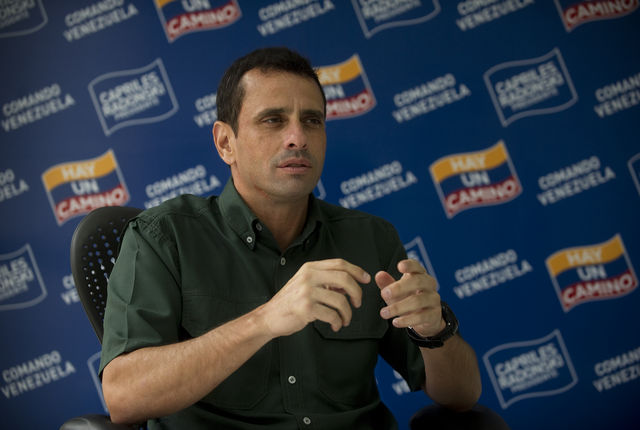
henrique capriles radonski Capriles Rally Draws Thousands Against Chavez Ahead of Vote

Courtesy of: Juan Barreto / AFP / Getty Images

Venezuelan opposition candidate Henrique Capriles Radonski symbolically closed his Caracas campaign against President Hugo Chavez yesterday with a march attended by tens of thousands of supporters.

Capriles, dressed in a shirt styled with the three colors of Venezuela’s flag, promised to confront growing violence in the South American country after he said three supporters were shot and killed over the weekend in Barinas state. He asked voters to judge Chavez’s priorities after 13 years in power and decide if they were happy with their lives today.

“This government gives away resources to every other country,” Capriles said. “There is no gauze in the hospitals here, but they give money away to sponsor samba dancing at the carnival in Rio.”

Capriles, 40, has held large rallies across Venezuela over the past month to close his campaign and build momentum after making house-to-house visits to offer what he described as a message of unity, progress and private investment. He filled the stadium used by Chavez’s favorite baseball team on Sept. 27 in a rally to close his campaign in the central state of Carabobo.

“This has to be one of the largest marches in the history of Caracas,” Capriles said yesterday to a throng filling the length of Bolivar Avenue in downtown Caracas, a symbolic space often used by Chavez for campaign rallies, waving party flags, chanting, dancing to campaign music and blowing vuvuzelas.

Leopoldo Lopez, a member of Capriles’ campaign team, said on the Globovision television network Sept. 28 that he hoped as many as a million people would attend the march. The campaign didn’t provide an estimate on the size of the march afterward.

Three Dead

Shots were fired at a caravan of cars in eastern Barinas state on Sept. 29 when Capriles supporters tried to pass a checkpoint, the Primero Justicia political party said in a statement, adding that the barricade had been set up by “presumed” Chavez supporters.

Police have detained three suspects, the Venezuelan government said yesterday in an e-mailed statement, without providing additional details. Chavez, who spoke at a rally yesterday in western Zulia state, said the incident was “regrettable” and urged his supporters not to fall into “provocations.”

Chavez, who also spoke at a rally on Sept. 29 in central Miranda state, said he himself is one of the biggest critics of his government and that there were reasons for some people to be “discontent.”

Insecurity, Crime

“There have been failures and problems, but what is at stake on Oct. 7 is not about the small or medium problems including water or electricity problems,” said Chavez. “We’ll solve the problems of insecurity and crime.”

Andrea Thadino, who lives in Caracas slum of San Agustin where a cousin was killed by a gunfight three years ago, said she works at a street nail salon because she can’t get a job teaching at a public school after signing a petition against Chavez.

“Despite studying for five years, I have to work as a street vendor to survive,” she said in an interview at yesterday’s march while carrying her 2-year-old son. “I voted for Chavez the first time but not anymore. I think Capriles is a sincere man who is going to make a change.”

Fitness for Office

Capriles, a former governor of Miranda state, has played up his youth and fitness to offer a stark contrast to the condition of his 58-year-old opponent, who is coming off three operations related to an unknown cancer in the past 15 months. He is ahead in several polls while trailing by as much as 15 percentage points in others.

“There are two options here. One we already know and has been in power for 14 years,” Capriles said. “I lead the other option that aims to solve your problems.”

Capriles, who arrived on a truck with “Progress” written on its windshield, said Chavez had dashed the hopes of many Venezuelans.

“There was a lot of hope, wherever you went, there were rivers of people full of hope,” said Capriles, referring to the period after Chavez was first elected. “Almost 14 years later, you be the judge of who is in the process of change and who is sick with power. Because the man in Miraflores defrauded the Venezuelan people.”

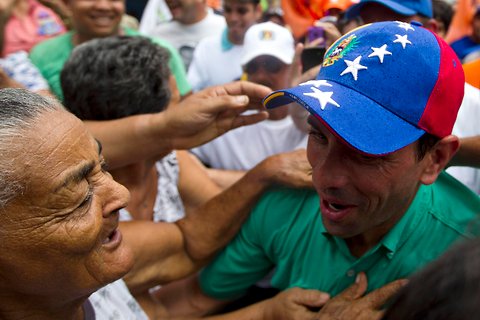
After his speech, Capriles hugged his mother and tossed his trademark baseball caps with the Venezuelan colors into the crowd.

Middle Class Votes

Chavez, a self-professed socialist who is traditionally supported by the country’s poor, has spent his final days on campaign trying to attract middle class and rich voters.

“Those with a big house and two or three cars in the garage, a good job, their kids in a good school, the ones who go to the club on Friday night and take their plane to Miami or Margarita Island on Saturday, those people should vote for Chavez,” the former paratrooper said in an interview broadcast yesterday on the Televen television network. “We are the guarantee of tranquility. Think about it well. It’s not for me, it’s for you.”

Armando Briquet, head of the Capriles campaign, said the government is trying to make the vote difficult for the opposition with actions including the closing of Venezuela’s Miami consulate, which will require thousands of voters to travel to the nearest voting center in New Orleans.

“Even with all that, we are going to win by more than 10 percentage points,” Briquet said backstage after the rally, citing the campaign’s polling numbers.

“On Oct. 7, Chavez wins!” Chavez told supporters yesterday in Zulia state. “It will be a grand victory, I don’t have a doubt.”

To contact the reporters on this story: Nathan Crooks in Caracas at [email protected]; Jose Orozco in Caracas at [email protected].

To contact the editor responsible for this story: Joshua Goodman at [email protected].

To read this article on Bloomberg News, please click here.

 
Aug
10
2012
Posted by
admin
Comments

In Case You Missed It… Articles Roundup Week of 8/10/12

iht 0810 latitude toro art3 blog480 In Case You Missed It… Articles Roundup Week of 8/10/12

Courtesy of: Carlos Garcia Rawlins / Reuters

With less than 60 days before the elections, opposition candidate Henrique Capriles’ team says polls show him leading President Hugo Chávez. The latest scandal in the campaign is over Capriles’ hat, which the National Electoral Council (CNE) says violates campaign laws concerning the use of the flag. The CNE ignores Chávez’s rampant use of similar imagery in his campaign. Chávez draws criticism for accusing Capriles, the grandson of a Holocaust survivor, of having ties to Nazi groups. Meanwhile, excessive election-year spending by Chávez’s government has investors predicting a currency devaluation in the coming months. Several outlets report that the country’s oil industry, despite possessing the world’s largest reserves, has been crippled by mismanagement and poor policy. Chávez’s ties with Iran and Hezbollah provoke worries about potential threats to U.S. security.

Venezuela’s Opposition Says Capriles Leading Chavez in Polls, Bloomberg

Venezuela’s opposition said today that its candidate Henrique Capriles Radonski is surging ahead of President Hugo Chavez in opinion polls for the Oct. 7 election.

Venezuela Presidential Race Rocked by Baseball Cap, Fox News

The latest issue to put Venezuela’s presidential rivals at odds with each other? A baseball cap. At the center of their latest dispute is a cap emblazoned with the colors of Venezuela’s flag that opposition candidate Henrique Capriles frequently wears at campaign rallies ahead of the country’s Oct. 7 election.

A Feather in Capriles’s Cap, International Herald Tribune

Venezuela’s campaign for the presidential contest of Oct. 7 descended into farce last week when election officials chastised the opposition for abusing campaign rules.

Venezuela candidate slams Chavez’s Nazi accusations, AFP

Venezuela’s leading opposition candidate — whose grandmother is a Holocaust survivor — on Tuesday slammed President Hugo Chavez’s accusations that he is tied to Nazi groups.

P&G Bracing for ‘Large’ Venezuela Devaluation After Election, Bloomberg Businessweek

Venezuela may carry out a “large” devaluation after October elections, according to Procter & Gamble Co. (PG) (PG), the world’s largest consumer products company.

The Venezuelan Elections: How Can PDVSA Recover?,Journal of Energy Security

The Venezuelan oil industry can be pictured as a toothless tiger resting on its haunches before a huge slice of raw meat.

Venezuelan cheap petrol backfires on economy, Financial Times

The perverse effects of Venezuela’s cheap petrol policy can be seen everywhere in the country.

Iran’s influence in Venezuela: Washington should worry, Miami Herald

The same week that President Obama downplayed the threat to U.S. security from Venezuela’s Hugo Chávez, a high-level delegation from Hezbollah was visiting Caracas and Havana. Ammar Musawi, head of Hezbollah International Department, praised Cuba as a model on how to oppose “imperialist hegemony, arrogance, and plunder.”