Sep
20
2013
Posted by
admin
Comments

ICYMI: Venezuela keeps rooting for Syrian dictator

Miami Herald

September 18, 2013

By Andres Oppenheimer
venezuela syria 2012 12 06 e1379694480735 ICYMI: Venezuela keeps rooting for Syrian dictator

Courtesy of: AFP

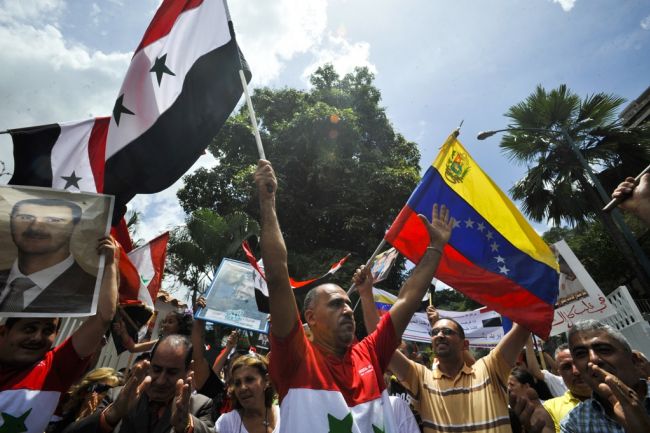
Much of the world is demanding greater pressure on Syria following a United Nations inspectors’ report hinting that Syrian strongman Bashar al-Assad used chemical weapons in his country’s civil war, but — amazingly — Venezuela and some of its Latin American allies are still passionately defending Syria’s dictator.

Earlier this week, after U.N. Secretary General Ban Ki-moon presented the U.N. inspectors’ report concluding that there is “clear and convincing” evidence that chemical weapons were used in an Aug. 21 incident on the outskirts of Damascus, Venezuelan President Nicolás Maduro lashed out against the U.N. chief for allegedly siding with the enemies of the Syrian people.

“Why is the U.N. secretary general lending himself (to plans to attack Syria,) as if he were a prosecutor and judge of the world’s people, putting himself at the service of the strategy of war, instead of being at the service of peace?” Maduro asked in a speech Monday in the state of Miranda.

In a speech last month more than a week after the Aug. 21 attack with chemical weapons, Maduro said, “Venezuela is with Syria, and with President Bashar al-Assad, and with the Syrian people.”

A day later, on Aug. 31, Maduro issued an official statement stating that Venezuela stands by “the Syrian people” in their fight against “unjustified war-mongering aggressions.”

Venezuela’s government-run media, meantime, has turned Assad into a hero and is blaming the United States and Israel for allegedly trying to invade Syria.

A cartoon in Venezuela’s state-run daily Correo del Orinoco this week shows a plane dropping hearts over Syria with the legend “to the Syrian people from the people of ALBA.” ALBA, which stands for the Bolivarian Alliance for the Peoples of Our Americas, is an organization formed by Venezuela that is it made up of nine Latin American and Caribbean countries.

Venezuela’s daily Vea, which like other government-backed newspapers often publishes anti-Semitic cartoons, ran a cartoon on May 9 showing a black-robed skeleton representing death, with a star of David and this legend: “Since we got tired of killing Palestinians, we are now going to finish with the Syrians.”

What’s most amazing about the pro-Assad statements in Venezuela’s official media is that they are still appearing after the U.N. inspectors’ report — which clearly suggests, without saying so explicitly, that Assad’s forces were responsible for the Aug. 21 chemical gas attack.

While it doesn’t officially take sides, because that wasn’t within the inspectors’ scope, the U.N. report shows that the rockets that carried Sarin gas are weapons that are not in the hands of Syria’s rebels, and that they were launched from several government-controlled points.

Although less strenuously, Venezuelan allies such as Cuba and Bolivia also have come out in support of Assad even after the U.N. findings. Most other Latin American countries have supported the Geneva agreement between the United States and Russia to demand that Syria destroy its chemical weapons.

But U.S. officials say major Latin American countries such as Mexico and Brazil have been late in joining the international community’s demands that Syria comply with the Geneva agreement.

Roberta Jacobson, the top U.S. State Department official in charge of Latin American affairs, told me Wednesday that “there is disappointment that more countries (in the region) would not have put out stronger statements condemning the Assad government’s use of Sarin gas, and supporting the Geneva U.S.-Russia agreements.”

Jacobson added that “countries in the Western Hemisphere want to be, and increasingly are, global actors. (But) If countries want to be global players, they should step up and confront challenges to the international community.”

My opinion: It’s entirely legitimate for Latin American countries to oppose a unilateral U.S. intervention in Syria, or even a U.S. intervention with dozens of allied countries but without the blessing of the United Nations. I myself have serious doubts about the wisdom of an intervention to stop Syria’s war crimes without some sort of U.N. cover.

But defending a dictator who has massacred a sizable part of the 100,000 people who have died in Syria’s civil war, and who according to all available evidence is responsible for the Aug. 21 attack with chemical weapons, is outrageous.

Maduro may be over-reacting on Syria because he needs to keep his Chavista radical base behind him after his dubious and narrow election victory April 14. His almost daily blunders, alongside Venezuela’s steep economic decline, are seriously weakening his government. And his adoration for dictators may explain his natural sympathy for Assad.

Still, Venezuela’s enthusiastic support for the Syrian regime after the Aug. 21 attack with chemical weapons should be denounced by everybody for what it is: an open defense of crimes against humanity.

To read this article at the Miami Herald, please click here.
 
Sep
10
2013
Posted by
admin
Comments

ICYMI: Capriles appeals to OAS human rights commission

BBC News
September 9, 2013

69757497 69757496 ICYMI: Capriles appeals to OAS human rights commission

Courtesy of: AFP

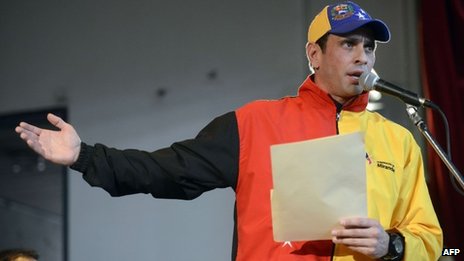
The defeated Venezuelan presidential candidate, Henrique Capriles, has filed a request at the Inter-American Commission on Human Rights to declare the April election void.

Mr Capriles alleges there was widespread fraud in the vote narrowly won by acting president Nicolas Maduro.

Last month, the Venezuelan Supreme Court rejected a final plea by Mr Capriles to have the vote annulled.

Mr Capriles vowed to take his fight beyond Venezuela.

Mr Maduro has repeatedly rejected the opposition allegations of fraud.

‘Supranational power’

He also dismissed the Washington-based human rights organisation as lacking credibility.

He praised the late president, Hugo Chavez, for beginning proceedings to pull out from the body last year.

Venezuela is due to officially withdraw from the Commission on Tuesday.

Mr Maduro accused the OAS Human Rights Commission of hating and despising Latin America

The Inter-American Commission on Human Rights is part of the Organisation of American States (OAS).

“They believe they are a supranational power, a power above the legitimate governments of the continent. Their time is passed,” said Mr Maduro.

The Venezuelan government decision was criticised by Amnesty International as “a serious setback for the rights of Venezuelans.”

‘Reinstate rights’

Opposition politician Ramon Jose Medina filed the request, signed by Mr Capriles, at the OAS headquarters.

The Venezuelan government “must be forced to reinstate the rights they violated,” said Mr Medina.

“The elections, which were fraudulent, must be repeated and the electoral process must be free and fair.”

Mr Maduro won the 14 April vote by less than 1.5 percentage points – about 200,000 votes.

Mr Chavez died on 5 March after a long battle against cancer.

Before going to Cuba for a last round of treatment in December, he appointed Mr Maduro as his preferred successor.

To read this article at BBC News, please click here.

 
Sep
4
2013
Posted by
admin
Comments

ICYMI: Blackouts Hit Nearly Half of Venezuela

Wall Street Journal
September 3, 2013
By Kejal Vyas

ALeqM5jqwUQc1j zylZx6VRZj8nU HvGvQ e1378316807289 ICYMI: Blackouts Hit Nearly Half of Venezuela

Courtesy of: AFP

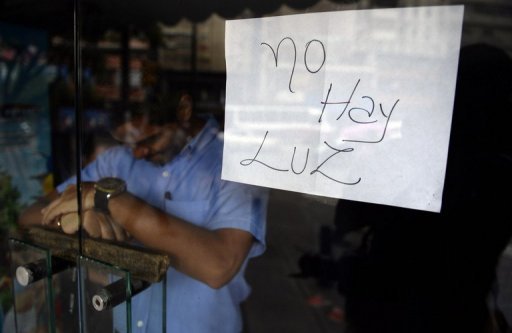
CARACAS—A failure in a transmission line cut power across much of Venezuela on Tuesday, leading the government to blame unidentified saboteurs for the widespread disruption.

Electricity outages struck parts of at least 11 of Venezuela’s 23 states in the early afternoon, mostly in the central and western regions, as well as the capital city, Electricity Development Vice Minister Franco Silva said in comments carried on state television.

Information Minister Delcy Rodríguez said in an address about five hours after the initial outage that power had been restored to several states, adding electricity was in the process of coming back online in the oil-rich western states of Zulia and Táchira, and the greater Caracas area.

A shaky power grid remains a thorn in the side of energy-rich Venezuela, leading critics of the current government to point the finger at mismanagement at state-run utility companies. Authorities have periodically turned to power rationing and levied additional surcharges and penalties on heavy electricity users.

Ms. Rodríguez said “complete restoration of this important service will be done in a progressive manner” without specifying how long it would take.

Messages posted on the Twitter account of President Nicolás Maduro said that the power grid was attacked by unnamed enemies of the government.

“It’s evident that behind [the blackout] is the hand of those that want to weaken our country,” said one post. Mr. Maduro didn’t offer evidence to back up his allegations. Calls seeking further comment from officials weren’t immediately returned.

While the government’s detractors accuse authorities of misappropriating investments into the country’s electricity network and falling behind growing consumer demand, the late leader Hugo Chávez often blamed conspirators against his self-styled socialist “Bolivarian revolution.” Mr. Chávez died in March following a nearly two year battle with cancer. Mr. Chávez nationalized much of the electricity sector in 2007.

In recent weeks, his successor Mr. Maduro has disclosed details of various other alleged plots against Venezuela, including several alleged assassination attempts against his life supposedly masterminded by agents of the U.S. and Colombian governments. Critics accuse him of fabricating plots in a bid to boost support.

Venezuela opposition leader Henrique Capriles, who lost April elections to replace Mr. Chávez, said the power failure underscored mismanagement at state companies. “The blackout today demonstrates one more time the terrible incapacity of this government,” Mr. Capriles said in a post on his official Twitter account. “Now they’ll come up with another story to try to cover up the failure.”

In Caracas, the blackouts briefly hit some key government buildings, including the Energy Ministry, which is also the headquarters of state oil company Petróleos de Venezuela, or PdVSA.

In a statement, Oil Minister Rafael Ramírez said refining and production operations in Venezuela’s vital oil industry were unaffected.

The sprawling capital city was furthered tangled by knotted traffic, disrupted subway service and severed water supplies, as several treatment plants went down, authorities said. Power shortfalls and outages are more common in the interior of the country of 29 million residents, while more rarely reaching Caracas.

Between 2009 and 2010, a drought cut production at Venezuela’s hydroelectric facilities that accounted for some 70% of the country’s power. The country has since had to divert more of its crude oil production and imports gas from Colombia to fulfill its own domestic power needs.

To read this article at The Wall Street Journal, please click here.