Mar
1
2013
Posted by
admin
Comments

In Case You Missed It…Articles Roundup Week of 3/1/13

protestaap123.jpg.940.600.thumb  e1362172682790 In Case You Missed It...Articles Roundup Week of 3/1/13

Courtesy of: Associated Press

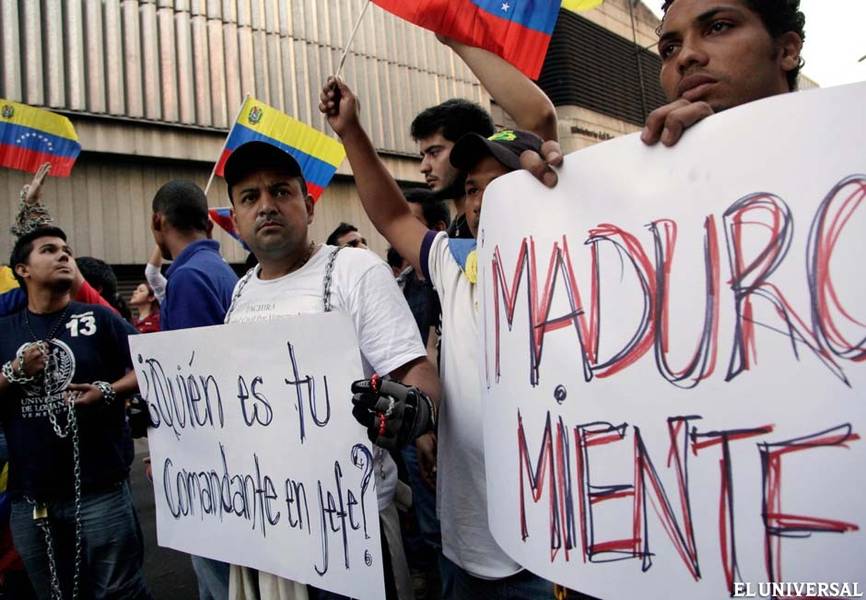
This week: Since his secretive return to Venezuela, confusion and uncertainty have surrounded Chávez’s health; while Chávez remains hidden from the public eye, the possibility of a new presidential election looms; members of the opposition march to demand answers on the president’s health; and vice president Nicolás Maduro admits on national television that Chávez is “is fighting for his health, for his life.” Price and currency controls cause pharmacy drug shortages to reach 40 percent; an electricity crisis and constant power cuts stir anger towards the Venezuelan government; price hikes continue in Venezuela, with the black market price of the dollar now at four times its official value; reports surface that 27.5 percent of Venezuelan imports reported by the government in 2012 in fact never happened; and Venezuela’s comptroller finds multiple administrative irregularities in two state-owned TV networks. Lastly, the Inter-American Commission on Human Rights urges Venezuela to reconsider its withdrawal from the respected human rights commission; authorities violently disperse student demonstrations demanding answers on Chavez’s health; US officials believe the US will have to play a role in any forthcoming transition of power in Venezuela; and opposition leader Leopoldo López is arrested as part of what he calls a “political persecution” by  the Chávez government.

Confusion reigns over Chávez’s condition, Financial Times

There has been no sign of Hugo Chávez since the stealthy pre-dawn return to Caracas of Venezuela’s ailing leader a week ago, but at least one person is confident of his wellbeing.

As Chávez’s silence persists, Venezuela mulls new elections, Miami Herald

President Hugo Chávez spent his first week back in Venezuela too frail to be seen in public and too weak to receive well wishers. But despite his precarious health, few doubt Chávez’s prowess at the ballot box.

Opponents to Hugo Chavez Continue to Demand Answers, Fox News Latino

Hundreds of opponents to the government of Hugo Chávez demonstrated Saturday to demand answers about the condition of the Venezuelan president while he remains out of the public eye.

Venezuela’s Chavez clings to life, vice president says, NBC News

Venezuelan President Hugo Chavez is clinging to life, according to the country’s vice president. “The commander is fighting for his health, for his life,” Nicolas Maduro said on national TV Thursday.

Drugs shortage in Venezuela accounts for 40%, El Universal

Through letters and conversations with the Government, the Venezuelan pharmaceutical sector has warned it is “choking” as medicine shortage is reaching a critical level.

Venezuela: power cuts stir resentment, Financial Times

The problem may have gone largely unnoticed in Caracas, where everyone is fixated by the ongoing Hugo Chávez drama, but Venezuelans living in the provinces are getting fed up with blackouts that inconvenience their everyday life.

Price hikes in Venezuela, Al Jazeera

Scores of Venezuelans descended from the hillside slums of Caracas 24 years ago on this day, burning cars and looting to protest a hike in gasoline prices, the last straw in a series of austerity measures.

An estimated 27.4% of Venezuelan gov’t imports never happened, El Universal

Ten years after forex restrictions were put in place in Venezuela, distortion accentuates. Imports at a low exchange rate seem to be increasingly encouraging overbilling and other procedural practices.

Venezuela’s comptroller finds irregularities in state-run TV networks, El Universal

Lack of internal controls and supervision of budget and assets, absence of personnel management manuals and award of no-bid contracts without justification whatsoever are just some of the administrative irregularities found by the Controller’s Office of Venezuela in state-owned TV networks Ávila TV and Vive TV.

IACHR hopes Venezuela to rethink withdrawal, El Universal

The president of the Inter-American Commission on Human Rights (IACHR), José de Jesús Orozco Henríquez, said he hoped “respectfully” that the Venezuelan state reconsiders its intention to leave the American Convention on Human Rights.

Student demonstration dispersed by authorities in Venezuela, El Universal

One more time, the student opposition movement Operation Sovereignty took the streets, a week after a protest at the Cuban Embassy in Caracas.

Venezuela Charges Opposition Leader With Misuse of Funds in 1998, Bloomberg

Venezuelan opposition politician Leopoldo Lopez faces as much as four years in prison for alleged misuse of public funds more than a decade ago as President Hugo Chavez’s health prompts speculation about new elections.

US says it has a role to play in transition in Venezuela, El Universal

Roberta Jacobson said the aim is to convey to “Venezuelans of all political stripes” the message that it is important to hold elections on an equal footing.

 
Jun
1
2012
Posted by
admin
Comments

The Truth About Venezuela’s New Labor Law

On April 30, before departing to Cuba to receive additional cancer treatment, President Hugo Chávez signed Venezuela’s new labor law on national television, in commemoration of Venezuelan Labor Day. The ceremony was — as most of his recent speeches have been — short, revealing few details about what the law actually entails.

After being reviewed by the Supreme Court, the 554 articles and 7 transitional provisions were formally approved and published on May 7. The ambiguity surrounding the details has left many wondering about the finer points of the new law, however. Critics, including opposition candidate Henrique Capriles, have argued that the law was approved primarily for political posturing, only seeking the consultation of his ministers and bureaucrats on such a sweeping reform, not business advocates or even the National Assembly itself.

The law’s enactment came less than two months away from the expiration of the 2010 passage of Venezuela’s “enabling law,” which gave the president 18 months to govern through issue decrees carrying the full force and effect of a measure passed by the Assembly. While the power was bestowed upon him to give him authority necessary to cope with the heavy rains and flooding that ravaged the country, as few as about six of 33 approved laws have to do with the reasons for requesting the enabling law. Despite its lack of relevance, Chávez circumvented the Assembly, unilaterally enacting this law. On the cusp of his most challenging election ever, he continues to tout it as a fundamental tool for the continuation of his socialist project.

The law does have populist appeal – reducing the working hours from 44 to 40 hours per week, limiting night shifts to 35 hours per week, raising minimum wage by nearly one-third, entitling women to an additional two months of maternity leave, and protecting new parents from dismissal for up to two years after the child’s birth.

In addition, it seeks to implement absolute job stability; in the absence of due cause, the only way for employers to terminate any employment relationship is via a workers’ resignation. The law reestablishes a rule calling for a retirement bonus of a worker’s last monthly wage multiplied by their years of service, while also requiring that employers compensate unfairly dismissed workers with double their retirement bonus.

Finally, the measure seeks to abolish private sub-contracted labor in Venezuela.

To the naked eye, many of these provisions would appear to be beneficial to working-class Venezuelans. However, many critics argue that law also promotes a regulatory scheme that many believe will hinder production and adversely impact small and medium sized enterprises, especially if the government is unable to reduce inflation in the coming years.

Others also fear that if not accompanied by the right policies to stimulate productivity and growth, the new law could inevitably deteriorate real wages, lead to a reduction in jobs availability, and result in lower investment and production, all of which would exacerbate inflation rates and shortages. Furthermore, critics have argued that women could be severely affected by the new regulations, as companies could see the extensive maternity leave as a risk, generating discrimination by employers when hiring female staff.

The most controversial provision, however, seems to be the formation of a government-managed fund from the severance benefits of workers. Severance benefits are the rainy day money Venezuelans deposit into individual trust accounts, which now will be placed into a state-managed fund. Previous to the new law, workers had direct access to these funds when they change jobs, retire or need to cover medical, housing or other expenses. Following rumblings of the proposed change, nervous workers lined up at banks to empty as much as they can out of their severance accounts. But the government, insisting that the new plan was still in development, blocked public sector workers from drawing on the accounts. Indeed, the government’s proposal has sparked widespread concern that could prove to weaken the president this fall.

Ostensibly, the provision’s objective is to establish a mechanism used to guarantee new bonds and finance development projects. But local analysts have cautioned that the private sector will absorb these costs, stoking unemployment. Moreover, analysts have expressed worries over the increased control of these benefits by a government notorious for its lack of transparency.

In addition, the labor law will restore the retroactivity of severance payments from June 1997, for those currently working in private or state-run sectors who decide to quit — a measure some believe will cause further strain on businesses.

As Ismael Pérez Vigil, the executive president of the Venezuelan Confederation of Industries (Conindustria) claims, “obviously, retroactivity (of severance payments) will have a very strong impact; (Venezuelan) businesses will be hardly hit.”

By appealing to workforce and the lower classes, Chávez hopes to use the labor law as an electoral gambit. By failing, however, to integrate many sectors into the discussion, skeptics fear that it will give rise to conflicts between businesses and employees, risk fueling unemployment, and shrink Venezuela’s private sector even further. Its full impact remains unclear, but it is apparent that there is more behind the law than the simple desire of bringing social justice to workers.

 
Jan
20
2012
Posted by
admin
Comments

In Case You Missed It… Articles Roundup Week of 1/20/12

In this week’s roundup… Venezuela confirms its decision to leave the World Bank’s International Centre for Settlement of Investment Disputes (ICSID), rebuffing long-term treaty agreements with 24 countries.  Hugo Chávez continues to defend his new defense minister, who allegedly has ties to drug traffickers and the Colombian FARC; Venezuelan opposition candidates sign a document foreswearing any “shock” reversals of Chávez’s economic policies should one of them win the presidential elections; the closure of Hovensa oil refinery in the Virgin Islands is expected to seriously hurt the Venezuelan economy; and Chávez delivers his longest speech to date, lasting a staggering nine and a half hours.

Venezuela to leave World Bank-affiliated body, renounces international arbitration, The Washington Post via the Associated Press

Venezuela plans to leave the World Bank’s international arbitration body and try to settle disputes with foreign companies within its own judicial system, Oil Minister Rafael Ramirez said Sunday. Ramirez also announced that Venezuela would seek to renegotiate dozens of international investment-related agreements.

Venezuela and international arbitration: Ick-SID, The Economist

For Hugo Chávez, sovereignty means never having to say you’re sorry. The Venezuelan president, who sees globalisation as an imperialist plot against developing countries, is determined to break free from all forms of international arbitration. His latest bid to de-couple his country from the rest of the world involves the World Bank’s International Centre for the Settlement of Investment Disputes (ICSID), a tribunal which serves as an arbitrator for foreign-investment contracts.

Venezuela Needs as Many as 15 Years to Leave Arbitration Court, Bloomberg

Venezuela will need as many as 15 years to renegotiate bilateral investment treaties before it can leave the World Bank arbitration court, said Prosecutor General Carlos Escarra. Venezuela has treaties with 24 countries that need to be amended or canceled before authorities can pull out of the Washington-based International Centre for Settlement of Investment Disputes, or ICSID, Escarra said yesterday in an interview with Union Radio.

Chávez Defends New Military Chief, TIME

President Hugo Chávez defended his new military chief on Tuesday, saying renewed allegations that he aided drug traffickers and Colombian rebels were part of a smear campaign against the general. Speaking before thousands of soldiers standing in formation at a Caracas military base, Chávez urged the military to defend his defense minister, Gen. Henry Rangel Silva.

Chavez Opponents Pledge No Shock Therapy If They Win Election, Bloomberg

Opponents of Venezuelan President Hugo Chavez won’t apply “shock” adjustments to reverse policies such as currency and price controls if they unseat the self-declared socialist in October’s election, according to two advisers for the opposition alliance. Six candidates competing in an opposition primary next month will sign a 164-page policy platform Jan. 23 committing them to a plan of action should they defeat Chavez.

Virgin Islands refinery shutdown to hit Venezuela hard, The Miami Herald

The announced shutdown of an oil refinery in the Virgin Islands will hit hard the state-run Petróleos de Venezuela, S.A. (PDVSA), a company that loses a major customer for its hard-to-place heavy crude and a major supplier of components for the gasoline consumed in the country, analysts said. The experts added that the closing of the refinery — one of the world’s 10 largest — could also impact the cash flow of the state-owned company, as the complex, where PDVSA has a 50 percent share, is one of the clients that best pays for Venezuelan crude. “It’s a very important customer for Venezuela,” said former state oil company manager Horacio Medina. “It is one of the places where they were sending large amounts [of crude] every month.”

Chavez Gives 9 Hour Speech Ahead of Campaign, Bloomberg

Venezuela’s President Hugo Chavez, who is running for re-election after battling cancer, signed off his longest-ever speech with a message to his opponents: “I’m back.” Chavez, who spoke for more than 9 1/2 hours during his annual address to the National Assembly on Jan. 13, said yesterday that he’ll begin campaigning for a third consecutive term once his opponents choose a single candidate from six aspirants in a primary on Feb. 12. The former tank commander last year reduced his almost- daily TV appearances after having surgery in June to remove a malignant tumor from his pelvic area. The speech on Friday was intended as a message that he’s regained his former energy and will be fit enough to campaign for the Oct. 7 election, said Marcelino Bisbal, director of media studies at the Universidad Catolica Andres Bello in Caracas.