Aug
2
2013
Posted by
admin
Comments

In Case You Missed It…Articles Roundup Week of 8/2/13

caprilesguarenas guatire.520.360 e1375469944950 In Case You Missed It…Articles Roundup Week of 8/2/13

Courtesy of: El Universal

This week: The Venezuelan government tightens its control over the media as authorities freeze the assets of “El Nacional” owner Miguel Henrique Otero; Otero then accuses the government of trying to intimidate and silence his paper; pro-government deputies in Venezuela revoke the immunity of opposition lawmaker Richard Mardo and drum up “corruption” charges; Henrique Capriles responds by accusing the PSUV of “trashing” the Venezuelan constitution. An Economic Survey conducted by the Economic Commission for Latin America and the Caribbean shows that inflation takes a bigger toll on Venezuela’s poor than in any other Latin American country; daily sales of U.S. dollars to the private sector sink 13 percent as the cost of government imports and foreign debt payments take money from the private sector; Venezuela’s strong currency controls create opportunities for illegal profiteering schemes. A poll conducted by the Venezuelan Data Analysis Institute (Ivad) reveals that today 45.1 percent of Venezuelans would vote for Capriles, while only 39.3 percent would choose Maduro; former ambassador Otto Reich files a lawsuit against three Venezuelan businessmen for bribery; seven U.S. Senators introduce a bill condemning violence against the opposition in Venezuela.

Venezuela Freezes Assets of Opposition Newspaper Editor, Wall Street Journal

Venezuelan authorities have frozen the assets of Miguel Henrique Otero, the editor and owner one of the country’s largest opposition-leaning newspaper, the attorney general’s office announced Saturday.

Editor: Venezuela Government Trying to Silence Us, Associated Press

The head of one Venezuela’s last two nationally circulating opposition newspapers accused the leftist government on Monday of trying to intimidate and silence it.

Pro-gov’t deputies lift immunity of opposition lawmaker Richard Mardo, El Universal

During the regular session held at the Venezuelan Parliament on Tuesday, pro-government legislators lifted the parliamentary immunity of opposition legislator Richard Mardo on corruption accusations filed by Parliament’s Speaker Diosdado Cabello and endorsed by the president of the Comptrollership Committee of the Parliament, Pedro Carreño, both ruling party legislators.

Capriles: Deputies trashed the Constitution by revoking Mardo’s immunity, El Universal

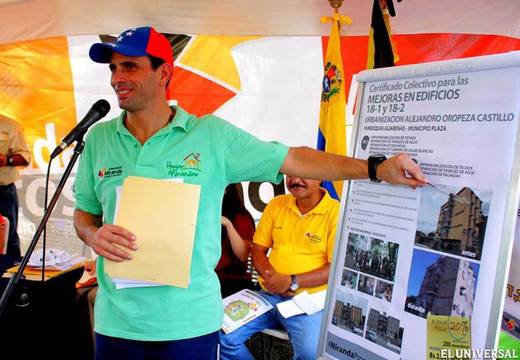
During a public event at a local community, Venezuelan opposition leader Henrique Capriles Radonski brought out the issue of opposition Legislator Richard Mardo and his parliamentary immunity –revoked– in Parliament, and stated that the “circumstantial majority in Parliament trampled on the Constitution and the decision of the Supreme Tribunal of Justice.”

Venezuela the only country where inflation lashes the poor the most, El Universal

Fairer distribution of national income has not been enough to solve the imbalance of the Venezuelan economy, which lashes the most vulnerable sector of society: the poor.

Daily US dollar sale to the private sector down 13%, El Universal

Claiming that the Venezuelan private sector was sold USD 125 million on a daily basis for ordinary imports in the first half of the year via both the Latin America Integration Association (Aladi) and the Unified System for Regional Compensation (Sucre), Armando León, member of the board of directors of the Central Bank of Venezuela, rejected allegations that authorities sold a lower amount of foreign currency with respect to the same period last year.

Venezuelan gov’t sucks up the dollars required by the private sector, El Universal

The minutes of meetings recording the decisions made by the Central Bank of Venezuela’s Board of Directors; the bank’s balance of payments; and the performances of both the Transaction System for Foreign Currency Denominated Securities (Sitme) and the Ancillary Foreign Currency Administration System (Sicad) are all cut pieces that are to be fitted together into a big jigsaw puzzle wherein foreign currency availability for the private sector is plummeting.

Venezuela central bank to sell $180 mln in forex auction, Reuters

Venezuela’s central bank said on Friday it would auction $180 million under its revamped currency exchange system known as Sicad, part of an effort to boost the flow of dollars to the economy and ease product shortages.

How Venezuelan Used ‘Scrape’ to Make Six Times Her Salary, Bloomberg

Venezuela’s currency controls are turning trips abroad into profitable junkets. A 27-year-old trade analyst from Caracas said she earned six times her monthly salary by traveling in April to Lima, where a business swiped her credit card and gave her $1,600 cash, charged at the official exchange rate of 6.3 bolivars per dollar.

Poll shows 45.1% of Venezuelans would vote Capriles, El Universal

Regardless of the outcome of the presidential election held in Venezuela last April 14, a survey conducted by the Venezuelan Data Analysis Institute (Ivad), Government Management, and Political Situation, showed that 45.1% of Venezuelans would vote Henrique Capriles over 39.3% who said would vote Nicolás Maduro.

Presumed corruption in Pdvsa and CVG aired in the United States, El Universal

The New York District Court admitted last Tuesday a racketeering and defamation lawsuit filed by US former ambassador Otto Reich against the partners of Derwick Associates in relation to contracts for the installation of electrical system executed with state-run oil holding Petróleos de Venezuela, electricity utility Corpoelec and the Venezuelan Guayana Corporation.

Suit Alleges Graft in Venezuelan Contracts, Wall Street Journal

A former top U.S. diplomat filed a lawsuit against three young Venezuelan businessmen whom he accuses of bribing senior Venezuelan officials in exchange for contracts worth hundreds of millions of dollars. The suit puts a spotlight on a group of executives who the diplomat, Otto Reich, and other critics say have made fortunes from links to Venezuela’s self-proclaimed socialist government.

US senators condemn political violence in Venezuela, Global Post

Seven US senators from both parties introduced a bill condemning violence against the opposition in Venezuela, calling for dialogue after a contested election.
 
Apr
15
2013
Posted by
admin
Comments

Venezuela’s Election Leaves Unexpectedly Narrow Margin of Victory

s1.reutersmedia.net  Venezuela’s Election Leaves Unexpectedly Narrow Margin of Victory

Courtesy of: Reuters

Millions of Venezuelans headed to the polls on Sunday to elect a new president for the second time in six months. Though expectations were low heading into the vote – especially among the country’s opposition – an unexpectedly close race has reignited tensions, uncertainty and indeed, hope.

Though Venezuelans had elected Hugo Chávez just last October, a new election was triggered after the former president lost a long battle to cancer in March. The government positioned Nicolás Maduro, the country’s vice-president and Chávez’s handpicked successor, as their new candidate. The opposition once again chose their leader and former candidate, Henrique Capriles.

Nicolas Maduro, in his capacity as acting president, enjoyed a de facto three month head start on the campaign. Capriles, on the other hand, was forced to campaign only during the formal period, which totaled 10 days. Meanwhile, the Venezuelan government did all it could to ensure Hugo Chávez’s memory was never far from the campaign trail. Maduro and the government invoked his image, name and voice in every single rally, trying to seize on the sympathy vote and keep open the subliminal connection with the powerful “Comandante.” Capriles and the opposition sought to draw a distinction between Chávez and Maduro, reminding Venezuelans that Chávez’s supposed “successor” is little more than an un-charismatic and power-hungry former underling of Chávez himself.

Maudro’s control over the country’s media and public resources proved to be an enormous advantage over this short campaign. While Maduro enjoyed more than 65 hours of state media coverage, Capriles received a paltry 23 minutes. In addition, during the auditing of voting machines, the opposition uncovered evidence that the government party had access to the secret codes needed to sabotage the voting process. International observers spoken out against the unfair playing field, also noting the egregious conflict of interest posed by the “independent” National Electoral Council composed of five officials – four who publicly support Maduro.

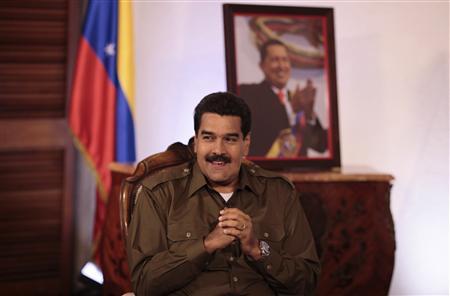
Given these advantages, analysts and pollsters favored Maduro to win Sunday’s vote by a significant margin. However, in a later than expected announcement, election authorities stunned Venezuelans, announcing Maduro as the winner, but with a margin of victory of only 1.59 percent or around 235,000 votes. The body announced around midnight that Maduro had received 50.6 percent of the vote and Capriles 49.1 percent.

Immediately after, Maduro took the stage to declare victory. The votes, however, clearly reflected the country’s serious doubts about the acting president’s ability to govern. In a brief, 10-day campaign, Capriles, who was predicted to lose by a similar margin as in October of 2012, managed to recover nearly all of 1.5 million votes he lost to Chávez just six months ago. The narrow margin – along with thousands of documented irregularities in the voting process – prompted Capriles and the opposition to call for a full recount of the votes.  Maduro announced he would accept the full recount. One must bear in mind, however, that this recount will be conducted by the Maduro-friendly National Electoral Council.

If the recount suggests a closer margin or reveals that Capriles was actually the winner, Venezuelans can expect a tumultuous time ahead. However, if electoral council upholds the reported results, the task ahead for Maduro is indeed daunting. He already faces a devastated country – left behind by 14 years of socialist rule – with a budget deficit of roughly 15 percent of annual economic output, inflation of almost 30 percent, extreme shortages, violent crime rates among the worst in the world, regular power outages, and a sclerotic state oil industry.

The results will also embolden the political opposition and undermine Maduro’s stature within Chávez’s former supporters. As a result, the political situation within the ruling socialist party will become more tempestuous. Maduro already lacks Chávez’s emotional connection with the nation’s poor; any fiscal retrenchment, therefore, could create a political backlash for the new president. Furthermore, this weak political mandate may spur divisions within the government’s political party. As memories of Chávez fade, other powerful figures like Assembly President Diosdado Cabello may challenge Maduro for primacy within the party.

Maduro’s narrow win has been termed by many a “Pyrrhic victory,” as does nothing to avoid the economic and political reckoning Venezuela’s ruling socialist party are heading for. Most analysts believe Venezuela has less than a year before the festering economic problems turn into a full-blown crisis.  With a sinking economy, a divided political party, and a confident and growing opposition, Venezuela seems set for contentious – and pivotal – days ahead.

 
Jun
30
2010
Posted by
admin
Comments

Venezuela in more trouble than Greece

Economy in VNZ Venezuela in more trouble than GreeceArticle originally posted by Bloomberg.

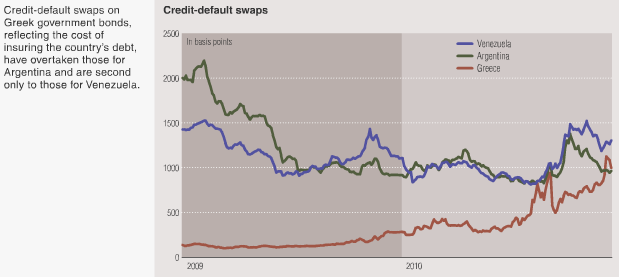
The cost of insuring Greek government debt is now second only to that of Venezuela, where Chavez has declared “economic war” against the “bourgeoisie.”
The CHART OF THE DAY shows that credit-default swaps on Greek government bonds, in red, have overtaken Argentina, which failed to pay more than $80 billion in December 2001. The Latin American nation still has more than $6 billion of defaulted securities outstanding after its second attempt to restructure.

“Greece isn’t Argentina,” said Niels Jensen, a portfolio manager at London-based investment firm Absolute Return Partners LLP, which oversees more than $300 million. “From an economist’s point of view, there’s no question that it’s much, much worse.”

Greece’s debt burden last year was equivalent to about 115 percent of gross domestic product, compared with a level of about 60 percent for Argentina when it defaulted. Credit swaps signal there’s a more than 67 percent chance the southern European nation won’t meet its commitments within the next five years.

Venezuela’s Chavez, a 55-year-old former army paratrooper who champions a socialist ideology, oversees an economy that may contract 2.5 percent this year, according to Bank of America Corp.

“You’ve declared an economic war against me, so I accept your challenge, stateless bourgeoisie,” Chavez said June 2 after business chambers criticized his handling of the economy. “I’m declaring an economic war with the help of the people and workers.”

Credit-default swaps pay the buyer face value in exchange for the underlying securities or the cash equivalent should an issuer fail to adhere to its debt agreements.