Oct
1
2013
Posted by
admin
Comments

ICYMI: With Accusations of Sabotage, Venezuela Expels 3 US Embassy Officials

The New York Times
September 30, 2013
By William Neuman
VENEZ articleLarge e1380645570814 ICYMI: With Accusations of Sabotage, Venezuela Expels 3 US Embassy Officials

Courtesy of: Agence France Presse

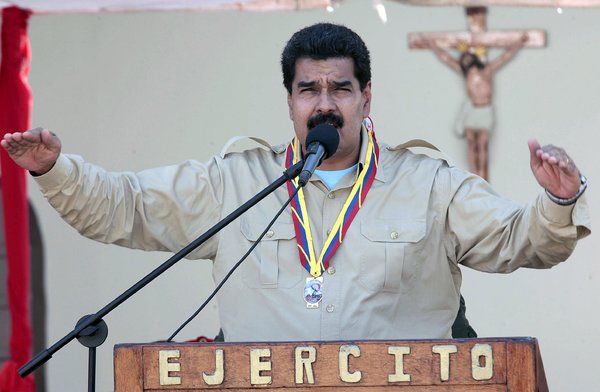
CARACAS, Venezuela — Stepping up hostilities with the United States, President Nicolás Maduro of Venezuela expelled the top American diplomat and two other embassy officials from the country on Monday, accusing them of supporting plots to sabotage the country’s electrical grid and the economy.

“Get out of Venezuela! Yankee go home!” Mr. Maduro shouted as he announced the expulsions at a military event to commemorate the bicentennial of a battle in Venezuela’s war of independence.

“We have detected a group of officials of the United States Embassy in Caracas, in Venezuela, and we have been tracking them for several months,” Mr. Maduro said during a live television broadcast. “These officials spend their time meeting with the Venezuelan extreme right wing, financing them and encouraging them to take actions to sabotage the electrical system, to sabotage the Venezuelan economy.”

The expulsions were the latest diplomatic swipe at Washington by Mr. Maduro since he took over for the country’s longtime president, Hugo Chávez, who died in March. Late last year, as Mr. Chávez grew increasingly ill, the two nations held informal talks aimed at improving the long-strained relations between them, and there was some optimism on the American side that Mr. Maduro, a former foreign minister sometimes described as pragmatic, would be amenable to a thaw.

But it quickly became clear that Mr. Maduro intended to stick closely to Mr. Chávez’s example, painting the United States as an imperialist aggressor out to undermine his government. Early on, he accused the Obama administration of plotting against him, and hours before he announced the death of Mr. Chávez on March 5, he kicked out two American military attachés, saying they had tried to recruit Venezuelan military personnel to conspire against the government.

The diplomats expelled on Monday included Kelly Keiderling, the chargé d’affaires, who runs the embassy in the absence of an ambassador here. The United States has not had an ambassador in Caracas since 2010, when Mr. Chávez refused to accept the new one proposed by Washington because of remarks that Mr. Chávez said were disrespectful.

Mr. Chávez had already expelled the American ambassador, Patrick Duddy, in 2008, saying that his government had discovered an American-supported plot by military officers to topple him. Mr. Duddy was later allowed to return to Caracas.

Another one of the diplomats expelled on Monday was Elizabeth Hoffman, an official in the embassy’s political section, whom Mr. Maduro had publicly accused at least as early as April of meeting with opposition figures to plot sabotage of the electrical system. He said at the time that he had proof but took no action until Monday. The third official being expelled is David Moo, the vice consul.

Foreign Minister Elías Jaua later said on television that the evidence against the American diplomats included meetings held in recent weeks with democracy advocates, union members and elected officials belonging to the political opposition, whom he accused of planning to destabilize the country.

Mr. Maduro said the officials had 48 hours to leave the country.

“We completely reject the Venezuelan government’s allegations of U.S. government involvement in any type of conspiracy to destabilize the Venezuelan government,” the American Embassy said in a statement. It called the meetings held by the officials “normal diplomatic engagements,” adding, “We maintain regular contacts across the Venezuelan political spectrum.”

Ever since he was elected by a narrow margin in April in a special election to replace Mr. Chávez, Mr. Maduro has struggled with intense economic woes and a deeply divided populace. He has often accused plotters and saboteurs of being responsible for a variety of the nation’s ills, including electrical blackouts and the deadly explosion at the national oil company’s enormous Amuay refinery.

“He needs diversions and distractions,” said Michael Shifter, president of the Inter-American Dialogue, a policy group in Washington. “The situation is so dire in Venezuela that he needs to find a scapegoat, and it’s convenient and politically so tempting to kick out U.S. diplomats.”

But Mr. Shifter said that describing the United States as the source of the country’s problems might not have the same effect it did for Mr. Chávez, who was beloved by many of his supporters. Mr. Maduro does not inspire nearly the same devotion, and the country’s economic woes are getting worse, with inflation over 45 percent a year and shortages of many basic foods and goods, including toilet paper.

“I doubt that it has the resonance it used to have,” Mr. Shifter said of the diplomatic expulsions.

To read this article at The New York Times, please click here.
 
Sep
20
2013
Posted by
admin
Comments

ICYMI: Venezuela keeps rooting for Syrian dictator

Miami Herald

September 18, 2013

By Andres Oppenheimer

venezuela syria 2012 12 06 e1379694480735 ICYMI: Venezuela keeps rooting for Syrian dictator

Courtesy of: AFP

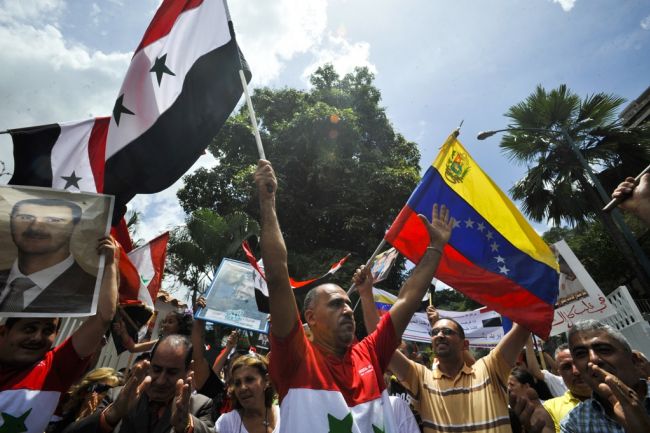
Much of the world is demanding greater pressure on Syria following a United Nations inspectors’ report hinting that Syrian strongman Bashar al-Assad used chemical weapons in his country’s civil war, but — amazingly — Venezuela and some of its Latin American allies are still passionately defending Syria’s dictator.

Earlier this week, after U.N. Secretary General Ban Ki-moon presented the U.N. inspectors’ report concluding that there is “clear and convincing” evidence that chemical weapons were used in an Aug. 21 incident on the outskirts of Damascus, Venezuelan President Nicolás Maduro lashed out against the U.N. chief for allegedly siding with the enemies of the Syrian people.

“Why is the U.N. secretary general lending himself (to plans to attack Syria,) as if he were a prosecutor and judge of the world’s people, putting himself at the service of the strategy of war, instead of being at the service of peace?” Maduro asked in a speech Monday in the state of Miranda.

In a speech last month more than a week after the Aug. 21 attack with chemical weapons, Maduro said, “Venezuela is with Syria, and with President Bashar al-Assad, and with the Syrian people.”

A day later, on Aug. 31, Maduro issued an official statement stating that Venezuela stands by “the Syrian people” in their fight against “unjustified war-mongering aggressions.”

Venezuela’s government-run media, meantime, has turned Assad into a hero and is blaming the United States and Israel for allegedly trying to invade Syria.

A cartoon in Venezuela’s state-run daily Correo del Orinoco this week shows a plane dropping hearts over Syria with the legend “to the Syrian people from the people of ALBA.” ALBA, which stands for the Bolivarian Alliance for the Peoples of Our Americas, is an organization formed by Venezuela that is it made up of nine Latin American and Caribbean countries.

Venezuela’s daily Vea, which like other government-backed newspapers often publishes anti-Semitic cartoons, ran a cartoon on May 9 showing a black-robed skeleton representing death, with a star of David and this legend: “Since we got tired of killing Palestinians, we are now going to finish with the Syrians.”

What’s most amazing about the pro-Assad statements in Venezuela’s official media is that they are still appearing after the U.N. inspectors’ report — which clearly suggests, without saying so explicitly, that Assad’s forces were responsible for the Aug. 21 chemical gas attack.

While it doesn’t officially take sides, because that wasn’t within the inspectors’ scope, the U.N. report shows that the rockets that carried Sarin gas are weapons that are not in the hands of Syria’s rebels, and that they were launched from several government-controlled points.

Although less strenuously, Venezuelan allies such as Cuba and Bolivia also have come out in support of Assad even after the U.N. findings. Most other Latin American countries have supported the Geneva agreement between the United States and Russia to demand that Syria destroy its chemical weapons.

But U.S. officials say major Latin American countries such as Mexico and Brazil have been late in joining the international community’s demands that Syria comply with the Geneva agreement.

Roberta Jacobson, the top U.S. State Department official in charge of Latin American affairs, told me Wednesday that “there is disappointment that more countries (in the region) would not have put out stronger statements condemning the Assad government’s use of Sarin gas, and supporting the Geneva U.S.-Russia agreements.”

Jacobson added that “countries in the Western Hemisphere want to be, and increasingly are, global actors. (But) If countries want to be global players, they should step up and confront challenges to the international community.”

My opinion: It’s entirely legitimate for Latin American countries to oppose a unilateral U.S. intervention in Syria, or even a U.S. intervention with dozens of allied countries but without the blessing of the United Nations. I myself have serious doubts about the wisdom of an intervention to stop Syria’s war crimes without some sort of U.N. cover.

But defending a dictator who has massacred a sizable part of the 100,000 people who have died in Syria’s civil war, and who according to all available evidence is responsible for the Aug. 21 attack with chemical weapons, is outrageous.

Maduro may be over-reacting on Syria because he needs to keep his Chavista radical base behind him after his dubious and narrow election victory April 14. His almost daily blunders, alongside Venezuela’s steep economic decline, are seriously weakening his government. And his adoration for dictators may explain his natural sympathy for Assad.

Still, Venezuela’s enthusiastic support for the Syrian regime after the Aug. 21 attack with chemical weapons should be denounced by everybody for what it is: an open defense of crimes against humanity.

To read this article at the Miami Herald, please click here.

 
Sep
10
2013
Posted by
admin
Comments

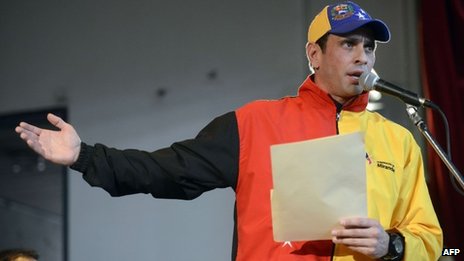
ICYMI: Capriles appeals to OAS human rights commission

BBC News
September 9, 2013

69757497 69757496 ICYMI: Capriles appeals to OAS human rights commission

Courtesy of: AFP

The defeated Venezuelan presidential candidate, Henrique Capriles, has filed a request at the Inter-American Commission on Human Rights to declare the April election void.

Mr Capriles alleges there was widespread fraud in the vote narrowly won by acting president Nicolas Maduro.

Last month, the Venezuelan Supreme Court rejected a final plea by Mr Capriles to have the vote annulled.

Mr Capriles vowed to take his fight beyond Venezuela.

Mr Maduro has repeatedly rejected the opposition allegations of fraud.

‘Supranational power’

He also dismissed the Washington-based human rights organisation as lacking credibility.

He praised the late president, Hugo Chavez, for beginning proceedings to pull out from the body last year.

Venezuela is due to officially withdraw from the Commission on Tuesday.

Mr Maduro accused the OAS Human Rights Commission of hating and despising Latin America

The Inter-American Commission on Human Rights is part of the Organisation of American States (OAS).

“They believe they are a supranational power, a power above the legitimate governments of the continent. Their time is passed,” said Mr Maduro.

The Venezuelan government decision was criticised by Amnesty International as “a serious setback for the rights of Venezuelans.”

‘Reinstate rights’

Opposition politician Ramon Jose Medina filed the request, signed by Mr Capriles, at the OAS headquarters.

The Venezuelan government “must be forced to reinstate the rights they violated,” said Mr Medina.

“The elections, which were fraudulent, must be repeated and the electoral process must be free and fair.”

Mr Maduro won the 14 April vote by less than 1.5 percentage points – about 200,000 votes.

Mr Chavez died on 5 March after a long battle against cancer.

Before going to Cuba for a last round of treatment in December, he appointed Mr Maduro as his preferred successor.

To read this article at BBC News, please click here.