Jul
8
2013
Posted by
admin
Comments

ICYMI: A circus without a ringmaster

The Economist
July 6, 2013
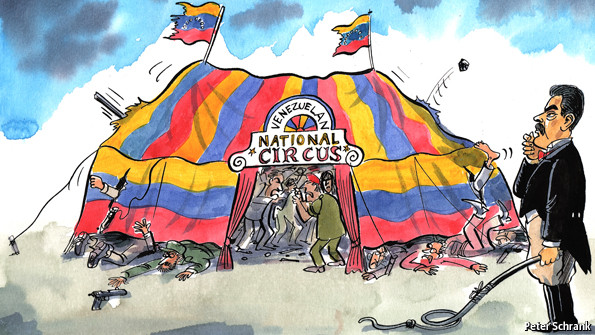
20130706 AMD001 0 e1373308466257 ICYMI: A circus without a ringmaster

Courtesy of: The Economist/Peter Schrank

During the presidency of Hugo Chávez, who ruled from 1999 until his death from cancer in March, the domineering personality of the comandante left no doubt as to who was in charge of Venezuela. By contrast Chávez’s successor, Nicolás Maduro, a former foreign minister, has yet to convince people that he is the one running the show. His disputed, razor-thin election victory on April 14th undermined his legitimacy (indeed, the supreme court has yet to resolve the opposition’s claim of fraud). Now the president faces problems within the ranks of the ruling coalition, and in particular his United Socialist Party of Venezuela (PSUV). In the absence of Chávez, there are worries that the PSUV will turn out to be held together, as the colourful Venezuelan metaphor has it, “with parrot spit”.

Fourteen years of chavismo have left the country in a mess. Despite the high price of oil, growth this year will be minimal or negative. Thousands of private companies have gone under, dragged down by regulations and threatened with fines, temporary closure or expropriation. Others have switched from production to importing. Even that is losing its appeal, now that foreign-exchange control mechanisms have seized up and dollars are scarce. Mr Maduro has sought to deal with the concerns of ordinary Venezuelans, as well as striking radical poses to please hard-core chavistas. Crime, poor public services, corruption and food-scarcity have been targeted with loudly trumpeted initiatives. But actually solving these problems will mean confronting powerful interests, and here Mr Maduro has little room for manoeuvre.

Moderates were encouraged when early in his presidency Mr Maduro sidelined Jorge Giordani, Chávez’s Marxist finance minister, and brought in Nelson Merentes, a former governor of the Central Bank who is seen as more ideologically flexible. But subsequent appointments seem designed to appease other interests. Amid talks with the private sector on how to get the wheels of commerce turning again, Mr Maduro last month reappointed Eduardo Samán head of the powerful consumer-protection body, a post he held under Chávez. A self-proclaimed “ultra-radical”, Mr Samán believes that inflation (heading for 40% a year) and empty supermarket shelves are caused by private-sector hoarding and speculation. “Humanity”, he has written, “will succeed in solving the food crisis only with the end of capitalism.”

Tentative efforts to tame corruption have also been undermined by a need to stay on friendly terms with the Chávez clan. On June 12th Argenis Chávez, the late president’s crafty youngest brother, was appointed head of the body that controls the administration of the justice system. On his brother’s watch, the younger Chávez had led the electricity ministry as well as Corpoelec, the graft-riddled state-run electricity giant. On becoming president, Mr Maduro quickly booted him out of both jobs. His return to office demonstrates the enduring power of the Chávez clan, as well as Mr Maduro’s willingness to subordinate the justice system to his political requirements.

Managing these rival factions has forced the PSUV to suspend internal party democracy. Grass-roots chavista radicals had backed Mr Samán’s bid to stand for mayor of Caracas. But party leaders, who see Mr Samán as a loose cannon, ruled out holding a primary that he might have won. Now the PSUV has cancelled all the primaries that were to have been held ahead of local elections, which have been postponed until December 8th. It remains to be seen whether choosing candidates by executive fiat will ruffle fewer feathers than the primaries would have done.

Our man in Havana

Rumours swirl that Mr Maduro could face a more immediate challenge to his own leadership. In a recorded conversation that was leaked on May 20th Mario Silva, the presenter of a state-television talk-show called “The Razor Blade”, was heard apparently passing information to a Cuban intelligence officer. In the recording Mr Silva warned the spy that Diosdado Cabello, the speaker of the National Assembly, wanted to overthrow Mr Maduro. It was a matter of urgency, he said, to cut off Mr Cabello’s sources of income, including the tax authority, which is run by his brother, José David Cabello. A few weeks later police arrested members of an alleged gang within the customs agency, which is part of the tax authority.

A former lieutenant who took part in a failed coup by Chávez in 1992, Mr Cabello has powerful friends in the army. The annual round of military promotions, due to be announced as The Economist went to press, may strengthen his hand. Henrique Capriles, the leader of the opposition, jeers that Mr Maduro’s role is confined to signing the promotions list. “Nicolás, you’re a laughing stock in the armed forces,” Mr Capriles tweeted.

During the presidential election campaign, Mr Maduro was seen as the favoured candidate not just of his predecessor but also of Cuba, Venezuela’s closest ally. A month ago, however, Mr Cabello made a three-day visit to Havana, holding meetings with President Raúl Castro and his brother, Fidel. The trip came shortly after the leaking of the Silva recording. No one knows what sort of deal the Cubans may have struck with Mr Cabello. For the moment, he and Mr Maduro are locked in a macho Latin embrace, of the kind some say was devised as a way for each man to frisk the other for weapons.

To read this article at The Economist, please click here.

 
Jun
28
2013
Posted by
admin
Comments

In Case You Missed It…Articles Roundup Week of 6/28/13

madurocadena1.520.360 e1372450486683 In Case You Missed It…Articles Roundup Week of 6/28/13

Courtesy of: VTV

This week: Reports emerge that Snowden may be headed to Venezuela via Havana, though his whereabouts remain unconfirmed; the US urges Ecuador, Cuba and Venezuela not to grant asylum to Snowden, yet Maduro expresses support for Snowden; Roberta Jacobson,  US Deputy Secretary of State for Latin America, meets with the Venezuelan chargé d’affaires in a sign that the two countries may normalize relations; Maduro makes his first official visit to Haiti; Venezuela plans to make its foreign currency system more flexible by reviving a stalled dollar auction scheme in July; in a further attempt to boost alleviate growing debt, Venezuela looks  to devalue the Bolivar by “stealth”; Standard & Poor lowers its long-term currency credit ratings on Venezuela from ‘B+’ to ‘B’; the Venezuelan government illegally records conversation between an opposition lawmaker and a local academic; the consultancy IHS Jane’s releases a report stating that Venezuela was the main purchaser of weapons in 2012; Maduro upsets Venezuelan journalists by giving Chavez a posthumous journalism award; During the celebration of the 192th anniversary of Battle of Carabobo, Maduro claims that “Corruption is going to engulf [Venezuela],” yet he continues to neglect enforcing rule of law.

Snowden heads to Venezuela via Moscow, Havana: airline source, Reuters

Former U.S. National Security Agency contractor Edward Snowden will fly from Moscow to Cuba on Monday and then plans to go to Venezuela, a source at the Russian airline Aeroflot said on Sunday. The source said Snowden was already on his way to Moscow from Hong Kong and would leave for Havana within 24 hours. The South China Morning Post also reported that Snowden had left Hong Kong for Moscow and that his final destination might be Ecuador or Iceland.

US urges Ecuador, Cuba and Venezuela not to grant asylum to Snowden, El Universal

The US government on Sunday urged Ecuador not to grant political asylum to Edward Snowden, a former National Security Agency contractor who sought refuge at the South American country after revealing Internet surveillance programs implemented by the US authorities, CNN reported. According to a source consulted by CNN, Washington also requested Venezuela and Cuba not to grant asylum to Snowden, which are other two likely destinations for Snowden, DPA reported.

Maduro: Venezuela ‘would consider asylum for Snowden’, BBC

Venezuela’s President Nicolas Maduro has said his country would consider an asylum application from fugitive US whistleblower Edward Snowden. “We say and advocate that someone in the world should stand with this young man and protect him, the revelations he has made with courage serve to change the world,” he said. Mr Maduro said that Venezuela had not received any such request, but would evaluate any application for asylum from Mr Snowden, because “every case is a humanitarian protection”. He was speaking from Port-au-Prince, during his first official visit to Haiti.

Venezuela voices solidarity with Ecuador for support to Snowden, El Universal

Once again, Edward Snowden, a former agent and expert of the CIA, was on the agenda of Venezuelan President Nicolás Maduro, who said Thursday night that, if requested humanitarian support or asylum for Snowden, Venezuela would not hesitate to grant it. In this regard, hailing Snowden for his revelations, Maduro said he supported President of Ecuador Rafael Correa for taking a firm stance vis-à-vis Washington’s warnings against Ecuador if it granted asylum to the former agent.

Venezuelan chargé d’affaires meets with US Deputy Secretary of State, El Universal

The chargé d’affaires of Venezuela in Washington, Calixto Ortega, met on Tuesday with the US Deputy Secretary of State for Latin America, Roberta Jacobson, three weeks after the respective foreign ministers took a first step towards rapprochement at the Assembly of the Organization of American States (OAS) in Guatemala. At the headquarters of the Department of State, Jacobson received the top diplomat of Venezuela in the United States, as both countries withdrew their ambassadors in 2010.

US interested in maintaining high-level dialogue with Venezuela, El Universal

The United States has a “strong interest” to continue high-level contacts to bring relations with Venezuela back to normal, with the exchange of ambassadors among the main goals, said on Thursday the State Department. That was the message the Deputy Secretary of State for Latin America, Roberta Jacobson, conveyed on Tuesday during her meeting in Washington with Calixto Ortega, the Venezuelan chargé d’affaires, William Ostick, a US State Department spokesperson, told Efe.

Venezuelan Leader Nicolas Maduro Visits Haiti, ABC News

Venezuelan President Nicolas Maduro made his first official visit to Haiti on Tuesday as the countries began negotiations to figure out ways to renew a special fund that uses oil money on mostly infrastructure projects. Maduro and Haitian President Michel Martelly met privately for several hours on the grounds of where the National Palace stood before it collapsed in the 2010 earthquake. Venezuela is one of the biggest donors to help impoverished Haiti rebuild from the catastrophic 2010 earthquake.

Venezuela to ease foreign exchange regime: source, Reuters

Venezuela will make its foreign currency system more flexible by reviving a stalled dollar auction scheme in July and after that allowing a revival of a free-floating secondary currency mechanism, a source in the government’s economic team said on Sunday. Venezuela has operated currency controls for a decade, and restricted access to dollars at the official rate of 6.3 bolivars are a major gripe for local businesses and a cause of the OPEC member’s slowing growth rate.

Venezuela to Devalue Bolivar by Stealth: Analyst Survey, Bloomberg

Venezuela will look to weaken the Bolivar this year without making an official devaluation of the currency, as it tries to boost revenue and narrow the budget deficit, according to a survey of analysts. South America’s biggest crude producer will step back from formally devaluing the Bolivar for the sixth time in nine years, said eight out of 11 analysts surveyed by Bloomberg.

S&P Lowers Venezuela Ratings to ‘B’ from ‘B+’, Latin American Herald Tribune

Standard & Poor’s Ratings Services said on Monday it lowered its long-term foreign and local currency sovereign credit ratings on the Bolivarian Republic of Venezuela to ‘B’ from ‘B+’. The outlook on the long-term ratings is negative. At the same time, the agency affirmed its ‘B’ short-term foreign and local currency sovereign credit ratings on Venezuela. S&P also downgraded its transfer & convertibility (T&C) assessment to ‘B’ from ‘B+’.

Venezuelan government says recording proves opposition plots, Reuters

Venezuela’s government released a recording on Wednesday of a well-known opposition lawmaker apparently criticizing the head of the opposition coalition and accusing him of meeting U.S. officials to provoke a crisis in the OPEC nation. In the latest of a string of secretly-made recordings that have roiled politics in the South American country in recent months, the new tape was of female legislator Maria Corina Machado talking to a local academic.

Venezuela main purchaser of weapons in 2012, but Brazil has largest defence budget, Mercopress

The report said Venezuela imported some 1.2bn in 2012, surpassing Brazil, the country with the largest defence budget in the region. The document highlighted that the trend may continue even after the demise of former President Hugo Chávez. IHS Jane’s analyst Ben Moores said that Venezuela was halfway in its rearmament program and that it would be very costly to drop it. The US remains the top defence supplier in the region, with 758.52 million dollars in 2012. But Russia, particularly thanks to sales to Venezuela, stood behind the US with 730.8 million.

Journalists upset as Venezuela’s late president Hugo Chavez given posthumous journalism award, ABC

The decision “was unanimous” to grant the award “with extraordinary mention to the comandante president Hugo Chavez,” said the head of the awards jury, Milagros Perez. “The history and practice of journalism can only be divided in two moments – before and after comandante Chavez,” Mr Perez said. A journalists’ association cried foul, saying Chavez had made a habit of closing down media outlets.

Tal Cual: And Where Are Venezuela’s Most Corrupt Politicians?, Tal Cual

“Corruption is going to engulf our country,” claimed President Nicolás Maduro on Monday. Such grandiloquent phrase couldn’t have been said anywhere else but at Campo de Carabobo, in the northern central coast of the country, during the celebration of the 192th anniversary of Battle of Carabobo, a fight that led Venezuela to its independence. We are sure this is not the first time and, regretfully, will not be the last, either, that such a harangue against corruption is said on that venue.

 
Apr
5
2013
Posted by
admin
Comments

In Case You Missed It… Articles Roundup Week of 4/05/13

12630596 copia1.jpg.520.360.thumb 1 e1365195898833 In Case You Missed It… Articles Roundup Week of 4/05/13

Courtesy of: El Universal

This week: A month after his death, Hugo Chávez continues to cast a shadow on the Venezuelan presidential election; amid personal attacks against opposition candidate Henrique Capriles, the official presidential campaign begins in Venezuela; Capriles leads a march with supporters in Caracas to kick off his presidential campaign; and Maduro steps up insults and slurs, this time calling the country’s opposition “heirs of Hitler.” Maduro bizarrely claims Chávez appeared to him in the form of a “little bird” and blessed him; Venezuela’s opposition warns that the military should not take sides in the upcoming election; Capriles points out the Venezuelan state media’s overwhelming bias toward Maduro; and Venezuela tries to weaken the influence of the respected Inter-American Commission on Human Rights. Cuba throws its support behind Maduro in the Venezuelan elections, hoping his victory will allow them more control over the country and its resources; dollar scarcity and an inflation rate of 22 percent continue to take their toll on the Venezuelan people, as businesses in Venezuela foresee only tough times ahead;  a decade of currency controls leave Venezuelans desperate for money and vulnerable to fraudsters; and crop numbers in Venezuela show that 2012 production fell behind the already-low 2010 levels.

Chávez casts shadow on Venezuela poll, Financial Times

Last year, Henrique Capriles proved no match for the electoral juggernaut of Hugo Chávez, who won over a dozen nationwide polls in as many years.

Venezuela presidential race begins amid personal attacks and tension, The Miami Herald

Drugs, lies and murder plots. Venezuela’s compressed presidential campaign officially begins Tuesday in a race that will determine the future of the Andean nation after the death of President Hugo Chávez, who led the country for 14 years.

Venezuela Opposition Marches as Presidential Campaign Kicks Off, Bloomberg

Venezuela opposition leader Henrique Capriles Radonski led a march of supporters last night in Caracas to mark today’s formal start to the presidential campaign against Hugo Chavez’s hand-picked successor.

Maduro calls Venezuela opposition “heirs of Hitler”, Reuters

Venezuela’s acting President Nicolas Maduro on Saturday called the country’s opposition “heirs of Hitler,” accusing them of persecuting Cuban doctors working in the South American country the way Jews were persecuted in Nazi Germany.

Venezuela: Ruling Party Candidate Said ‘Little Bird’ Told Him He’ll Become President, Fox News Latino

A little birdie whistled in his ear that he’s ready to become the next president of Venezuela.

Venezuela Opposition: Military Can’t Take Sides, TIME

Venezuela’s presidential campaign on Wednesday veered between warnings of military meddling in the April 14 vote and opposition mirth at the acting president’s suggestion that the spirit of Hugo Chavez visited him as “a little bird” while he prayed.

Henrique Capriles accuses Venezuelan state media of bias in favouring political rival, The Independent

Henrique Capriles has hit out at the overwhelming bias of the Venezuelan state media, claiming that the VTV channel alone has given 46 hours and 43 minutes of coverage to Nicolas Maduro since the former bus driver became acting President after the death of Hugo Chavez on 8 March.

Venezuela Tries to Weaken Human Rights Watchdog, The Heritage Foundation

A group of populist Latin American states—led by Bolivia, Ecuador, and Venezuela—hopes to reduce the role of an international human rights commission and watchdog.

Cuba’s Venezuelan Pawn, The Wall Street Journal

Venezuela’s military government will hold what it refers to as a presidential “election” on April 14, and one of the candidates on the ballot will be Hugo Chávez’s handpicked successor, Nicólas Maduro.

Tough times ahead in post-Chavez Venezuela as dollar scarcity takes its toll, The Washington Post

Doing business in post-Hugo Chavez Venezuela is not for the faint of heart. Thousands of companies suffer under currency controls that all but deny them the U.S. dollars they need to import vital items into this oil-rich country, from food to cars to spare parts — even gasoline.

Dollar-Desperate Venezuelans Get Defrauded on Internet, Bloomberg

The retired Venezuelan teacher says he was so desperate for dollars that he wired his life savings to a front company posing as a Margarita Island inn.

Crop area in 2012 lags behind 2010 levels in Venezuela, El Universal

The results provided by the Venezuelan Ministry of Agriculture and Lands (MAT) reveal that in 2012, the agricultural activity recovered, featuring an important upturn in several highly demanded agricultural items.