Mar
14
2013
Posted by
admin
Comments

Capriles Prepares for a Tough Fight Against the Memory of Chávez

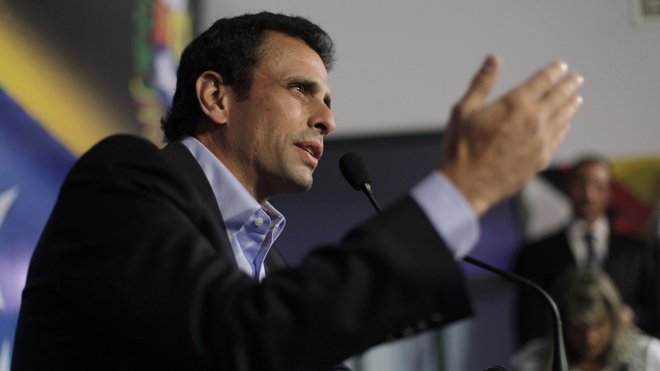
31013 capriles1 e1363269277543 Capriles Prepares for a Tough Fight Against the Memory of Chávez

Courtesy of: Associated Press

On Monday, interim president Nicolás Maduro and opposition leader Governor Henrique Capriles formally registered as candidates for Venezuela’s special presidential election, to determine who will succeed the late Hugo Chávez. The former vice president Maduro was sworn in just three days earlier – merely three days after the government announced Chávez’s death.

Even by the standards of an electoral system already skewed to the PSUV’s benefit, April’s special election is hardly a fair fight. The candidates are only permitted to campaign during an official 10-day campaign period from April 2-11, but the timing of the April 14 election already sets the opposition at a distinct disadvantage. While both candidates are prohibited from campaigning until April 2, Maduro has been riding the wave of grief over Chávez’s death to bolster his own image. Currently, state-run TV is saturated with 24/7 coverage of Chávez’s life and legacy, and the government has bused in thousands of supporters to wait in hour-long lines to view his casket. In addition, like Chávez, Maduro has not been timid about using his “cadena” powers, which require mandatory national broadcasts at the discretion of the president. Similar to Chávez, Maduro has made these a daily occurrence; even using one to take the oath of office in front of Chávez’s casket. While the official campaign will not begin for weeks, Maduro’s presence on the airwaves is virtually ubiquitous.

Although the campaign period officially ends on April 11, the days in between are fraught with symbolism that is sure to benefit Maduro. April 13 – the day before the election – is the anniversary of Chávez’s return to power after the April 11, 2002 coup that briefly ousted him from power. In the years following, the anniversary has been marked with widespread celebration by Chavistas – led by Chávez himself. This year will likely see that celebration further intensified – allowing Maduro to carry out de facto campaign events through official government celebrations of Chávez’s memory.

Capriles has spent much of his political career criticizing the Chávez administration for its expropriations, centralization of power, and corruption. He is currently serving as the Governor of Miranda, one of the largest states in Venezuela—the latest stage in his fast political rise. At the age of 26, he became the youngest elected member of the National Congress before winning two consecutive mayoral elections in Baruta, a division of the Greater Caracas municipality. Last year, he became the first candidate in 14 years to unite the opposition parties and seriously challenge Chávez in the October presidential election. Capriles traversed Venezuela for months, seeking to rally Venezuelan’s behind his vision for the country’s future. Although he lost the election, his quest was hardly unsuccessful: Capriles won an unprecedented 44 percent of the vote (over 6 million people).

Meanwhile, Maduro has risen far from his origins as a bus driver, becoming Chávez’s Vice President and handpicked successor. As a former Foreign Minister, he strengthened the Venezuelan government’s ties with Cuba and with the Castros. During Chávez’s absence in June 2011 and last winter, he worked to shore up his power as acting president and his political clout within the PSUV. Maduro lacks Chávez’s charisma and popularity, a weakness he has sought to counteract by currying favor with the late president and the Cuban government through a fierce commitment to PSUV’s principles of socialism.

The presidential campaign has not even officially begun, but Capriles has already been subjected by his rival to a malicious smear campaign. In a speech responding to Capriles’ candidacy, Maduro called him a “fascist” and used racist and homophobic slurs against the governor, a descendant of Polish Jews who escaped the Holocaust. The Venezuelan government is also threatening the opposition candidate with legal action for the defamation of Chávez and his family after Capriles raised questions about the government’s lack of transparency regarding the circumstances of the former president’s death.

Capriles has taken a tougher tone against Maduro than he did against Chávez in last year’s presidential election. Capriles has accused Maduro of exploiting Chávez’s memory for political gain. Indeed, Capriles’ chance at victory will likely hinge on his ability to demonstrate to Venezuelans that Maduro is not Chávez’s “second coming,” but is instead a lifelong political operative and puppet of the Castros, wholly complicit in the PSUV government’s economic mismanagement.

With only 10 days to campaign, Capriles will be fighting an uphill battle. Maduro will leverage every facet of Chávez’s finely-tuned political machine to secure a victory: at his disposal are a formidable (and corrupt) voter turnout program, unobstructed access to government resources, and the hysterical grief of Chávez’s devoted followers. It is little surprise that Maduro has already christened his campaign the “Comando de Campaña Hugo Chávez Frías” (Hugo Chávez Campaign Command). The month ahead will combine elements of a political rally and funeral march, as Maduro looks to ride a wave of Chávez sympathy and nostalgia into power.

Nevertheless, Capriles has defeated Chávez’s top deputies before. Just two months after his strong showing against Chávez in the presidential elections, Capriles held on to his Miranda governorship against Chávez’s close friend and former Vice President, Elías Jaua. He originally defeated Diosdado Cabello, the current head of the National Assembly, to first assume the governorship of Miranda in 2008. Capriles will capitalize on his youthful energy and the strong support of his base to do everything possible to obtain a victory.
 
Mar
1
2013
Posted by
admin
Comments

In Case You Missed It…Articles Roundup Week of 3/1/13

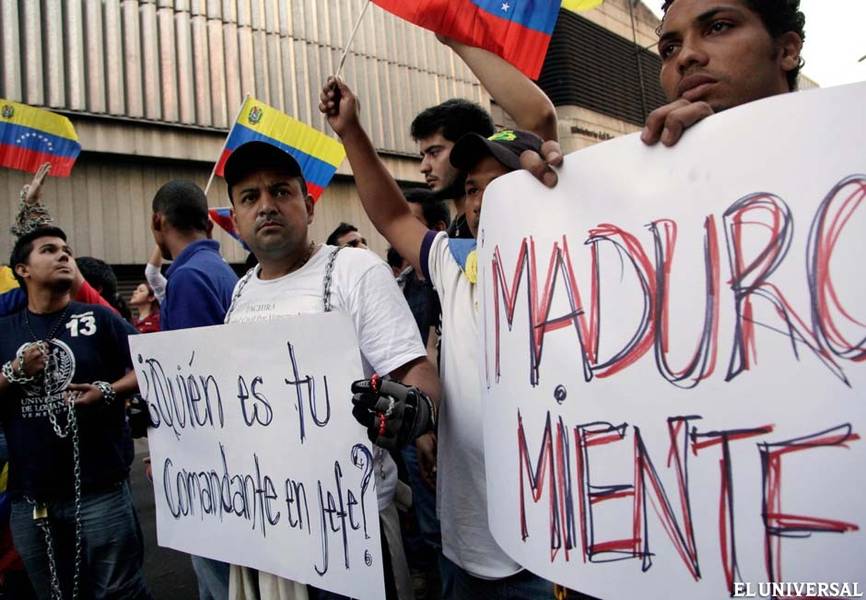
protestaap123.jpg.940.600.thumb  e1362172682790 In Case You Missed It...Articles Roundup Week of 3/1/13

Courtesy of: Associated Press

This week: Since his secretive return to Venezuela, confusion and uncertainty have surrounded Chávez’s health; while Chávez remains hidden from the public eye, the possibility of a new presidential election looms; members of the opposition march to demand answers on the president’s health; and vice president Nicolás Maduro admits on national television that Chávez is “is fighting for his health, for his life.” Price and currency controls cause pharmacy drug shortages to reach 40 percent; an electricity crisis and constant power cuts stir anger towards the Venezuelan government; price hikes continue in Venezuela, with the black market price of the dollar now at four times its official value; reports surface that 27.5 percent of Venezuelan imports reported by the government in 2012 in fact never happened; and Venezuela’s comptroller finds multiple administrative irregularities in two state-owned TV networks. Lastly, the Inter-American Commission on Human Rights urges Venezuela to reconsider its withdrawal from the respected human rights commission; authorities violently disperse student demonstrations demanding answers on Chavez’s health; US officials believe the US will have to play a role in any forthcoming transition of power in Venezuela; and opposition leader Leopoldo López is arrested as part of what he calls a “political persecution” by  the Chávez government.

Confusion reigns over Chávez’s condition, Financial Times

There has been no sign of Hugo Chávez since the stealthy pre-dawn return to Caracas of Venezuela’s ailing leader a week ago, but at least one person is confident of his wellbeing.

As Chávez’s silence persists, Venezuela mulls new elections, Miami Herald

President Hugo Chávez spent his first week back in Venezuela too frail to be seen in public and too weak to receive well wishers. But despite his precarious health, few doubt Chávez’s prowess at the ballot box.

Opponents to Hugo Chavez Continue to Demand Answers, Fox News Latino

Hundreds of opponents to the government of Hugo Chávez demonstrated Saturday to demand answers about the condition of the Venezuelan president while he remains out of the public eye.

Venezuela’s Chavez clings to life, vice president says, NBC News

Venezuelan President Hugo Chavez is clinging to life, according to the country’s vice president. “The commander is fighting for his health, for his life,” Nicolas Maduro said on national TV Thursday.

Drugs shortage in Venezuela accounts for 40%, El Universal

Through letters and conversations with the Government, the Venezuelan pharmaceutical sector has warned it is “choking” as medicine shortage is reaching a critical level.

Venezuela: power cuts stir resentment, Financial Times

The problem may have gone largely unnoticed in Caracas, where everyone is fixated by the ongoing Hugo Chávez drama, but Venezuelans living in the provinces are getting fed up with blackouts that inconvenience their everyday life.

Price hikes in Venezuela, Al Jazeera

Scores of Venezuelans descended from the hillside slums of Caracas 24 years ago on this day, burning cars and looting to protest a hike in gasoline prices, the last straw in a series of austerity measures.

An estimated 27.4% of Venezuelan gov’t imports never happened, El Universal

Ten years after forex restrictions were put in place in Venezuela, distortion accentuates. Imports at a low exchange rate seem to be increasingly encouraging overbilling and other procedural practices.

Venezuela’s comptroller finds irregularities in state-run TV networks, El Universal

Lack of internal controls and supervision of budget and assets, absence of personnel management manuals and award of no-bid contracts without justification whatsoever are just some of the administrative irregularities found by the Controller’s Office of Venezuela in state-owned TV networks Ávila TV and Vive TV.

IACHR hopes Venezuela to rethink withdrawal, El Universal

The president of the Inter-American Commission on Human Rights (IACHR), José de Jesús Orozco Henríquez, said he hoped “respectfully” that the Venezuelan state reconsiders its intention to leave the American Convention on Human Rights.

Student demonstration dispersed by authorities in Venezuela, El Universal

One more time, the student opposition movement Operation Sovereignty took the streets, a week after a protest at the Cuban Embassy in Caracas.

Venezuela Charges Opposition Leader With Misuse of Funds in 1998, Bloomberg

Venezuelan opposition politician Leopoldo Lopez faces as much as four years in prison for alleged misuse of public funds more than a decade ago as President Hugo Chavez’s health prompts speculation about new elections.

US says it has a role to play in transition in Venezuela, El Universal

Roberta Jacobson said the aim is to convey to “Venezuelans of all political stripes” the message that it is important to hold elections on an equal footing.

 
Feb
22
2013
Posted by
admin
Comments

In Case You Missed It…Articles Roundup Week of 2/22/13

 In Case You Missed It...Articles Roundup Week of 2/22/13

Courtesy of: Associated Press

This week: Hugo Chávez returns home to Venezuela, fueling speculation he will soon retire due to his declining health; the military hospital in Caracas housing Chávez remains the center of attention, though there have been no physical signs of the president; as the president remains hidden, Venezuela faces political uncertainty and an impending constitutional crisis; and the Venezuelan government remains discouraged about Chávez’s condition as his breathing difficulties persist. Chávez’s return to Venezuela prompts discussion of succession and a new election; the president’s declining health prevents a visit from his ally President Evo Morales of Bolivia; and Cuba continues to play an outsized role in Venezuelan politics. Lastly, Globovisión, the sole remaining Venezuelan TV channel that criticizes the Chávez regime, accuses the government of excluding it from a new digital television system; Harvest Natural’s deal to sell Venezuelan assets falls through after the devaluation causes the company’s shares to plunge; and companies from the U.S., China and Canada question the lawfulness of the Venezuelan government.

Chavez Return to Venezuela Fuels Speculation He’ll Quit, Bloomberg Businessweek

Venezuelan President Hugo Chavez was rushed to a military hospital early this morning after returning home from two months of cancer treatment in Cuba.

Venezuela hospital at center of attention in Chavez’s cancer fight, but no sign of leader, The Washington Post

At Caracas’ military hospital, the only outward signs that President Hugo Chavez is a patient inside are the motorcades that come and go and the soldiers standing guard, some of them wearing red berets.

Venezuela: Constitutional Crisis and a Barely Visible President, The Huffington Post

“Now that the president is back, there can be no doubt about the democratic institutions working in Venezuela,” said communication and information minister Ernesto Villegas on the return to Caracas of the Venezuelan president.

Venezuela Downcast on Chávez’s Condition, The Wall Street Journal

Venezuelan President Hugo Chávez, who is recovering from cancer surgery at a military hospital, is still suffering respiratory problems and hasn’t responded favorably to treatment, a government spokesman said late Thursday.

Chavez Back in Venezuela, Stirs Succession Talk, ABC News

Hugo Chavez’s sudden return to Venezuela after more than two months of cancer treatments in Cuba has fanned speculation that the president could be preparing to relinquish power and make way for a successor and a new election.

Chavez’s Health Prevented Him From Seeing Ally Morales, Bloomberg Businessweek

Venezuelan President Hugo Chavez has endured the “most difficult moments of his life,” according to Bolivian President Evo Morales, who didn’t get to see his close ally during a visit to Caracas.

Cuba has outsized role in Venezuela as Chavez fights cancer, The Washington Post

It’s become a well-worn routine here: A news flash about President Hugo Chavez’s battle with cancer is issued, invariably delivered with great fanfare but scant details.

Venezuela launches digital television, critical TV channel complains it was excluded, The Washington Post

A Venezuelan television channel that takes a critical stance toward President Hugo Chavez accused the government on Wednesday of excluding it from a new digital television system, and it warned that the action could force it off the open airwaves

Harvest Natural’s $725 Million Deal to Sell Venezuela Assets Falls Through, The Wall Street Journal

Harvest Natural Resources Inc. (HNR) said a deal under which Indonesia’s state-owned PT Pertamina had agreed to buy its interests in Venezuela for $725 million has been terminated.

Chinese companies query into Venezuelan governance lawfulness, El Universal

Companies from China, United States and Canada have a big question mark as to lawfulness of governance in Venezuela. For this reason, they hesitate to invest in the country, said Adolfo Salgueiro, an expert in international law.