May
10
2013
Posted by
admin
Comments

In Case You Missed It… Articles Roundup Week of 5/10/13

Maduro In Case You Missed It… Articles Roundup Week of 5/10/13

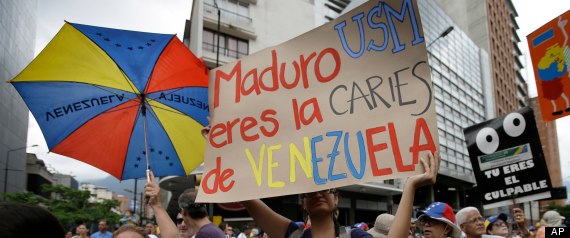
Courtesy of Reuters

This week: The Venezuelan government starts an expanded audit of the disputed April 14 presidential election as Henrique Capriles files a legal challenge of the results; the Obama administration continues to monitor Venezuela’s crackdown on political opposition; Nicolás Maduro reacts angrily to Barack Obama’s comments about the political crisis in Venezuela; the family of Timothy Tracy, the American filmmaker held in Venezuela on charges of alleged espionage, calls the situation a “nightmare”; and U.S. diplomats are finally granted access to Tracy in Venezuela. Senior Venezuelan banking official is held on charges of accepting at least $5 million in bribes to funnel business to two Miami broker-dealers; the U.S. Treasury punishes Iran-Venezuela Binational Bank for helping the Iran government evade international sanctions; the Venezuelan government scrambles for answers to the country’s homicide rate, creating concerns about possible human rights abuses; and representatives of 130 countries believe Venezuela fails to meet the minimum democratic requirements. Venezuelan inflation soars toward 30 percent, the highest since August 2010, as the central bank’s scarcity index reaches a record high; according to mathematicians, the tally in Venezuela’s disputed election presents logical and numerical inconsistencies; Venezuela falls to seventh place in scientific research in Latin America, ranking below Cuba; and Venezuela’s only opposition TV station announces management changes after being taken over by the government.

Venezuela Starts Election Audit, The Wall Street Journal

Authorities on Monday began an expanded audit of the disputed April 14 presidential election even though the opposition candidate who called for the review has since withdrawn his support and instead filed a legal challenge of the results.

U.S. Monitoring Venezuela’s Political Crackdown On Opposition, Obama Says, Reuters

The United States is watching “crackdowns on the opposition” in Venezuela, President Barack Obama said in a television interview aired on Friday when asked if he considered newly elected Nicolas Maduro to be the country’s legitimate president.

Venezuela’s Government Condemns Obama’s Comments, The Associated Press

Venezuela’s government on Saturday angrily rejected comments made by U.S. President Barack Obama about the South American country’s political crisis and accused Washington of being behind violence that has followed its recent presidential election.

Family of American held in Venezuela says experience ‘a nightmare;’ embassy has had no access, The Associated Press

U.S. diplomats have been given no access to a California man held in Venezuela for nearly two weeks in what his family on Monday called a “nightmare” that unfolded after he was accused of being a spy fomenting postelection unrest.

US officials are granted access to American detained in Venezuela, Associated Press

Venezuela’s government has granted U.S. diplomats access to a California man who is being held while he awaits trial on charges of espionage and fomenting unrest.

Venezuelan banking official and 2 Miami broker dealers charged in $5 million NY bribery case, The Associated Press

A senior Venezuelan banking official is being held in Miami on charges that she accepted at least $5 million in bribes to funnel business to two Miami broker-dealers, federal authorities in Manhattan announced Tuesday.

US punishes Venezuelan-Iranian bank for helping Tehran, El Universal

The US Department of the Treasury punished on Thursday the Iran-Venezuela Binational Bank (IVBB) for helping the Iranian government to “sort out” international sanctions because of its controversial nuclear program.

Justice minister says Venezuela’s military to form part of anti-crime initiative, The Associated Press

Venezuela’s top security official announced Sunday the government of President Nicolas Maduro will use the military to fight rampant violent crime, raising concerns among activists who warned the initiative could lead to human rights violations.

No democracy in Venezuela, according to 130 countries, El Universal

Representatives of 130 Foreign Offices of countries viewed as democratic met last week in Mongolia, at the Summit of the Community of Democracies.

Venezuela Inflation Soars Toward 30% as Maduro Cuts Dollar Sales, Bloomberg

Venezuelan consumer prices soared the most in three years last month as President Nicolas Maduro’s government reduced dollar sales to importers and the central bank’s scarcity index reached the highest on record.

Mathematicians claim that election numbers in Venezuela do not match, El Universal

The results released by the board of the Venezuelan National Electoral Council (CNE) in several bulletins about the presidential election of April 14 exhibit “logic and numerical inconsistencies.”

Venezuela ranks below Cuba in scientific research, El Universal

Venezuela ranked seventh in scientific production in Latin America in 2011, according to international indicators such as SCImago Institutions Rankings (SIR).

Sole Opposition TV Channel in Venez Makes Changes, The Associated Press

Venezuela’s only opposition television channel says it is bringing in new management after its sale to new owners, but pledges to maintain its critical line against the government.
 
Mar
14
2013
Posted by
admin
Comments

Capriles Prepares for a Tough Fight Against the Memory of Chávez

31013 capriles1 e1363269277543 Capriles Prepares for a Tough Fight Against the Memory of Chávez

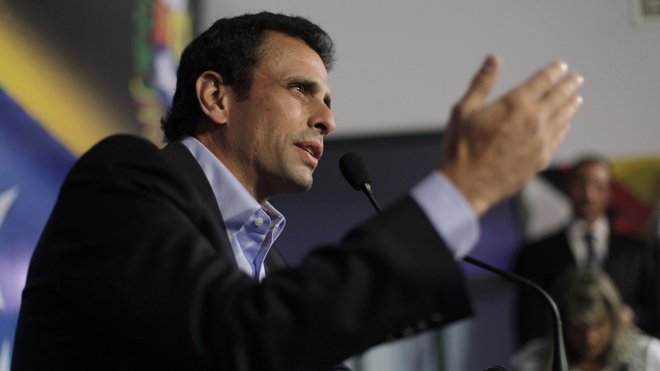
Courtesy of: Associated Press

On Monday, interim president Nicolás Maduro and opposition leader Governor Henrique Capriles formally registered as candidates for Venezuela’s special presidential election, to determine who will succeed the late Hugo Chávez. The former vice president Maduro was sworn in just three days earlier – merely three days after the government announced Chávez’s death.

Even by the standards of an electoral system already skewed to the PSUV’s benefit, April’s special election is hardly a fair fight. The candidates are only permitted to campaign during an official 10-day campaign period from April 2-11, but the timing of the April 14 election already sets the opposition at a distinct disadvantage. While both candidates are prohibited from campaigning until April 2, Maduro has been riding the wave of grief over Chávez’s death to bolster his own image. Currently, state-run TV is saturated with 24/7 coverage of Chávez’s life and legacy, and the government has bused in thousands of supporters to wait in hour-long lines to view his casket. In addition, like Chávez, Maduro has not been timid about using his “cadena” powers, which require mandatory national broadcasts at the discretion of the president. Similar to Chávez, Maduro has made these a daily occurrence; even using one to take the oath of office in front of Chávez’s casket. While the official campaign will not begin for weeks, Maduro’s presence on the airwaves is virtually ubiquitous.

Although the campaign period officially ends on April 11, the days in between are fraught with symbolism that is sure to benefit Maduro. April 13 – the day before the election – is the anniversary of Chávez’s return to power after the April 11, 2002 coup that briefly ousted him from power. In the years following, the anniversary has been marked with widespread celebration by Chavistas – led by Chávez himself. This year will likely see that celebration further intensified – allowing Maduro to carry out de facto campaign events through official government celebrations of Chávez’s memory.

Capriles has spent much of his political career criticizing the Chávez administration for its expropriations, centralization of power, and corruption. He is currently serving as the Governor of Miranda, one of the largest states in Venezuela—the latest stage in his fast political rise. At the age of 26, he became the youngest elected member of the National Congress before winning two consecutive mayoral elections in Baruta, a division of the Greater Caracas municipality. Last year, he became the first candidate in 14 years to unite the opposition parties and seriously challenge Chávez in the October presidential election. Capriles traversed Venezuela for months, seeking to rally Venezuelan’s behind his vision for the country’s future. Although he lost the election, his quest was hardly unsuccessful: Capriles won an unprecedented 44 percent of the vote (over 6 million people).

Meanwhile, Maduro has risen far from his origins as a bus driver, becoming Chávez’s Vice President and handpicked successor. As a former Foreign Minister, he strengthened the Venezuelan government’s ties with Cuba and with the Castros. During Chávez’s absence in June 2011 and last winter, he worked to shore up his power as acting president and his political clout within the PSUV. Maduro lacks Chávez’s charisma and popularity, a weakness he has sought to counteract by currying favor with the late president and the Cuban government through a fierce commitment to PSUV’s principles of socialism.

The presidential campaign has not even officially begun, but Capriles has already been subjected by his rival to a malicious smear campaign. In a speech responding to Capriles’ candidacy, Maduro called him a “fascist” and used racist and homophobic slurs against the governor, a descendant of Polish Jews who escaped the Holocaust. The Venezuelan government is also threatening the opposition candidate with legal action for the defamation of Chávez and his family after Capriles raised questions about the government’s lack of transparency regarding the circumstances of the former president’s death.

Capriles has taken a tougher tone against Maduro than he did against Chávez in last year’s presidential election. Capriles has accused Maduro of exploiting Chávez’s memory for political gain. Indeed, Capriles’ chance at victory will likely hinge on his ability to demonstrate to Venezuelans that Maduro is not Chávez’s “second coming,” but is instead a lifelong political operative and puppet of the Castros, wholly complicit in the PSUV government’s economic mismanagement.

With only 10 days to campaign, Capriles will be fighting an uphill battle. Maduro will leverage every facet of Chávez’s finely-tuned political machine to secure a victory: at his disposal are a formidable (and corrupt) voter turnout program, unobstructed access to government resources, and the hysterical grief of Chávez’s devoted followers. It is little surprise that Maduro has already christened his campaign the “Comando de Campaña Hugo Chávez Frías” (Hugo Chávez Campaign Command). The month ahead will combine elements of a political rally and funeral march, as Maduro looks to ride a wave of Chávez sympathy and nostalgia into power.

Nevertheless, Capriles has defeated Chávez’s top deputies before. Just two months after his strong showing against Chávez in the presidential elections, Capriles held on to his Miranda governorship against Chávez’s close friend and former Vice President, Elías Jaua. He originally defeated Diosdado Cabello, the current head of the National Assembly, to first assume the governorship of Miranda in 2008. Capriles will capitalize on his youthful energy and the strong support of his base to do everything possible to obtain a victory.

 
Nov
16
2012
Posted by
admin
Comments

In Case You Missed It… Articles Roundup Week of 11/16/12

propiedad comunal In Case You Missed It… Articles Roundup Week of 11/16/12

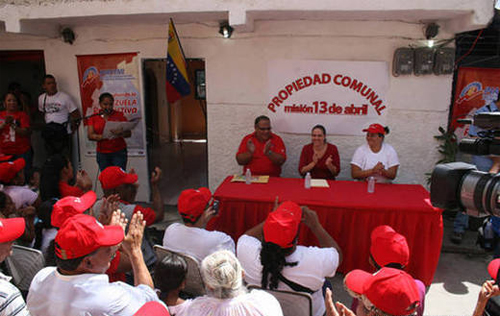
Courtesy of: AVN

In the news this week, Venezuela won a seat on the United Nations Human Rights Council despite international criticism; regulators of the securities industry had tough questions for U.S. broker-dealers regarding practices used to mitigate money laundering and sanctions risks related to their involvement in a Venezuelan government-run exchange system; Venezuela’s crumbling infrastructure remains in the news as the electric energy minister admits the nation’s electrical system has been out of date for twenty years; and government takeovers continue as PDVSA seizes control of the Loma de Niquel mine from the Anglo American mining and natural resource company. Meanwhile, Chávez continues to lay the foundations for a communal state as forty communes await authorization by the Venezuelan government; Capriles looks to the regional December elections to legitimize the opposition coalition not only to a weary electorate but also to its own fractious members; problems persist in Venezuela’s industrial sector as the lack of raw materials reaches 83 percent; and the Venezuelan government continues to violate collective bargaining agreements, causing protests among workers. Lastly, the ADEN Competitiveness Institute ranks Venezuela among countries with the lowest competitiveness index, citing “problems of macroeconomic instability and institutional mishaps.”

Venezuela, the bane of human rights, The Washington Post

ON MONDAY, new members will be selected for the United Nations Human Rights Council, the top-level group for the protection and promotion of human rights. Its members have not always been paragons of respect for human dignity.

U.S. broker-dealers scrutinized for anti-laundering compliance in Venezuelan currency swaps, Reuters

NEW YORK, Nov. 13 (Thomson Reuters Accelus) -Securities industry regulators are beginning to ask U.S. broker-dealers tough questions about how they are mitigating money laundering and sanctions risks associated with their involvement in a 2-year-old currency exchange system run by the Venezuelan government, sources familiar with the issue said.

Some 71% of Venezuela’s electric energy system is outdated, El Universal

Venezuela’s Electric Energy Minister Héctor Navarro stated that 71% of the national electric system has been out of date for 20 years.

Venezuelan gov’t takes over Loma de Níquel mine, El Universal

Last Saturday, at 12 a.m., multinational Anglo American handed over to the Venezuelan State the control of Loma de Níquel mine, upon the expiration of the concession and failure to get a renewed term for the operation.

Communes await authorization by Venezuelan Government, El Universal

The Venezuelan National Assembly (AN) continues laying the foundations for the communal State. On October 20, during a meeting of ministers, President Hugo Chávez urged his cabinet to speed up the establishment of communes.

Capriles, Opposition Seek to Solidify Gains in Venezuela, World Politics Review

CARACAS — With campaigning for Venezuela’s December gubernatorial races now officially under way, the country’s political opposition finds itself in a tough spot. Still licking its wounds from its loss in October’s presidential election, the Democratic Unity Coalition (MUD) must get quickly off the mat to prove its credibility not only to a weary electorate but also to its own fractious members.

Lack of raw materials hits 83% of Venezuelan industries, El Universal

Obstacles are hitting the Venezuelan industrial sector, as lingering barriers continue to undermine their performance, according to data provided by the Venezuelan Confederation of Industries (Conindustria).

Government allegedly trying to uproot collective bargaining agreements, El Universal

In recent years, numerous labor protests by different sectors have sparked in Venezuela. Only in October, some 521 demonstrations were reported, 204 of which were labor-related, said the NGO Venezuelan Observatory of Social Unrest.

Venezuela among the countries with lower competitiveness index, El Universal

Chile is the leader of competitiveness among 18 Latin American countries, based on the Competitiveness Index established in October 2012 by the ADEN Competitiveness Institute. The information was disclosed by the higher studies institution based in Argentina, Efe quoted.