Oct
19
2012
Posted by
admin
Comments

In Case You Missed It… Articles Roundup Week of 10/19/12

Venezuela Chavez Maduro In Case You Missed It… Articles Roundup Week of 10/19/12

Courtesy of: AP

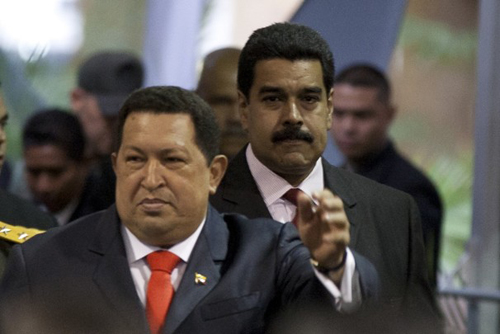
Less than a week after winning reelection, Chávez swore in his new Vice President, former Foreign Minister Nicolas Maduro and six other cabinet ministers. On Monday Chávez will submit his fiscal year 2013 budget to the National Assembly, largely based on his socialist model. According to the National Institute of Statistics (INE), Venezuela’s inflation rate will reach almost 20 percent by the end of the year. The country’s international reserves are also far below an optimal level. Recent political polarization is threatening freedom of speech in Venezuela, as a new report reveals “mistreatment, detentions, insults, confiscation of equipment, and fundamental rights violations” against journalists, camerapersons, and others in the press. Meanwhile, Chávez has begun to develop Venezuela’s defense industry with plans to build drones with the help of China, Russia and Iran. Chávez breaks diplomatic ties to Paraguay with his decision to expel their diplomats following the ouster of his ally, former President Fernando Lugo. Simultaneously, Chávez’s ties to former Brazilian President Lula are strained after Lula said in a recent interview that Chávez should prepare for his succession. In most recent news, the Venezuelan National Assembly stirs up controversy as they take steps to regulate cable TV.

Venezuela’s Chavez swears in vice president, 6 other ministers in post-election shake up, The Washington Post

CARACAS, Venezuela — Venezuelan President Hugo Chavez swore in his new vice president and six other Cabinet ministers on Saturday, less than a week after winning a new mandate to extend his self-styled Bolivarian revolution.

Venezuela’s 2013 budget bases on socialist model, El Universal

The Venezuelan Government on Monday will summit to the National Assembly a FY2013 draft budget that will be based on the socialist model.

Venezuela Official Inflation Just Under 20%, Latin American Herald Tribune

CARACAS — According to the government’s National Institute of Statistics (INE), Venezuela’s September inflation came in at 1.6%, above the value in August of 1.1%. Factoring in September’s rate, inflation for the first nine months of the year has been 11.5%. One-year inflation stands at 19.98%.

Venezuela’s international reserves far from optimal level, El Universal

Venezuelan international reserves remain below the optimal level (USD 26.8 billion) established by national authorities.

Polarization threatens freedom of speech in Venezuela, El Universal

The Venezuelan Press Block (BPV) presented a report on Sunday at the 68th Inter-American Press Association (IAPA) General Assembly, held at the city of Sao Paulo, Brazil, denouncing increased aggressions against journalists, due to political polarization in Venezuela.

Venezuela serious about producing drones, UPI.com

CARACAS, Venezuela, Oct. 16 (UPI) — Venezuelan President Hugo Chavez is pursuing plans to develop a home-grown defense industry topped by a drone built reportedly with Chinese, Iranian and Russian help.

Venezuela’s government expelling the last of Paraguay’s diplomats in Caracas, envoy says, Fox News

CARACAS, Venezuela – Venezuela’s government has decided to expel Paraguay’s remaining diplomats from the country, the top envoy at the Paraguayan Embassy said Wednesday. Charge d’affaires Victor Casartelli said that he and three other Paraguayan diplomats in Caracas were told by Venezuela’s Foreign Ministry to leave within three days.

Venezuela’s oil exports to Asia to jump to 2.8 million bdp, El Universal

State-run oil holding Petróleos de Venezuela (Pdvsa) is in negotiations with India’s Reliance Industries and Oil & Natural Gas Corp (ONGC) for investments in the Ayacucho and Boyacá oil fields, informed on Wednesday Pdvsa’s Corporate Planning Executive Director, Fadi Kabboul, at a press conference in India.

Venezuela’s Chavez should prepare for succession: Lula, Chicago Tribune

BUENOS AIRES (Reuters) – Venezuela’s newly re-elected president, Hugo Chavez, should start preparing to hand over power, former two-time Brazilian President Luiz Inacio Lula da Silva said in a newspaper interview published on Thursday.

Venezuela’s National Assembly to regulate cable TV, El Universal

The Venezuelan National Assembly (AN) is to make a law for the regulation of subscription television services, informed the President of the People’s Power and Media Committee of the AN, Darío Vivas, deputy for the ruling party United Socialist Party of Venezuela (PSUV).
 
Oct
1
2012
Posted by
admin
Comments

What’s Next Venezuela Election Update: October 1, 2012

Henrique Capriles exaltado 655x471 What’s Next Venezuela Election Update: October 1, 2012

Courtesy of: EFE / Getty Images

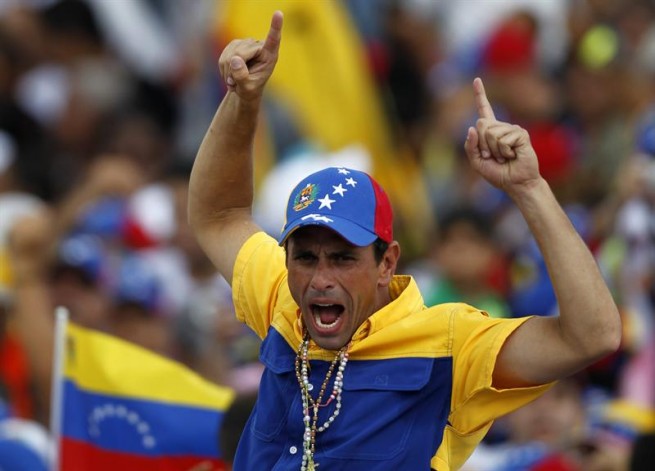
With less than a week before the Venezuelan elections the focus remains on the tight race between opposition candidate, Henrique Capriles and President Chávez. With violence at an all time high, many believe Venezuela’s crime pandemic will destabilize Chávez’s regime. Chávez, meanwhile, has called for a new fight against crime as the election draws near in an attempt to gain support from Venezuelans. However, Capriles continues to rise in the polls, gaining ground on Chávez. Many see his campaign’s success as due to his focus on the day-to-day issues that matter most to Venezuelans: the chronic power shortages, out-of-control crime, runaway inflation and unemployment. Meanwhile, the CNE, Venezuela’s electoral authority, is requiring Venezuelans registered in Miami to vote in New Orleans, making it a three-day trip to the polling center for the largely pro-Capriles group of expatriates. Capriles’ closes his Caracas campaign with a march attended by thousands of supporters. Meanwhile, Chávez uses dirty tricks on the Venezuelan ballot to confuse voters on election day.

Will Venezuela’s Pandemic of Crime Destabilize Hugo Chávez’s Regime?, Time

The three gangbangers are holed up in a small hut deep in the lush overgrowth of San Casimiro, a town two hours south of Caracas – and they’ll be there for the foreseeable future. They’re in hiding  after a shootout days earlier back in their home barrio of Antímano, one of the hillside slums located above the Venezuelan capital, scared of retaliation from rival gang members.

Chavez calls for crime fight as Venezuela vote nears, Reuters

CARACAS, Sept 25 (Reuters) – Venezuelan President Hugo Chavez called for a new fight against crime on Tuesday, acknowledging an issue that voters say is their top concern ahead of an election in less than two weeks.

Chávez Rival Rises in Venezuela Polls, The Wall Street Journal

CARACAS—Venezuelan opposition politician Henrique Capriles is gaining ground on President Hugo Chávez two weeks before a presidential election in this highly polarized country. A pair of surveys published Tuesday showed a tighter race for the Oct. 7 election than many had expected.

The three-day trip to the polling station, The Economist

ON OCTOBER 7th millions of Venezuelan voters will head to polling stations to cast their ballot in a presidential election, which pits Hugo Chávez, the radical leftist incumbent, against Henrique Capriles of the opposition Democratic Unity (MUD) coalition.

The Challenger, New York Times

MONTREAL — Even on TV, the energy of the crowd comes through. The opposition candidate Henrique Capriles Radonski is ripping into his stump speech, and the townspeople in the city of Maturin, in Eastern Venezuela, are eating it up: “Today,” he bellows, “I want you to think about your problems, and think: Has the government brought solutions to your problems?!”

Some former allies ditch Chavez in Venezuela vote, CBS News

CARACAS, Venezuela — Liliana Carias used to hope President Hugo Chavez would change her life. Not anymore. She’s been living for years in a dirt-floor shack without running water, and after voting for Chavez in the last three presidential elections, the single mother of four said she’s tired of waiting for help.

Venezuela’s Capriles Closes Caracas Campaign as Thousands March, Bloomberg Businessweek

Venezuelan opposition candidate Henrique Capriles Radonski symbolically closed his Caracas campaign against President Hugo Chavez yesterday with a march attended by thousands of supporters.

Chavez dirty tricks? Venezuela prints a confusing ballot, The Cristian Science Monitor

With a week to go before the election and the ballots all printed, the Venezuelan National Electoral Council (CNE) announced that votes for the Unidad Democratica party will go to a relatively unknown third party candidate (Reina Sequera) even though opposition candidate Henrique Capriles’s picture is on the ballot in that spot (h/t Miguel).

 
Sep
28
2012
Posted by
admin
Comments

ICYMI: Henrique and Hugoliath: Even if he wins, the Chávez aura is gone

The Economist
September 28, 2012

20120929 LDP003 0 ICYMI: Henrique and Hugoliath: Even if he wins, the Chávez aura is gone

Courtesy of: Reuters

IMAGINE an election in which the incumbent routinely commandeers the nation’s airwaves for endless campaign broadcasts while his opponent gets just three minutes a day. The incumbent uses all the resources of the state—money, vehicles, buildings—for his campaign, and he has branded state social-welfare programmes as his own personal gift. He controls the courts and the electoral authority. His opponent’s supporters fear that the ballot is not secret, and that for those of them who work in the public sector, voting against the incumbent could cost them their jobs. That is Venezuela’s presidential ballot on October 7th. No wonder that Henrique Capriles, the opposition candidate, calls the contest between himself and Hugo Chávez, who has ruled Venezuela for almost 14 years, one of David against Goliath, and that one of his allies says that the election will be “free but not fair”.

Yet despite all these unfair advantages, Goliath is threatened. Although he rules as an autocrat and has hollowed out Venezuela’s democracy, Mr Chávez’s legitimacy derives from the ballot box. That is both his greatest strength—and his biggest potential weakness. Unlike his idol, Fidel Castro, Mr Chávez has regularly held himself accountable to the voters, and so far always prevailed. There are two main reasons for that. Even his biggest detractors would have to concede that the president is a political communicator of genius, who enjoys a unique rapport with many poorer Venezuelans. Second, he has been fortunate that his rule has coincided with an unprecedented rise in the price of oil, his country’s main export. That has allowed him to shower tens of billions of dollars on social programmes, and to deploy largesse in order to pose as the champion of the downtrodden throughout Latin America. Had it not been for the oil boom, Mr Chávez would surely have long since become a footnote in Venezuelan history.

A convincing challenger

But there are clear signs that Mr Chávez’s appeal is finally fraying (see article). And so it should: by any objective standard, he has squandered his extraordinary oil windfall. His regime is corrupt and incompetent. His hounding of the private sector has made the country ever more dependent on the state oil company, which he has turned into a bloated all-purpose development agency. Venezuela’s infrastructure is decaying. Unchecked violent crime has made it one of Latin America’s most dangerous places.

For its part, the opposition has learned from its travails. It has put aside past squabbles and united behind Mr Capriles. He is sensibly trying to close Venezuela’s partisan divide by promising to maintain and improve most of Mr Chávez’s social programmes, while pledging to crack down on corruption and boost the economy by seeking the foreign investment the president has shunned.

For all these reasons, Mr Capriles deserves to win, and he just might do so. Although most opinion polls give the president a five-to-ten-point lead, many voters say they are undecided. And although the campaign has been unfair, the electronic voting system itself seems tamper-proof.

If Mr Capriles does win, it will be up to the army and the rest of Latin America to ensure that the result is respected. The unpicking of Mr Chávez’s Bolivarian Revolution would make for a difficult transition. Even if Mr Chávez prevails once more, he is unlikely to enjoy the sort of landslide he got in 2006. His health is uncertain and his pre-election spending binge will force him to tighten the purse-strings later this year. Win or lose, Latin America’s most controversial autocrat is a diminished figure.

To read this article on The Economist, please click here.