Jun
24
2013
Posted by
admin
Comments

U.S. Companies to Chavismo’s Rescue?

jose r cardenas U.S. Companies to Chavismo’s Rescue?

José R. Cárdenas

José R. Cárdenas served in several foreign policy positions during the George W. Bush administration (2004-2009), including on the National Security Council staff. He is a consultant with Vision Americas in Washington, DC.

News that oil giant Chevron is lending $2 billion to the bankrupt regime in Venezuela has raised eyebrows in both Washington and Caracas.  Red flags went up after the parties to the loan issued conflicting cover stories about its intended purpose.  Venezuelan Oil Minister Rafael Ramirez announced that it would be used “to boost production” at the government’s joint venture with Chevron, Petroboscan, in western Venezuela (a line echoed by Chevron’s head of Latin America operations, Ali Moshiri).  However, Chevron CEO John Watson told Spain’s ABC that the loan was instead “designed to facilitate the repatriation of funds and facilitate further operational activity in the Boscan field.”

According to sources in the oil industry, the loan was likely meant to merely maintain operations at the Boscan field and partly to repay PDVSA’s debt to Chevron resulting from non-payment of proceeds from the joint venture.  Indeed, one expert shot down Ramirez’s rosy scenario of increasing production by telling ABC that would require an infusion of at least $8 billion.

Why does this shell game matter?  We know that PDVSA has been bled dry by the late Hugo Chávez and now by his successor Nicolas Maduro, who have siphoned off its revenues to finance massive domestic programs.  Reinvestment in maintenance and oil production has been neglected, which has led to declining output, a shortage of cash, and a failure to repay some $16.5 billion in debts to oil partners.  In other words, this story matters if it means a U.S. company is helping to mask PDVSA’s insolvency.

Chevron is already the only U.S. major oil company to remain in Venezuela after Chávez tore up existing contracts with oil companies to give his government majority control of oil projects.  Chevron’s shareholders have a right to know just what risks the company is taking by lending money to a regime widely recognized for its corruption and mismanagement – not to mention its swelling debt. The Venezuelan people, meanwhile, also have a right to know just what their government is committing to in terms of repayment of the loan.

Here are some of the questions that the Venezuelan people and Chevron shareholders ought to be asking.  What exactly is the $2 billion for?  What is PDVSA’s current debt to Chevron?  What portion of the loan will be used to recoup what PDVSA already owes Chevron?  Given PDVSA’s chronic shortage of dollars, do the terms of repayment include oil, and, if so, at what price per barrel?  Who exactly will receive the proceeds of the loan?  Will it be PDVSA, Petroboscan, or will it remain under Chevron’s control?  In other words, what guarantees are there that the loan will go to its ostensible purpose – whatever that is – and not be squandered by an unaccountable government?  Given the Venezuelan government’s notorious record of abrogating contracts with foreign companies, what guarantees are there that Chevron will recoup its loan?

There are other troubling issues.   It is well-known that the Venezuelan government has for some time been using the threat of canceling its current contracts to strong-arm its oil partners into investing more money in Venezuela. Already this year, Russian and Chinese firms given Venezuela $9 billion in new financing, while the oil services giant Schlumberger has granted Venezuela a revolving credit line of $1 billion.

Finding salvation in Chinese and Russian companies is one thing.  It is quite another when U.S. companies are exposing their shareholders by helping the chavista government dig itself out of the economic hole it has created at great cost to the Venezuelan people and U.S. interests in the region.

That’s why anyone concerned about Venezuela’s future needs to take a hard look at what deals the Maduro government is cutting to keep afloat, especially if it involves U.S. companies.  Maduro’s desperation is great and so likely will be his proclivity to mortgage more of the country’s oil future for short-term political gains.  All concerned should demand transparency and accountability, not only of the Maduro government, but from companies like Chevron, as well.
 
Feb
8
2013
Posted by
admin
Comments

ICYMI: Venezuela’s economy: Out of stock

The Economist
February 9, 2013

27717escasez e1360352874868 ICYMI: Venezuela’s economy: Out of stock

Courtesy of: TalCual

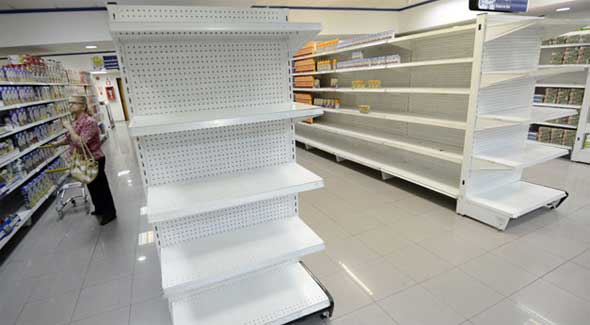
It is now two months since Venezuelans last saw or heard from their president, Hugo Chávez, who remains in intensive care in a high-security Havana hospital, battling what seems to be terminal cancer. But it is an absence of a different kind that is uppermost in many people’s minds. Cooking oil, sugar, wheat flour, coffee and the all-important pre-cooked maize flour that goes into many Venezuelan dishes are among the staple items that have largely disappeared from the shelves. Both the Central Bank, which tracks the level of supply, and private economists reckon that shortages are at their greatest since 2008.

Temporary shortages often occur at the start of the year, thanks to higher demand, reduced output and distribution delays over the Christmas holidays. But this year they are a symptom of bigger distortions, which include a black-market dollar that trades at more than four times the official exchange rate, and chronic inflation (20.1% in 2012 and likely to rise this year).

Economists expected a big devaluation in the early months of this year. That would make revenue from oil exports go further in local currency, bridging a fiscal deficit which reached 8.5% of GDP last year after an increase in spending of 26% in real terms in the 12 months before a presidential election in October, won by Mr Chávez. But there is no sign of it, probably because the president’s agony means that a fresh election is just around the corner.

The underlying problem is a shortage of cash at the state oil monopoly, Petróleos de Venezuela (PDVSA), which provides 94% of the country’s foreign earnings. Under a plan announced in 2005, Venezuela should have produced 5.8m barrels a day by 2012. Even by the government’s reckoning, it pumped little more than 3m; private sources suggest the number was around 2.8m. Local consumption has risen sharply, partly because petrol is provided almost free to Venezuelans but also because power plants have switched to fuel oil because PDVSA is unable to supply them with gas. Around 270,000 b/d of oil goes to China, to repay loans to the government, and almost 400,000 b/d at a big discount to Cuba and other allies. Refinery and production snags have even forced the company to import crude and oil products.

PDVSA is also obliged by the government to divert billions of dollars into unaudited funds which the president manages at his discretion. The biggest, known as Fonden, absorbed $15.5 billion last year, forcing PDVSA to pay part of its taxes in the form of IOUs. The Central Bank’s foreign reserves have been depleted, too, to $30 billion (down from $42 billion in 2008). Most of that is in gold or other non-liquid assets; liquid reserves amount to only a couple of months’ worth of imports. Importers say it is taking six months to obtain foreign currency at the official rate.

Official propaganda proclaims that Mr Chávez’s socialist revolution has promoted sovereignty and “endogenous development”. But Venezuela is more dependent than ever on imports. Domestic production has fallen victim to an overvalued currency and government hostility to the private sector. A wave of expropriations and confiscations has left millions of hectares of farmland and a swathe of the food industry in government hands. The expansion of the money supply, along with redistributive policies, has raised demand for food and other basic goods, met largely by imports.

Officials blame private-sector “hoarders” and “speculators” for inflation and shortages. They have raided warehouses, seizing 8,520 tonnes of sugar, for example, from Pepsi-Cola, which the company says was imported with government permission. As with other staples, the state controls the price and import licences for sugar, and its distribution (which can only be carried out with government permits). It also owns most of the sugar industry. In the case of pre-cooked maize flour, the government owns half of production capacity, but only supplies a fifth of the market, according to figures from Datanálisis, a market-research company.

Some stopgap measures have been taken to ease the flow of dollars. The government has quietly started to cut spending, and shaved PDVSA’s annual contribution to Fonden by $2.9 billion. It is looking for fresh loans, especially from China. But Fedecámaras, the main employers’ federation, says it will take three or four months to reduce food scarcity. That suggests that predictions of a March election are wide of the mark. Eventually, says Jorge Botti, the chairman of Fedecámaras, the government will have to “move towards the centre and understand how the private sector works”. But there is no sign of that yet.

To read this article at The Economist, please click here.

 
Feb
5
2013
Posted by
admin
Comments

Venezuela’s Economy: Papering Over the Cracks


4e7a2d0fa37e1d03280f6a706700d32d2 e1360094179201 Venezuelas Economy: Papering Over the Cracks

Courtesy of: Associated Press

For years, the Venezuelan economy under Chávez has languished. As the rest of the world emerged from the global recession of 2008, Venezuela has continued to struggle. Soaring inflation – topping 27 percent in 2011 and currently at 20.1 percent – has crippled Venezuelans’ purchasing power. Rampant expropriations, price controls and other heavy-handed policies have harmed business and left farmland idle, sapping more than 11 percent from the country’s gross domestic product between 2005 and 2010.

One would have expected such dreary economic news to make it difficult, if not impossible, for the incumbent Chávez to win reelection last year. But Chávez, in addition to leveraging his control of Venezuela’s media, spent recklessly, using oil revenues to keep the country’s economy afloat through the election cycle. It was also reported that Chávez loyalists offered free goods, such as refrigerators, to induce poorer Venezuelans to turn out at the polls for the president. Such measures, however, are akin to economic steroids; they offered an illusory sense of growth during the politically-vital election period, but severe side-effects are not far behind.

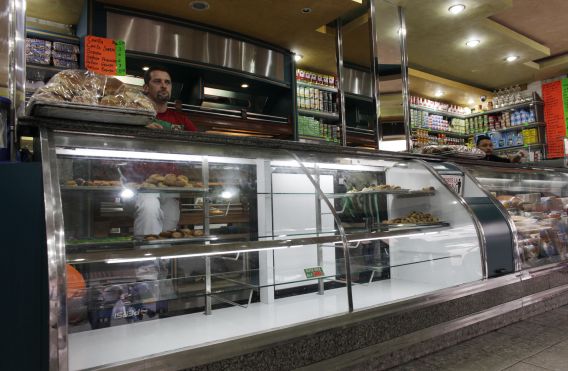
Indeed – as Chávez remains secluded in Cuba – it seems the ruling PSUV are running out of tools to forestall the inevitable reckoning. The nation’s debt continues to mount, leaving the country’s economy ill-equipped to handle any new stress; a recent International Monetary Fund analysis found that Venezuela’s already-high public debt would “balloon” to 145 percent of GDP in the event of a crisis. Expropriations and heavy-handed price controls, meanwhile, are crippling Venezuela’s ability to produce goods domestically. Over the last decade, as Chávez tightened his price controls on goods from flour to chicken to maize, shortages of these staple commodities have tripled. A dearth of flour has prevented Venezuelan bakeries from making bread.  The Wall Street Journal reported Sunday that “the worst food and consumer-goods shortages in nearly four years are making buying flour and other goods such as meat, sugar, cooking oil and toilet paper into a harrowing ordeal. Even medicines, like asthma inhalers, are hard to come by.”

After years of unsustainable policies, the Venezuelan economy still has far to fall. The price of oil has risen threefold over the last decade, hiding the underlying weakness of the nation’s public finances. If and when oil prices dip, Venezuela’s debt crisis would worsen. Chávez spent the run-up to the election siphoning off PDVSA oil revenues into an off-budget discretionary fund. But now, in a tacit acknowledgement of the economy’s weakness, much of this revenue will be re-directed back into the economy. Also, foreign Minister Jaua is now asking China for more loans to staunch the economic pain felt throughout Venezuela.

Meanwhile, unchecked inflation has crippled the value of Venezuela’s currency, the Bolivar. This has made foreign goods ludicrously expensive, even as shortages force Venezuelan people to rely ever more on imports. Economic analysts continue to predict that the government will be forced to devalue Venezuela’s currency in order to support oil revenues. This measure, however, will weaken the Bolivar still further, making imports more costly, eroding living standards and fueling Venezuela’s already sky-high inflation rate.

With the continuing uncertainty surrounding Chávez’s health – and the potential for a new election should he be unable to return – analysts expect the government to delay this devaluation for at least several months longer. In the end, however, years of government mismanagement mean that the Venezuela’s abysmal economic fundamentals cannot be concealed for much longer. As they say, what goes up must come down. The Chávez government has pumped Venezuela with spending, relying on borrowed money and unsustainable oil prices. Meanwhile, the foundation of the nation’s economy – her infrastructure and domestic industry – continues to crumble. Chávez’s cancer may yet claim his life, but the Venezuelan people will remain to feel the pain his policies have wrought.