Jul
1
2010
Posted by
admin
Comments

Caracas Archbishop says that Venezuela is on its way to downfall

Interview Caracas Archbishop Caracas Archbishop says that Venezuela is on its way to downfallGreat interview published by El Universal to Jorge Cardinal Urosa Savino, Caracas Archbishop about the current situation in Venezuela:

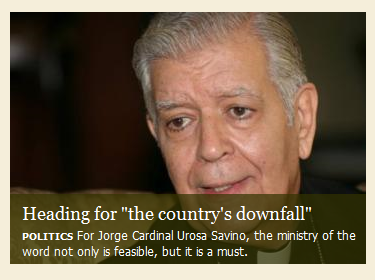
For Jorge Cardinal Urosa Savino, the ministry of the word not only is feasible, but it is a must, mostly nowadays, when, in his view, “the intended way to take us is dictatorship and the country’s downfall.” He noted his dislike of permanent exposure to the media, yet feels the need to speak to the country.

The communiqué from the presidency of the Venezuelan Bishops’ Conference on the spoiled food is noteworthy because it refuels the controversy under which the boundaries between the spiritual mission of the Catholic Church and its interference in politics are so blurry, to such an extent that it is accused of dealing with matters which are not their business.

Politicians say so whenever what one says is not appropriate for them. Bishops’ remarks on social and political life always are in line with supreme principles. We do not go into circumstantial details, except for the result of a government wrongful behavior. The statement referred by you is in accordance with our mission as shepherds of the people of God. In addition, we, bishops, are fully entitled, as citizens, to give our opinion, particularly when the common good, freedom, justice and peace are at stake.

Therefore, the Church is worried not only about a breaking point, such as spoiled food.

It is a breaking point, but a heavy one. Not only hundred thousand tons of food has been lost, but also what does this mean. Firstly, there is likely administrative corruption; further, inefficient management of activities which should correspond to individuals. All of this happens because the government, which tries to cover all areas, is in a totalitarian fashion and going beyond its own tasks, such as ensuring personal and material security of citizens, good working order of public utilities, sovereignty and the country’s independence. Thus, the government has embarked upon production, distribution and marketing of every kind of goods. It attempts to take part in all aspects of Venezuelans’ lives by imposing a Marxist-communist line.

Should the government be efficient and honest in management of the property taken over, would the Venezuelan Church have the same reporting position?

No matter what efficient and honest, it would be fulfilling functions that should correspond to individuals, who, according to the Constitution have the right to engage in economic activities. Such intervention in all the fields of economy, going beyond necessary controls, is an expression of the Marxist-communist line intended to be imposed by the president (Hugo Chávez), which, incidentally, was refused by the people on December 2, 2007 (in a referendum on the constitutional reform). Marxist totalitarianism allows those who occupy top government positions absolute control over the rest of people and this is something questioned by the Church social doctrine, because it leads to gross injustice and people’s submission to the government.

While totalitarianism fills the political, economic and social life, it also enters family life and individual intimacy. Are we reaching such extreme cases in Venezuela? Is it time to chase the Catholic religion?

I hope not, but we are on that way. There is surely the attempt at taking hold of people consciousness, but they have not made it because there is a strong democratic spirit in most Venezuelans.

Was Jesus Christ, as President Chávez claims, the first socialist in the history?

There is a big mistake here. Jesus Christ was not a socialist or monarchist or republican or liberal or a political leader. He was a religious leader; more precisely, the son of God becoming a man. He is above any system, ideology or regime. Such remarks aim at misleading people’s religious feelings. Jesus Christ promotes fraternal love, justice, the human being’s magnanimity. The values proposed, forcefully, by this socialism put power not in the people’s hands, but in their leaders’; remove pluralism, any dissent and different opinions not necessarily opposed to the government thinking.
 
Jul
1
2010
Posted by
admin
Comments

Caracas Archbishop says that Venezuela is on its way to downfall

Interview Caracas Archbishop  Caracas Archbishop says that Venezuela is on its way to downfallGreat interview published by El Universal to Jorge Cardinal Urosa Savino, Caracas Archbishop about the current situation in Venezuela:

For Jorge Cardinal Urosa Savino, the ministry of the word not only is feasible, but it is a must, mostly nowadays, when, in his view, “the intended way to take us is dictatorship and the country’s downfall.” He noted his dislike of permanent exposure to the media, yet feels the need to speak to the country.

The communiqué from the presidency of the Venezuelan Bishops’ Conference on the spoiled food is noteworthy because it refuels the controversy under which the boundaries between the spiritual mission of the Catholic Church and its interference in politics are so blurry, to such an extent that it is accused of dealing with matters which are not their business.

Politicians say so whenever what one says is not appropriate for them. Bishops’ remarks on social and political life always are in line with supreme principles. We do not go into circumstantial details, except for the result of a government wrongful behavior. The statement referred by you is in accordance with our mission as shepherds of the people of God. In addition, we, bishops, are fully entitled, as citizens, to give our opinion, particularly when the common good, freedom, justice and peace are at stake.

Therefore, the Church is worried not only about a breaking point, such as spoiled food.

It is a breaking point, but a heavy one. Not only hundred thousand tons of food has been lost, but also what does this mean. Firstly, there is likely administrative corruption; further, inefficient management of activities which should correspond to individuals. All of this happens because the government, which tries to cover all areas, is in a totalitarian fashion and going beyond its own tasks, such as ensuring personal and material security of citizens, good working order of public utilities, sovereignty and the country’s independence. Thus, the government has embarked upon production, distribution and marketing of every kind of goods. It attempts to take part in all aspects of Venezuelans’ lives by imposing a Marxist-communist line.

Should the government be efficient and honest in management of the property taken over, would the Venezuelan Church have the same reporting position?

No matter what efficient and honest, it would be fulfilling functions that should correspond to individuals, who, according to the Constitution have the right to engage in economic activities. Such intervention in all the fields of economy, going beyond necessary controls, is an expression of the Marxist-communist line intended to be imposed by the president (Hugo Chávez), which, incidentally, was refused by the people on December 2, 2007 (in a referendum on the constitutional reform). Marxist totalitarianism allows those who occupy top government positions absolute control over the rest of people and this is something questioned by the Church social doctrine, because it leads to gross injustice and people’s submission to the government.

While totalitarianism fills the political, economic and social life, it also enters family life and individual intimacy. Are we reaching such extreme cases in Venezuela? Is it time to chase the Catholic religion?

I hope not, but we are on that way. There is surely the attempt at taking hold of people consciousness, but they have not made it because there is a strong democratic spirit in most Venezuelans.

Was Jesus Christ, as President Chávez claims, the first socialist in the history?

There is a big mistake here. Jesus Christ was not a socialist or monarchist or republican or liberal or a political leader. He was a religious leader; more precisely, the son of God becoming a man. He is above any system, ideology or regime. Such remarks aim at misleading people’s religious feelings. Jesus Christ promotes fraternal love, justice, the human being’s magnanimity. The values proposed, forcefully, by this socialism put power not in the people’s hands, but in their leaders’; remove pluralism, any dissent and different opinions not necessarily opposed to the government thinking.

 
Jul
1
2010
Posted by
admin
Comments

Outgoing US ambassador concerned Venezuela’s agenda is focused on opposition to Washington

Article originally posted on Fox News.

The outgoing U.S. ambassador to Venezuela expressed concern Wednesday that Chavez’s government  has focused its agenda on opposing Washington and said he fears trade between the countries is fraying. Ambassador Patrick Duddy, who will soon end his assignment in Caracas, said he hopes the two countries can improve cooperation in some areas. “But these are difficult times for the bilateral relationship,” he said.

The United States remains Venezuela’s leading trade partner and the top buyer of Venezuelan oil, though oil exports to the U.S. have slipped recently as Chavez has sought to diversify his customers.

Venezuela exported $28.1 billion in oil and other goods to the U.S. in 2009, according to U.S. Census Bureau figures — a 45 percent decline from the previous year as crude prices dropped and oil output declined. Venezuelan exports to the U.S. have since sharply increased in the first months of this year. The country imported $9.3 billion in goods from the United States in 2009, a 26 percent decline from 2008.

“I am concerned that our long-standing commercial ties are weakening,” Duddy said. “I am concerned that the government of Venezuela has decided to define its economic, political and social agenda in terms of opposition to the United States, rather than seeking a positive course of cooperation with us.”

Chavez’s antagonism toward the U.S. has dominated his 11-year presidency, as he has accused successive U.S. governments of trying to undermine him and meddle in Latin America’s affairs. “Let me be clear about something: We are not intervening in Venezuela,” Duddy told a gathering of dignitaries and journalists at U.S. Embassy.

The diplomat also said the U.S. respects Venezuela’s sovereignty and its decisions to choose its trading partners as it pleases. But, he added, “It is hard to understand how the people of Venezuela … are going to benefit from a policy that explicitly wants to limit the long-standing relationship with the United States.”

He called it a shame Venezuela has seen a sharp decline in visits by American tourists, while noting that more than 1,000 Venezuelans show up at the U.S. Embassy most days to apply for travel visas.

Duddy arrived in 2007 and was expelled in 2008 by Chavez, who said it was in solidarity with Bolivia’s allied government after it ordered out the U.S. ambassador there, accusing him of helping the opposition incite violence. The administration of then-President George W. Bush denied the accusation and reacted by expelling the envoys of Venezuela and Bolivia.

Duddy was allowed back into Venezuela nine months after his expulsion, once President Barack Obama was in office.

The White House on Monday announced that Obama is nominating career diplomat Larry Palmer to succeed Duddy as ambassador. He must be confirmed by the Senate.