Oct
3
2013
Posted by
admin
Comments

ICYMI: To Venezuelans, Heir of Chavez Is a Poor Copy

The New York Times
October 2, 2013
By William Neuman
VENEZUELA articleLarge e1380753017255 ICYMI: To Venezuelans, Heir of Chavez Is a Poor Copy

Courtesy of: The New York Times

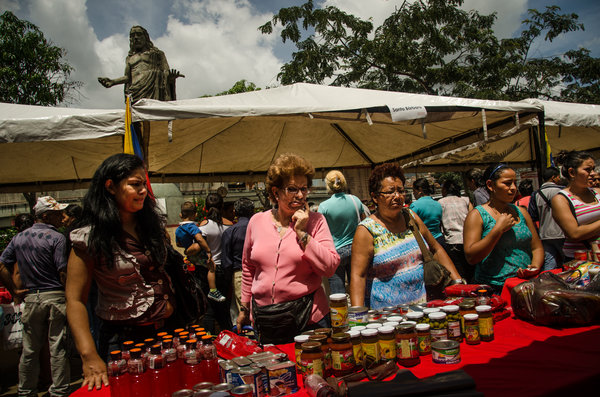
CARACAS, Venezuela — The start of the season for two premier teams in this baseball-loving nation was thrown into doubt after thieves stripped vast amounts of copper wire from the lights in this city’s main stadium. Basic items are often so hard to find that when a truck driver slumped dead at the wheel after a highway accident last week, motorcycle-riding looters swarmed in to grab the cargo: tons of red meat.

Prices are soaring, the country is plagued by electrical blackouts, some neighborhoods go days without water, and protests tangle the already stifling traffic. To top it all off, the cheap beer that helps people let off steam at many a weekend party has suddenly become scarce, too.

Nearly seven months after the death of Hugo Chávez, the country’s longtime leftist president and father figure, there is a growing sense that things are falling apart.

The new president, Nicolás Maduro, has revived a longtime scapegoat for the country’s woes, accusing Washington of conspiring with other enemies of the government in waging an “economic war” that has subjected the populace to blackouts, chronic shortages and other ills. Borrowing from Mr. Chávez’s script, Mr. Maduro on Monday expelled the top American diplomat here and two other embassy officials, contending that they were plotting to destabilize the country.

But while Mr. Chávez skillfully portrayed the United States as an imperialist bully and cast himself in the role of underdog hero, many Chávez supporters are finding Mr. Maduro’s attempts to imitate his mentor unconvincing.

“This is the biggest mistake Chávez ever made,” said Axel Ortiz, 20, a student, referring to Mr. Chávez’s choice of Mr. Maduro as his successor. Mr. Ortiz still defines himself as a Chavista — a loyal Chávez supporter — but he questioned Mr. Maduro’s ability to solve the nation’s problems. “Chávez was the only one who was qualified, the only one who could keep things here under control.”

The country’s economic problems have become acute. Inflation in the first eight months of this year was more than triple the rate in the same period last year. When measured over the 12 months that ended in August, it exceeded 45 percent. A government indicator that measures the scarcity of basic goods is close to its highest level in more than five years.

Many stores allow customers to buy only a limited number of scarce items like corn flour and cooking oil. People complain of having to stand in line for hours, often in vain, and many are losing patience with the government’s explanation that unsavory conspirators are to blame for the nation’s problems.

“The government is resorting to more and more outrageous and extravagant actions and statements to control the agenda,” said Andrés Cañizalez, a communications professor at Andrés Bello Catholic University.

All of this would be a lot to handle for any neophyte president, but the gaffe-prone Mr. Maduro has come under withering criticism for regularly tripping over his words, eliciting cringes from supporters and jeers from opponents. When he fell off his bicycle on live television recently, the event threatened to become a metaphor for a struggling presidency.

“People laugh at him,” said María López, 32, a mother of two on a recent morning in the Terrazas del Alba slum in the center of Caracas. She voted for Mr. Maduro, and said she still supported him. But she fought back a smirk when asked about Mr. Maduro’s bicycle accident, which occurred during a ride to promote his party’s youth movement. “We don’t want a president who’s a joke,” she said.

The blunders have piled up, much like the entourage of politicians and bodyguards who screeched to a halt in a tangle behind the president’s fallen bicycle.

In one of his most infamous verbal flubs, in August, Mr. Maduro sought to make a reference to the biblical story of Jesus’ multiplying the loaves and fishes — only to have it come out of his mouth as “the multiplication of the penises.” Mr. Maduro apparently conflated “peces” (fish) and “panes” (loaves) to produce “penes” (penises). He quickly apologized and corrected himself, but the damage was done.

“A person who doesn’t know how to speak will never know how to run a country,” said Jorge Flores, 30, a messenger at a government-run hospital, who voted for Mr. Maduro but now bitterly regrets doing so.

“This is the worst government I’ve ever seen,” Mr. Flores said. “The best government we’ve ever had here was with Chávez.”

Mr. Maduro calls his critics elitists and once said he had misspoken on purpose to bait his detractors.

Mr. Chávez, a fiery socialist, had a connection with ordinary Venezuelans that was so strong they often refused to blame him for many of the same problems that continue to bedevil the country. Mr. Maduro does not have the same charisma, and at least some of Mr. Chávez’s followers seem to be tuning him out.

“The government does these things to distract us from our real problems,” said Cristian Nivela, 24, a Chávez loyalist who voted for Mr. Maduro, referring to the expulsion of the American diplomats.

On Tuesday, Mr. Maduro used a special national television broadcast to present what he said was evidence that the diplomats had been conspiring with the extreme right in Venezuela to destabilize the country.

He showed a video, accompanied by ominous music, contending that the top diplomat at the United States Embassy, Kelly Keiderling, and the other two expelled diplomats had met in recent weeks with elected officials — including a state governor and a mayor — who belong to the Venezuelan opposition. The video also showed them leaving a meeting at the office of a pro-democracy group.

“These officials are meeting, well, in a shameless manner, and talking about strikes, sabotage, talking about the internal affairs of Venezuela, offering money,” Mr. Maduro said.

Such accusations resonate here because of the United States’ history of intervention in Latin America, including its tacit support of a 2002 coup that briefly ousted Mr. Chávez.

But a State Department official called the accusations absurd.

“Our diplomats were doing what they do all over the world,” said the official, Roberta S. Jacobson, assistant secretary of state for Western Hemisphere affairs. “They were visiting parts of the country and talking to all kinds of different people. They were doing nothing covert or out of the ordinary for diplomats.”

She said that in response, the United States was expelling the top Venezuelan diplomat in Washington and two other Venezuelan Embassy officials. The United States and Venezuela do not maintain an ambassador in each other’s capital.

On Tuesday night the State Department identified the Venenezuelan diplomats, who were given 48 hours to leave the country, as the charge d’affaires, Calixto Ortega Rios, and Second Secretary Monica Alejandra Sanchez Morales, both of whom are assigned to the country’s embassy in Washington, and Marisol Gutierrez de Almeida, the consul in Houston,

“It is regrettable that the Venezuelan government has again decided to expel U.S. diplomatic officials based on groundless allegations, which require reciprocal action. the State Department said in a statement. “It is counterproductive to the interests of both our countries.”

With the diplomatic tussle in the background, officials said the burglarized stadium — home to the Caracas Lions and the La Guaira Sharks, roughly equivalent to the Yankees and Mets in Venezuelan baseball — would be ready for the start of the season on Oct. 10.

They said workers had finally finished repairs to the lighting system after thieves stripped out much of the wiring, in a very public example of the crime, corruption and disarray in this country.

But the looting of the meat truck on Friday was shocking even to many who have become inured to the high levels of violence here. The truck became stuck under a barrier meant to block oversize vehicles. Part of the cargo crushed the top of the cab.

Denny Medina, 44, the owner of a fleet of trucks, said that he had tried to rescue the driver, but that he could not open the door. Instead of helping, he said, looters clambered over the vehicle.

“What made me feel powerless was to see the people carrying off the boxes of meat, and no one was showing any concern for the driver right below them,” Mr. Medina said. “It was terrible. I hope that we don’t get used to this.”

To read this article at The New York Times, please click here.
 
Oct
1
2013
Posted by
admin
Comments

ICYMI: With Accusations of Sabotage, Venezuela Expels 3 US Embassy Officials

The New York Times
September 30, 2013
By William Neuman

VENEZ articleLarge e1380645570814 ICYMI: With Accusations of Sabotage, Venezuela Expels 3 US Embassy Officials

Courtesy of: Agence France Presse

CARACAS, Venezuela — Stepping up hostilities with the United States, President Nicolás Maduro of Venezuela expelled the top American diplomat and two other embassy officials from the country on Monday, accusing them of supporting plots to sabotage the country’s electrical grid and the economy.

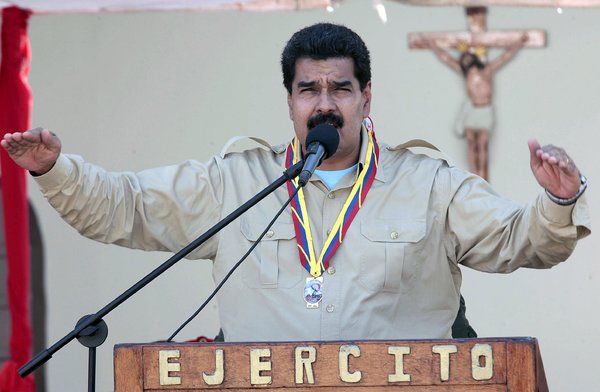
“Get out of Venezuela! Yankee go home!” Mr. Maduro shouted as he announced the expulsions at a military event to commemorate the bicentennial of a battle in Venezuela’s war of independence.

“We have detected a group of officials of the United States Embassy in Caracas, in Venezuela, and we have been tracking them for several months,” Mr. Maduro said during a live television broadcast. “These officials spend their time meeting with the Venezuelan extreme right wing, financing them and encouraging them to take actions to sabotage the electrical system, to sabotage the Venezuelan economy.”

The expulsions were the latest diplomatic swipe at Washington by Mr. Maduro since he took over for the country’s longtime president, Hugo Chávez, who died in March. Late last year, as Mr. Chávez grew increasingly ill, the two nations held informal talks aimed at improving the long-strained relations between them, and there was some optimism on the American side that Mr. Maduro, a former foreign minister sometimes described as pragmatic, would be amenable to a thaw.

But it quickly became clear that Mr. Maduro intended to stick closely to Mr. Chávez’s example, painting the United States as an imperialist aggressor out to undermine his government. Early on, he accused the Obama administration of plotting against him, and hours before he announced the death of Mr. Chávez on March 5, he kicked out two American military attachés, saying they had tried to recruit Venezuelan military personnel to conspire against the government.

The diplomats expelled on Monday included Kelly Keiderling, the chargé d’affaires, who runs the embassy in the absence of an ambassador here. The United States has not had an ambassador in Caracas since 2010, when Mr. Chávez refused to accept the new one proposed by Washington because of remarks that Mr. Chávez said were disrespectful.

Mr. Chávez had already expelled the American ambassador, Patrick Duddy, in 2008, saying that his government had discovered an American-supported plot by military officers to topple him. Mr. Duddy was later allowed to return to Caracas.

Another one of the diplomats expelled on Monday was Elizabeth Hoffman, an official in the embassy’s political section, whom Mr. Maduro had publicly accused at least as early as April of meeting with opposition figures to plot sabotage of the electrical system. He said at the time that he had proof but took no action until Monday. The third official being expelled is David Moo, the vice consul.

Foreign Minister Elías Jaua later said on television that the evidence against the American diplomats included meetings held in recent weeks with democracy advocates, union members and elected officials belonging to the political opposition, whom he accused of planning to destabilize the country.

Mr. Maduro said the officials had 48 hours to leave the country.

“We completely reject the Venezuelan government’s allegations of U.S. government involvement in any type of conspiracy to destabilize the Venezuelan government,” the American Embassy said in a statement. It called the meetings held by the officials “normal diplomatic engagements,” adding, “We maintain regular contacts across the Venezuelan political spectrum.”

Ever since he was elected by a narrow margin in April in a special election to replace Mr. Chávez, Mr. Maduro has struggled with intense economic woes and a deeply divided populace. He has often accused plotters and saboteurs of being responsible for a variety of the nation’s ills, including electrical blackouts and the deadly explosion at the national oil company’s enormous Amuay refinery.

“He needs diversions and distractions,” said Michael Shifter, president of the Inter-American Dialogue, a policy group in Washington. “The situation is so dire in Venezuela that he needs to find a scapegoat, and it’s convenient and politically so tempting to kick out U.S. diplomats.”

But Mr. Shifter said that describing the United States as the source of the country’s problems might not have the same effect it did for Mr. Chávez, who was beloved by many of his supporters. Mr. Maduro does not inspire nearly the same devotion, and the country’s economic woes are getting worse, with inflation over 45 percent a year and shortages of many basic foods and goods, including toilet paper.

“I doubt that it has the resonance it used to have,” Mr. Shifter said of the diplomatic expulsions.

To read this article at The New York Times, please click here.
 
Aug
12
2013
Posted by
admin
Comments

ICYMI: Venezuela Opposition Comes Under Siege

Wall Street Journal
August 9, 2013
By José de Córdoba and Ezequiel Minaya

Oscar Lopez left adviser 010 ICYMI: Venezuela Opposition Comes Under Siege

Courtesy of: Associated Press

CARACAS—Venezuela’s President Nicolás Maduro, the political heir to late populist Hugo Chávez, is ratcheting up intimidation of his political foes as his government prepares for key municipal elections amid a deteriorating economy.

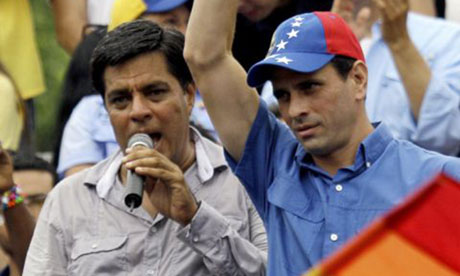
Oscar López, a senior aide to former opposition presidential candidate Henrique Capriles, was in hiding Friday after a government legislator said a warrant had been issued for the aide’s arrest. Days earlier, the apartment of Mr. López, Mr. Capriles’s chief of staff, was searched by military-intelligence agents, according to opposition officials.

“He doesn’t know what this circus is all about so he is taking care of himself” by going into hiding, said Julio Borges, a legislator and national coordinator of Venezuela’s leading opposition party, Justice First.

Mr. Capriles himself faces possible arrest after the Supreme Court on Wednesday rejected his challenge to Venezuela’s April presidential election, which Mr. Maduro won by a sliver but which was marred by allegations of fraud. The court went on to fine Mr. Capriles $1,700 for what it said was a “disrespectful” filing and said the opposition leader should be prosecuted for trying to undermine the election.

“It’s a way to attack Henrique and his movement,” Mr. Borges said.

A senior U.S. official said Washington is worried about developments in Venezuela. “The Venezuelan government is increasingly taking legal actions against the opposition, a development the United States finds profoundly worrying,” the official said. The wave of actions against opposition leaders like Mr. Capriles “raises legitimate and urgent concerns,” the official said.

Venezuela’s Attorney General’s Office declined to comment as did Venezuela’s Information Ministry.

Venezuelans go to the polls in December to contest some 335 mayors’ posts throughout the country, as well as hundreds of other local offices. The elections will be the first gauge of Mr. Maduro’s popularity since his win in April’s election.

In the run-up to the vote, Venezuela’s economy has shown signs of increasing stress after years of ramped-up public spending under Mr. Chávez, who died in March. The country’s inflation is north of 42%, common consumer goods like toilet paper are scarce, and despite high oil prices, Venezuela just defaulted on the payment of a $100 million bond of a nationalized steel company, spooking bond buyers. Divisions in the Chavista movement, nominally led by Mr. Maduro, are deep.

“This is clearly a wounded government as far as its mandate and its internal dynamics. And like any wounded animal, it can be dangerous. It is taking very severe steps to consolidate power,” said Christopher Sabatini, senior director of policy at the Americas Society and Council of the Americas.

Also this week, authorities jailed and froze the assets of the editor of a small independent paper and website, Leocenis García of Sexto Poder, who has published detailed reports of alleged government corruption. On Thursday, a judge fined two opposition newspapers—including El Nacional, the country’s most influential daily—1% of their 2009 income for showing a photograph of deteriorated conditions in a morgue. The judge said showing the photo was harmful to the welfare of children.

In Caracas, Juan Carlos Zapata, an author and political analyst, said the escalating repression shows a clear government intention to frighten the opposition. “They want to dismantle the opposition, they want Capriles’s aides to flee the country, and for Capriles to throw in the towel before elections,” said Mr. Zapata. “It’s an orchestrated plan to scare off the opposition.”

The Maduro government has said that it is simply rooting out corruption, regardless of political affiliation. Soon after taking office, Mr. Maduro launched an antigraft initiative that has resulted in the arrest of a handful of mid-level state officials.

The latest government moves follow last week’s stripping of parliamentary immunity by government deputies of a popular opposition congressman, by less than the constitutionally required two-thirds majority. Richard Mardo, who has built up a large following in the Chavista state of Aragua, now must face charges of alleged corruption.

Legal moves by the government against its foes are common in Venezuela. A study by Human Rights Watch found that as of May 2012, Venezuela’s Comptroller General’s Office had temporarily disqualified some 800 people, most of them Chávez foes, from running for office due to accusations of corruption—even though charges hadn’t been filed against them. About 300 people are still barred from running for office.

During his time in office Mr. Chavez routinely brushed aside international criticism as attempts to meddle with domestic affairs and plots to topple his government.

Meanwhile, the opposition is struggling to get out its message to ordinary Venezuelans. Globovisión, once a feisty opposition TV channel—and the only one that gave Mr. Capriles significant airtime—was sold earlier this year, and its coverage of Mr. Capriles has fallen sharply. News about Mr. Capriles is now relegated to a recently opened Web channel dubbed “Capriles TV.” Mr. Borges said that the opposition would have to work hard to get its message out by taking a “grass-roots” approach.

Opposition figures as well as analysts say the repressive wave points to the deep divisions in Mr. Chávez’s movement following his death. “Chávez was a kind of crazy glue that was able to keep different elements together,” says Mr. Borges.

Mr. Borges sees different power groups within the government fighting for influence and control. Within these groups are groups of powerful businessmen and executives who control different sectors of the economy such as the state oil industry, food imports, and the country’s other basic industries. “There are no institutions anymore, just different clans balancing each other,” Mr. Borges said. “Maduro is not president of the country, he is the boss of one of these groups.”

Analysts foresee a difficult time ahead for Venezuela. “It’s a disaster in the making because nobody is in charge,” says Riordan Roett, the head of Latin American studies at Johns Hopkins University.

Many analysts believe the most powerful faction is led by Diosdado Cabello, the president of the National Assembly. Mr. Cabello, a burly and bull-necked former army lieutenant who took part in Mr. Chávez’s failed 1992 coup, has close ties to the country’s armed forces and has reportedly built up a considerable personal fortune.

In late April, Mr. Cabello presided over the congress as a number of opposition legislators were beaten in the congressional chamber. At the time, Mr. Cabello didn’t allow opposition deputies to take the floor to speak until they recognized Mr. Maduro’s victory. Mr. Cabello has ruled the chamber with an iron fist ever since.

Javier Corrales, an expert on Venezuelan politics at Amherst College says that while Mr. Maduro has shown some signs of moderation—such as meeting with top businessmen, Mr. Cabello is openly confrontational. “This crackdown seems to come from Diosdado,” he said. “His instinct appears to be brute force.”

Mr. Cabello couldn’t be reached to comment.

To read this article at the Wall Street Journal, please click here.