Wall Street Journal
March 10, 2013
By Ezequiel Minaya
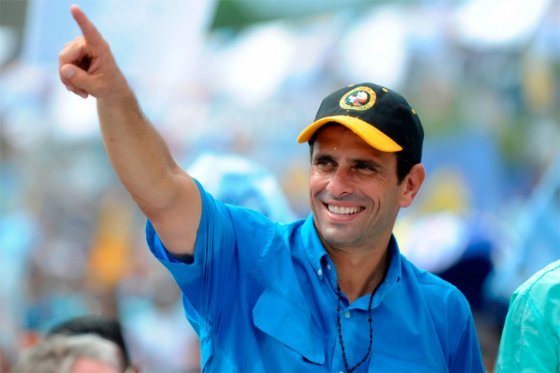
Courtesy of: Agence France Presse
CARACAS—Venezuela opposition leader Henrique Capriles, who challenged the re-election bid of former President Hugo Chávez last fall, announced Sunday his candidacy in snap elections set over the weekend for April 14 to replace the late president.
The 40-year-old governor of Miranda, Venezuela’s second most-populous state, will be pitted against acting President Nicolás Maduro, who was tapped by Mr. Chavez as his preferred successor before his death last week. Mr. Capriles blasted his rival in remarks broadcast on state television, accusing Mr. Maduro of lying to the country about the timing of the death of the president—who hadn’t mad a public appearance since December—and using the loss for political gain. “Nicolás lied to this country,” Mr. Capriles said, referring to the acting president by his first name. “You submitted the country to a lie. I don’t play with death, I don’t play with pain.”
Mr. Capriles, who some analysts say was nonconfrontational during much of his run against the notoriously combative Mr. Chávez, has taken a tougher tone with Mr. Maduro from the outset. “Are those tears sincere?” he asked of Mr. Maduro, who has paid several emotional tributes to Mr. Chávez since his death March 5.
In a fiery televised response to the governor, Mr. Maduro, standing in front of a framed photo of the late leader, called his counterpart “miserable” and said he was trying to incite violence.
“He has committed the biggest error in his history,” Mr. Maduro said of Mr. Capriles. He also noted that Mr. Chávez’s family holds the right to take legal action against the governor for his comments, without offering details.
“Now if all of these [opposition parties] come out to back this serious offense, well, that’s a declaration of war,” Mr. Maduro said. He insisted however that the country had to maintain peace.
Mr. Capriles, a law graduate and former national legislator, lost to Mr. Chávez in Oct. 7 elections by 11 percentage points, capturing 44% of ballots. Though unsuccessful, Mr. Capriles posted the best showing ever against Mr. Chávez, who succumbed to complications linked to his battle with cancer of nearly two years.
No opinion surveys have been released tracking a possible Maduro-versus-Capriles contest since the death of Mr. Chávez at age 58. But a poll last month by local pollster Hinterlaces showed Mr. Maduro, who many expect to benefit from a sympathy vote amid the passing of his mentor Mr. Chávez, beating Mr. Capriles 50% to 36%, with the remainder undecided.
Election authorities have designated only 10 days for campaigning, a short time frame that likely favors Mr. Maduro, who is backed by the formidable electoral machine of the ruling United Socialist Party of Venezuela, or PSUV. The candidates have both planned to visit the national election board on Monday to make their decisions official. Mr. Capriles added that he will launch a tour of the country on Tuesday.
During the heated presidential contested last year, the opposition coalition of roughly 30 parties that backed Mr. Capriles, known by its Spanish acronym MUD, filed more than a 100 complaints with election authorities accusing Mr. Chávez of skirting electoral norms with lengthy appearances on state broadcasters and using public workers as part of his campaign, among other allegations. Venezuela’s National Electoral Council, seen by many as aligned with the PSUV, declined to open an investigation into the Chávez camp and responded to only a handful of MUD complaints.
A youthful sports-fan, Mr. Capriles has described himself as a center-left lawmaker who draws inspiration from the “new left” policies of former Brazilian President Luiz Inácio Lula da Silva. Detractors of Mr. Capriles have accused him of aping the populist style of Mr. Chávez to disguise allegedly far-right leanings.
Mr. Capriles endured a barrage of near-daily attacks from state media and government officials during last year’s presidential run, including accusations that he was both a Zionist agent and a neo-Nazi sympathizer. Mr. Capriles, a practicing Catholic, has Jewish ancestors, some of whom fled Europe during the Holocaust.
Venezuelan law calls for new elections within 30 days if the presidency is vacated within the first four years of a six-year term. In his final public appearance in December, Mr. Chávez backed the 50-year-old Mr. Maduro as Venezuela’s next leader if a new vote was required.
Mr. Chávez never revealed the exact type of cancer he suffered. During the president’s three months out of the public eye, Mr. Maduro and other government officials insisted on various occasions that Mr. Chávez was showing improvement and remained at work.
Mr. Maduro, a former bus driver and union organizer, was foreign minister for six years beginning in 2006 before being named vice president last year. He is considered a hard-line Chávez loyalist. He has, nonetheless, been praised by fellow diplomats for being an approachable representative of a government that is often provocative and strident in its anti-U.S. sentiment. Mr. Maduro, who delivered an emotional eulogy for Mr. Chávez on Friday, took the oath of office hours after the funeral services and named the late president’s son-in-law, Science and Technology Minister Jorge Arreaza, as vice president.
Many analysts doubt, however, that Mr. Maduro can match the outsize personality and charisma that helped Mr. Chávez dominate Venezuelan politics for 14 years. And it remains to be seen how Mr. Maduro will perform in a high-profile election, having had most of his political posts coming by way of appointment. Mr. Capriles, in contrast, is a veteran of several prominent showdowns, including an upset victory to capture the Miranda statehouse in 2008 over incumbent Diosdado Cabello, an influential Chávez ally who is now president of the National Assembly.
To read this article at the Wall Street Journal, please click here.