Jan
30
2012
Posted by
admin
Comments

Meet the Candidates: Diego Arria

 Meet the Candidates: Diego Arria

Source:
Wikimedia commons

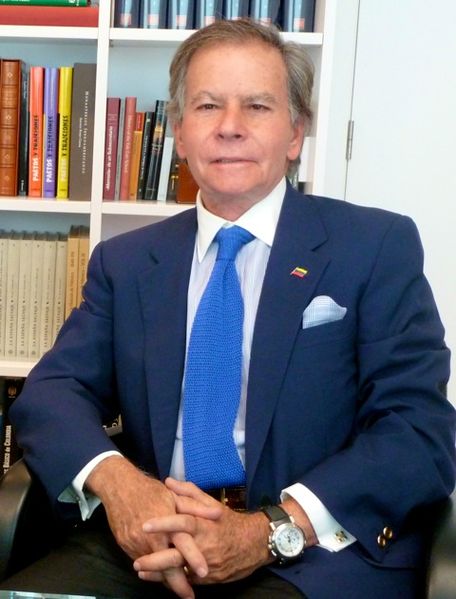
This week, What’s Next Venezuela presents our “Meet the Candidates” series. Over the next five days, we will share with you the backgrounds of five Venezuelans battling to become the presidential candidate for the Mesa de la Unidad Democrática (MUD) in the February 12 primary. The winner will face President Hugo Chávez in the October 7 presidential elections. Today, we introduce Diego Arria.

Diego Arria, known for his work in international diplomacy, is running as an independent candidate in the 2012 Venezuelan primary elections.

For much of his political career, Arria held several positions within the United Nations (UN). He served as the Venezuelan permanent representative to the UN, rising to chair the UN Security Council, the organization’s most important committee. Later, he served as special advisor to Kofi Annan, then Secretary General of the UN. During his time leading the Security Council, Arria directed several conflict resolution missions in Sarajevo, Bosnia, the Balkans and Rwanda, becoming recognized as a champion of human rights. He actively endorsed the creation of an international tribunal to try human rights violators and served as a witness during the trial against Slobodan Milosevic. He also established himself as an approachable leader through the creation of “Arria Formula,” a program that allowed individuals and organizations to engage in informal dialogue with the Security Council.

Prior to his involvement in the UN, Arria was a prominent politician in Venezuela. Arria was appointed in 1974 as the Governor of the Federal District (Caracas) during the presidency of Carlos Andrés Peréz. Later, in 1978, after a brief stint as Minister of Information and Tourism, Arria ran as an independent candidate in the Venezuelan presidential election of 1978, in which he garnered only 1.7 percent of the vote.

In the present campaign, Arria has emphasized the need for a Constitutional Assembly that would amend changes to the current Venezuelan Constitution that was adopted in 1999. Arria has also been a sharp, vocal critic of Chávez’s expropriation policies. Following Arria’s participation in the Oslo Freedom Forum, where he accused Chávez of crimes against his people, the Venezuelan government seized his ranch, known as “La Carolina,” in the State of Yaracuy.

Since announcing his candidacy, Arria has filed a complaint against President Chávez, accusing him of crimes against humanity before the International Criminal Court (ICC) at The Hague. The complaint alleges that President Chávez and several of his top advisors violated human rights through murder, forced displacement and violation of property.

Leading up to the February elections, Arria has established a platform focused on:

  • Decentralizing power and distributing it among governors and mayors;
  • Convening a Constitutional Assembly to limit presidential terms to 3 years with no possibility of reelection;
  • Strengthening Venezuela’s relationship with the United States.
  • Improving Venezuela’s education system by focusing on equal access to education, freeing the classroom of political ideologies, and providing teachers with greater influence;
  • Working to improve the daily lives of ordinary citizens by protecting human rights, including the right to private property;
  • Quelling violence related to drug trafficking that crosses into Venezuela;
  • Reestablishing the Armed forces without corruption;

Click here to learn more about Diego Arria on his website.
 
Dec
8
2011
Posted by
admin
Comments

Chávez’s Campaign Dirty Tricks Reveal a More Sinister Side

JDSC 0754 150x150 Chávez’s Campaign Dirty Tricks Reveal a More Sinister Sideosé R. Cárdenas served in several foreign policy positions during the George W. Bush administration (2004-2009), including on the National Security Council staff. He is a consultant with Vision Americas in Washington, DC.

Even as the world marvels at the ways in which social media can work to undermine undemocratic regimes, the flip side is that the same new communications technologies can be exploited by those regimes to further repress and control their populations.

As U.S. Assistant Secretary of State for Human Rights Michael Posner recently noted, “We are seeing a growing number of repressive regimes get hold of the latest, greatest Western technologies and use them to spy on their own citizens for the purpose of quashing peaceful political dissent or even information that would allow citizens to know what is happening in their communities.”

Indeed, the opportunities have not been lost on Venezuelan President Hugo Chávez.  Ahead of the 2012 Venezuelan presidential election, his loyalists have begun employing such technologies to hack into the websites and Twitter accounts of his political opponents and other critics.

Already, the website and Twitter accounts of candidates Henrique Capriles Radonski and Diego Arria have been hacked, as well as those of prominent pollster Luis Vicente León, journalists, opposition news sites like LaPatilla.com, and numerous other sites and Twitter accounts of Chávez critics.

The hackings range from posting vitriolic comments against the opposition to more subtle faux posts meant to foment internal discord and division among the opposition. One hacker group calling itself N33 even uses a chavista red beret as its calling card.

One could be tempted to dismiss such hacking as typical chavista political dirty tricks that should surprise no one. From his first re-election, Chávez and his supporters have employed every measure legal or illegal to tilt the political playing field in his favor.

Yet, there are ominous signs that this is just the tip of the technological iceberg when it comes to the government invading citizens’ privacy and monitoring their actions, movements, and political orientation.

According to Anthony Daquin, a Venezuelan computer engineer who formerly advised the Venezuelan Ministry of Interior and Justice, the Chávez government is working with Cuba to implement a new electronic national identity system that would allow the government to instantly monitor private and sensitive personal information on each Venezuelan citizen, including how much they earn, where they live, what property they own, and what their political leanings are.

Daquin, who is seeking political asylum in the United States, told Miami’s El Nuevo Herald that he had a falling out with the government and its Cuban advisors when he objected to the new technology because of how it could be abused by gathering sensitive data about a person without their consent.

Chávez long ago outsourced the management of Venezuelan national identity cards and passports to the Cubans, who have developed an enormous data base of information about Venezuelans that will now be transferred to their identity cards using an embedded microchip that can be monitored – a technology, known as RFID, that has generated protests from privacy advocates around the world.

Clearly, the Cuban hand betrays a nefarious purpose in the introduction of such technologies to Venezuela. The Castro regime has succeeded in only one thing in its 50 years in power: controlling its citizens. Whether it is hacking the websites and Twitter accounts of the Venezuelan opposition and other Chávez critics or managing the national identity card system, there is no other purpose but to help maintain Chávez and his successors in perpetual power.

Systematic violations of privacy remind us of the significant obstacles that confront Venezuela’s democratic opposition in trying to unseat Hugo Chávez at the ballot box. They also are a stark reminder of the long-term dangers to individual freedoms in Venezuela. It also demonstrates the lengths to which those with vested interests in chavismo will go to ensure that it continues, in the event Chávez succumbs to cancer. Unless the true champions of democracy in the region demand some level of fealty to the democratic process, Venezuela will continue to spiral into a full-fledged police state.

 
Oct
29
2010
Posted by
admin
Comments

VenEconomy: An Attempt at Terrorizing or a Result of Uncontrolled Crime?

This article was originally posted by The Latin American Tribune

At VenEconomy’s seminar “Venezuela 2010- 2012?” held this Wednesday, October 27, several questions were raised: Are Venezuelans aware of the dangers currently facing Venezuelan democracy? Are politicians prepared to accept the challenge of defending democracy? and Is society in general aware of the responsibilities that this entire situation puts on its shoulders?

Unfortunately, the almost unanimous perception of the participants was no. 

Summing up why there was no such awareness of the risks facing the country, former Ambassador to the United Nations Diego Arria said that people “continue to view the country’s situation in the context of an election year calendar, when it is clear that they are on the brink of turning us into a communist society.”

In Diego Arria’s opinion, the fundamental issue for confronting this grave crisis of the country’s democratic institutions is “national reunification.” It is necessary to “rebuild consensus looking forward to the future, not looking back to the past, learning from the mistakes of our country’s experience.” It is a matter of building bridges so that the unity is the country’s unity.

This reunification of the democratic sectors would include the Church, the political parties, whether or not they are part of the Coalition for Democratic Unity, businessmen, trade unions and workers, academe and students, and civil and neighborhood organizations; in other words, society as a whole.

Unfortunately, no one has understood this self-evident truth better than the government, and for that reason its strategy is to divide.

Given this situation, the kidnapping of and subsequent attack on Fedecámaras directors Noel Álvarez, Luis Enrique Villegas, Ernesto Villasmil, and Albis Muñoz give cause for particular concern.

Read More