Oct
12
2012
Posted by
admin
Comments

In Case You Missed It… Articles Roundup Week of 10/12/12

colgate 300x196 In Case You Missed It… Articles Roundup Week of 10/12/12

Stock Photo

Sunday’s reelection of Chávez disappointed many Venezuelans, but, with gubernatorial elections in December, Henrique Capriles and the opposition still may pose a threat to Chávez’s political aims in the future. Meanwhile, Chávez hails his reelection as evidence of Venezuela’s “perfect” democracy, despite the unfair playing field. Chávez also criticizes U.S.-Syria policy in his first press conference after the election, while vowing to deepen his socialist revolution in Venezuela. Yet his victory spurs further emigration as Venezuelans predict more economic woes. On Wednesday, Chávez named Foreign Minister Nicolas Maduro as his new Vice President to replace Elias Jaua. And with the end of 2012 only three months away, the Venezuelan inflation rate is expected to rise to 21 percent by the end of the year. Meanwhile, Chávez’s reelection raises worries among manufacturers from Coca-Cola to Colgate, with the threat of currency devaluation looming.

Chavismo Wins, Venezuela Loses, The Wall Street Journal

It was around 9 p.m. in Caracas on Sunday when opposition presidential candidate Henrique Capriles Radonski tweeted his followers: “Calm, prudence, patience. Today was a great historic day. The people spoke.” Chávez also used his first press conference following his reelection to criticize U.S. Syria policy.

Venezuelan opposition candidate Capriles may still pose future threat to Chavez, The Washington Post

CARACAS, Venezuela — His loss in Sunday’s presidential election was resounding, but in conceding defeat before tearful followers, Henrique Capriles hinted at an active political future that may yet pose a challenge to President Hugo Chavez’s self-proclaimed socialist revolution.

Venezuela’s Hugo Chavez wins 3rd term, vows to deepen socialist revolution, NBC News

CARACAS, Venezuela — President Hugo Chavez scored a comfortable election victory that could extend his rule to 20 years and vowed to deepen his self-styled socialist revolution after a bitterly fought race against a youthful rival who has galvanized Venezuela’s opposition.

Venezuela’s Chavez hails “perfect” democracy, mocks tyrant image, Reuters

(Reuters) – An ebullient President Hugo Chavez on Tuesday hailed his comfortable re-election as evidence of Venezuela’s “perfect” democracy and mocked his foes’ depiction of him as a dictator.

Venezuela’s Chavez criticizes US over Syria policy, Kansas City Star

In his first press conference since winning reelection Sunday, President Hugo Chávez said he was willing to work with the opposition even as he doubles down on his socialist reforms.

Chavez Victory Spurs Exodus as Venezuelans Foresee Economic Woes, Bloomberg Businessweek

Juan Ibarra, a 35-year-old surgeon from Caracas, is preparing to emigrate after Venezuelan President Hugo Chavez won another six-year term on Oct. 7.

Venezuela’s Chavez names Maduro vice-president, Reuters

(Reuters) – Venezuelan President Hugo Chavez named Foreign Minister and former bus driver Nicolas Maduro as his new vice president on Wednesday in a Cabinet shake-up following his comfortable re-election.

Inflation rate estimated at 21% ending 2012, El Universal

On Tuesday, the Central Bank of Venezuela (BCV) published the results of the performance of the National Consumer Price Index (NCPI) in September, resulting in a monthly variation of 1.6% for an accrued amount of 11.5% and annualized inflation at 18%.

Colgate: not toasting Chavez’s return, Financial Times

How do you toast the victory of Hugo Chávez, Venezuela’s socialist president, who last Sunday won another six-year term, reconfirming him as one of Latin America’s most commanding political figures?

 
Oct
3
2012
Posted by
admin
Comments

Will Venezuelans Oust Chavez? Miracles Do Happen

Bloomberg
October 3, 2012
By Enrique Krauze
i6afTBb119I8 Will Venezuelans Oust Chavez? Miracles Do Happen

Illustration by Forest

If Henrique Capriles Radonski triumphs in Venezuela’s elections on Oct. 7, it will be a democratic feat without precedent in Latin American history.

It is possible that an opposition candidate has never faced a force like that represented by Hugo Chavez. His government doesn’t employ physical violence as a state policy, but it exercises another kind of coercive and menacing violence, manifold and oppressive. Its power comes from the ballot box under the tight control of arms — his arms.

When democracy finally edged out dictatorships in Argentina, Uruguay and Chile, the military establishment — because of public repudiation of its genocidal acts — found itself in irreversible retreat.

At the other end of the ideological spectrum, perhaps the only case of an authoritarian leftist regime democratically overturned was that of the Sandinistas in Nicaragua in 1990. But the difficulties then weren’t as great as those involved in the Venezuelan process, for the very reason that the Sandinista government — already in decline at the end of the 1980s — wasn’t democratic, nor did it pretend to be.

Either way, whether against the militarist right or the revolutionary left, democracy wasn’t obliged to retrace a path, but to forge it.

Reclaiming Democracy

In Venezuela, the democrats must go back to before the beginning: They must restore true meaning to what has become a corrupted democracy. Chavez’s explicit aim has been to rule until at least 2030, when he will be 76 (and if he makes it to 76, there is no question he will want to continue). But unlike Fidel Castro of Cuba (and the Sandinistas or the old South American dictators such as Jose Gaspar Rodriguez de Francia of Paraguay or Juan Vicente Gomez of Venezuela), Chavez has astutely used democracy to do away with democracy.

He has accomplished this step by step, institution by institution, imposing his designs and spokesmen on the Legislature, the judiciary, the fiscal and electoral bodies. If he hasn’t finished his demolition work, it is because a broad sector of Venezuelan society hasn’t forgotten the meaning of freedom. In an unequal contest (because Chavez enjoys the private property of public resources, and uses them lavishly to his advantage), that sector has displayed an admirable spirit of unity, and it has in Capriles a young, sensitive and visionary leader. The possibilities of victory are real, but the adversary — despite (or thanks to) his illness — is formidable.

Chavez isn’t just a caudillo: He is a redeemer. To play up that twisted religious dimension, he has abused the media pulpit. For many years, he appeared on the Sunday program “Alo, Presidente,” a six-hour-long reality show in which Chavez delivered monologues, danced, sang, recited, read letters, declared his love for the people, railed at the empire and the “pitiyanquis” (or “little Yankees,” the purported allies of the U.S. within Venezuela), gave lessons on “21st-century socialism,” recalled scenes from his autobiography (which in his peculiar understanding of it is the incarnation of Venezuelan history) and issued thundering decrees.

Before his Cabinet members (all dressed in red, silent and as obedient as children in a classroom), he dictated expropriations, troop movements, diplomatic insults and public policies.

Many people in Venezuelan society rejected this spectacle. But more than half of the electorate celebrated it. For them, Chavez has been the reincarnation of Simon Bolivar and even Christ’s representative on earth, now more so than ever as Chavez has turned his grievous illness into a public calvary.

Chavez Loyalists

Beyond that incarnation is his social role. A considerable number of poor Venezuelans have been grateful to him for the “misiones” he established in 2003 (staffed mainly by Cubans, who have also taken charge of the security apparatus) with the aim of providing health care, food and education.

Though many of these programs have faced serious operational problems and are designed not to promote people’s autonomy, but rather their dependence on government, the “Chavistas” don’t see it that way. The near monopoly on public truth (which Chavez has enjoyed since he expropriated the major public-television channels) has masked reality. Millions of Venezuelans take his word as the mirror of truth, particularly if they are public employees whose income depends — or so they believe — on his munificence.

But the concealment of the truth has been massive. Will Venezuelans ever assess the incredible squandering of the almost $700 billion that passed through the coffers of Petroleos de Venezuela SA, the state-owned oil company that was once a bigger example of modernization than Brazil’s Petroleo Brasileiro SA? It’s impossible to know.

Many understand that Venezuela is in the midst of a crisis: Inflation and crime rates are among the highest in South America, and there are persistent shortages of goods. Basic services are also in chaos as a result of harassment in the private sector and because of inefficiency and corruption.

The Capriles campaign has been brave and conciliatory. His proposals seek to restore financial sense and protect social progress (real or perceived). Chavez has accused him of wanting to end the “misiones”; Capriles insists he will touch them only to improve them. Chavez points to him as the reincarnation of the political old guard of Venezuela; Capriles has shown how the bad practices of Chavismo are similar to those of the so- called Fourth Republic and pledged that his government will correct both.

Chavez has vilified him incessantly with crude insults and has committed the sacrilege of calling him a Nazi, knowing that Capriles’s great-grandparents were exterminated by the Nazis. Capriles, meanwhile, has remained unruffled.

Opposition’s Opening

Anything can happen, including an outbreak of the endemic violence that has plagued Venezuelan history. The fascination with a sick Chavez and his far-reaching control of the state apparatus may bring him victory.

If this is the case, the opposition must press on without pause or discouragement. Chavez may triumph, but it will be a hollow victory, and after his eventual death, divisions within his group as well as internal and international pressures may pave the way for a return to full democracy. Such a development would have the additional effect of precipitating the Cuban transition, drawing us nearer to the emergence — unprecedented in history — of an entirely democratic Latin America.

This outcome, which until recently would have seemed utopian, is at hand if Capriles wins. We have witnessed such a result before, in the December 2007 referendum, when Venezuelans, against all forecasts, voted down a plan for constitutional reform that would have turned the country into a new Cuba.

I have faith in that civic miracle. And I hope that such a victory will herald not only the return of democracy but something much more important and necessary: the reconciliation of the Venezuelan family, divided today by an ideological hatred that is alien to it, that has poisoned it for almost 15 years, and that has choked all possibility of harmony.

(Enrique Krauze is a historian and author of “Mexico: A Biography of Power” and of “Redeemers: Ideas and Power in Latin America.” The opinions expressed are his own. This article was translated from the Spanish by Natasha Wimmer.)

To contact the writer of this article: Enrique Krauze at [email protected].

To contact the editor responsible for this article: Katy Roberts at [email protected].

To read this article on Bloomberg, please click here.
 
Oct
1
2012
Posted by
admin
Comments

Panel: Superior Capriles Campaign negates Unlevel Playing Field

South Americas October Surpise Panel: Superior Capriles Campaign negates Unlevel Playing Field

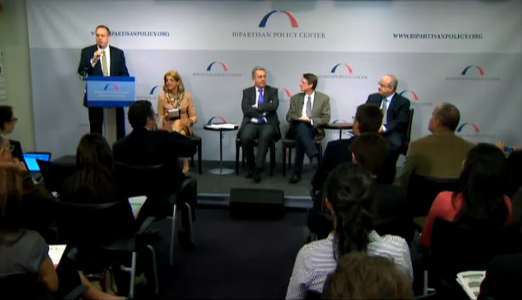
Screen Capture: Bipartisan Policy Center - South Americas October Surpise

Venezuela under Chávez does not meet the standards for a real democracy, according to statements made by former Colombian President Álvaro Uribe. The former leader told an audience at Washington’s Bipartisan Policy Center (BPC) that Chávez has failed to protect the security and freedoms of Venezuelan citizens during his rule and has not allowed their active participation in government.

Uribe participated in a BPC panel last week focusing on recent developments in Venezuela and Colombia, which include Venezuela’s tight presidential election, entitled “South America’s October Surprise?” The former Colombian president was joined by Dan Fisk of the International Republican Institute and Michael Shifter of the Inter-American Dialogue.

The panel discussed whether Venezuela’s upcoming elections can be considered fair as well as the likelihood that opposition candidate Henrique Capriles will defeat Chávez. Participants also tried to predict how the president will respond if he loses.

“There was a hemispheric consensus that elections [are] how you judge a democracy,” Fisk said of Venezuela’s upcoming vote. But he added that Chávez has manipulated the system to provide the appearance of a democracy while suppressing citizens’ democratic rights. “A lot of people have given [Chávez] credit that you can take away people’s freedom through a series of democratic processes.”

Uribe, though, had much stronger words. “I am against the Chávez dictatorship with or without elections,” he said. He further criticized the Chávez administration for failing to pursue the narco-terrorist organization FARC in Venezuelan territory. That failure has bled across Venezuela’s borders, undermining the stability of Colombia that the government of president Uribe worked hard to attain.

Fisk said that while the technical voting process in Venezuela appears to be fair, the real disparity – and the threat to democracy – lies in the campaign itself.

“The problem is not the machinery, it is the campaign process,” Fisk said. Venezuelan law allows the president to call mandatory national broadcasts, known as cadenas, at any time, and Chávez has abused this power to saturate Venezuela with campaign propaganda. Meanwhile, Capriles must pay for airtime, and lacks the resources to match the reach of the state media.

Chávez has also used the resources of the government, supplied by the country’s vast oil reserves, to finance his campaign. “In many ways PDVSA is the lubricant of the Chávez campaign,” Fisk said. Chávez has increased social spending, and then trumpeted that increased spending in his campaign rhetoric, giving Venezuelans the impression that it is he, not the government, who is giving them these benefits.

Despite all of this, Fisk says that this is the most competitive race that Chávez has ever faced. It remains to be seen if all of the electoral advantages Chávez enjoys can blunt the impact of his economic mismanagement, which has led to severe shortages and skyrocketing inflation, or make Venezuelans forget the recent refinery fires and one of the world’s highest crime rates.

Shifter added that the opposition has run an excellent campaign, and Capriles has refused to fall for tactics and provocations of Chávez. The opposition has stumbled in the past and has its best chance yet, in part because it has unified itself into one group. In addition, he did join the concerns of the other panelists, adding that “there is not a level playing field.”

In an encouraging bit of consensus, the panelists for the most part dismissed worries that Chávez would reject the results if the opposition wins. “It would be very hard in terms of politics in Venezuela and international pressure to deny [an opposition victory],” Shifter said. He warned, however, that the process may not be smooth. “We should be prepared for some amount of violence and instability. We have seen that in campaign stops in the past couple of days,” alluding to recent Chavista-incited violence at Capriles rallies.

Fisk added that the United States should be prepared to accept the results if the election appears credible, and that he believes that Venezuelans will peacefully accept the results as well.