Sep
10
2013
Posted by
admin
Comments

ICYMI: Capriles appeals to OAS human rights commission

BBC News
September 9, 2013
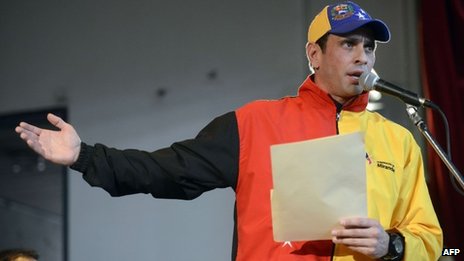
69757497 69757496 ICYMI: Capriles appeals to OAS human rights commission

Courtesy of: AFP

The defeated Venezuelan presidential candidate, Henrique Capriles, has filed a request at the Inter-American Commission on Human Rights to declare the April election void.

Mr Capriles alleges there was widespread fraud in the vote narrowly won by acting president Nicolas Maduro.

Last month, the Venezuelan Supreme Court rejected a final plea by Mr Capriles to have the vote annulled.

Mr Capriles vowed to take his fight beyond Venezuela.

Mr Maduro has repeatedly rejected the opposition allegations of fraud.

‘Supranational power’

He also dismissed the Washington-based human rights organisation as lacking credibility.

He praised the late president, Hugo Chavez, for beginning proceedings to pull out from the body last year.

Venezuela is due to officially withdraw from the Commission on Tuesday.

Mr Maduro accused the OAS Human Rights Commission of hating and despising Latin America

The Inter-American Commission on Human Rights is part of the Organisation of American States (OAS).

“They believe they are a supranational power, a power above the legitimate governments of the continent. Their time is passed,” said Mr Maduro.

The Venezuelan government decision was criticised by Amnesty International as “a serious setback for the rights of Venezuelans.”

‘Reinstate rights’

Opposition politician Ramon Jose Medina filed the request, signed by Mr Capriles, at the OAS headquarters.

The Venezuelan government “must be forced to reinstate the rights they violated,” said Mr Medina.

“The elections, which were fraudulent, must be repeated and the electoral process must be free and fair.”

Mr Maduro won the 14 April vote by less than 1.5 percentage points – about 200,000 votes.

Mr Chavez died on 5 March after a long battle against cancer.

Before going to Cuba for a last round of treatment in December, he appointed Mr Maduro as his preferred successor.

To read this article at BBC News, please click here.
 
Jun
29
2012
Posted by
admin
Comments

In Case You Missed It… Articles Roundup Week of 6/29/12

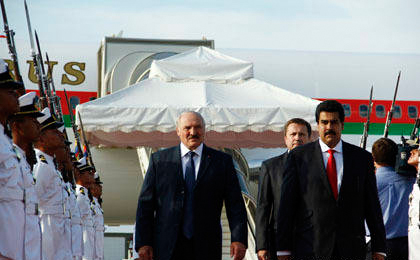
lukashenko with maduro 300x185 In Case You Missed It… Articles Roundup Week of 6/29/12

Courtesy of: El Universal

This week: With the Venezuelan presidential election campaign to officially start this Sunday, a new poll shows that Hugo Chávez holds only a slight lead over opposition candidate Henrique Capriles; Chávez claims that he has completed his cancer treatments; the opposition criticizes Chávez for his mandatory national broadcasts during the campaign; the television station Globovision, known for its refusal to kowtow to PSUV propaganda, is in danger of being closed after the Venezuelan Supreme Court freezes its assets. Meanwhile, the presidents of Iran and Belarus visit Chávez to strengthen ties between their countries; falling oil prices lead a cash-strapped Venezuela to lobby OPEC for controls on the price of oil; and controversy continues over the decision not to make a voting center available to Venezuelans in Miami, a decision which has led some expatriate Venezuelans to plan to file a complaint against Chávez before the International Criminal Court.

Venezuela poll shows tight race for Chavez, Reuters

A new poll shows Venezuelan President Hugo Chavez only slightly ahead of challenger Henrique Capriles in the October 7 presidential election, welcome news for the opposition following numerous surveys showing Chavez with a wide lead.

Venezuela’s Chavez sees no more cancer treatment on horizon, The Chicago Tribune

Venezuelan President Hugo Chavez said on Tuesday he sees no need for further treatment for the cancer that struck him last year just weeks after he had said medical tests showed him in good health.

Venezuela opposition presidential hopeful says Chavez’s on-air talks should be limited, The Washington Post

Venezuelan presidential candidate Henrique Capriles is demanding election officials prevent President Hugo Chavez from taking over the airwaves of the nation’s TV and radio stations for lengthy speeches while campaigning for re-election.

Venezuela court orders embargo on channel’s assets, CBS Money Watch

Venezuela’s Supreme Court on Thursday ordered an embargo on nearly $5.7 million in assets belonging to a television channel that takes a critical line against President Hugo Chavez’s government.

Lukashenko starts visit to Venezuela to strengthen cooperation, El Universal

Alexander Lukashenko, the president of Belarus, arrived Monday in Caracas to meet with President Hugo Chávez as part of his tour of Latin America.

Venezuela’s Chavez hosts close ally Ahmadinejad, AFP

Venezuelan President Hugo Chavez and his Iranian counterpart Mahmoud Ahmadinejad pledged Friday to stand together to battle “imperialism,” with Chavez criticizing tough sanctions on Tehran.

Chavez: Drop in oil price will not stop Venezuela development , Fox News Latino

President Hugo Chavez said Monday that the drop in oil prices will not affect government plans for Venezuelan development.

Exclusive: Venezuela wants OPEC price band restored, Reuters

Venezuela wants OPEC to restore an oil price band, with a range of between $80 and $120 a barrel, to control global market volatility, Energy Minister Rafael Ramirez told Reuters.

87% of Venezuelans living in Miami prepares to vote in Louisiana, El Universal

Pedro Mena, executive director of opposition Unified Democratic Panel (MUD) in Miami, State of Florida, is certain that 87% of Venezuelan residents in Miami will head for the Consulate of New Orleans to cast their ballot in the presidential election of next October 7.

Dissenters to sue Chávez at the International Criminal Court, El Universal

Venezuelan dissenters living in Miami on Wednesday described as a “crime against humanity” President Hugo Chávez’s decision to close Venezuela’s consulate in Florida, and said they are going to file a lawsuit against the Venezuelan president at the International Criminal Court in The Hague.

 
May
25
2012
Posted by
admin
Comments

New State Department Report Details Human Rights Violations in Venezuela

The U.S. State Department has released its annual assessment of human rights practices throughout the world. For Venezuelans, the news is far from encouraging, as the report details a variety of human rights violations that occurred in the country during the past year. Coincidentally, the new report was released just weeks after president Hugo Chávez announced his intention to withdraw from the OAS’s Inter-American Human Rights Commission, and only days following the resolution of three weeks of fighting between prisoners and the military at a Caracas jail.

Leading the report is the continued concentration of power in Hugo Chávez’s executive branch. After the last Venezuelan elections, the National Assembly gave Chávez the power to rule by edict for 18 months. Although those powers were ostensibly intended to allow the president to respond swiftly to a state of emergency created by flooding, he instead used it to pass 26 decrees, including broad-reaching laws restricting the rights of labor unions, enacting new labor regulations, and restricting property rights, all without the approval of Venezuela’s National Assembly.

The report also provides clear evidence that the judicial branch is effectively controlled by the Chávez administration, and that Chávez has used the courts to consolidate his hold on power and intimidate his opposition. The report states that “[t]he government used the judiciary to intimidate and selectively prosecute political, union, business, and civil society leaders who were critical of government policies or actions.” This echoes the recent allegations of former Supreme Court judge Eladio Aponte Aponte, who has said that judges and court decisions were manipulated by Chávez, through his vice president Elías Jaua. According to the report, the TSJ (the Venezuelan Supreme Court) rejected 93 percent of cases against the top officials of the Venezuelan government and legal actions against Chávez.

The report also notes widespread corruption within the government.

The State Department also observes that the Chávez government has continually restricted the press and Venezuelans right to self-expression. On multiple occasions, the government has censored press and intimidated journalists who do not support the administration’s goals. For example, the television station RCTV was forced off the air for broadcasting criticism of Chávez. The censorship spreads to the online world as well: last week, readers reported a block of the website of the popular newspaper La Patilla.

The State Department report also noted the extensive human rights violations in the Venezuelan prison system, a fact which many around the world are already aware of thanks to the recent violent standoff at the La Planta prison. Due to overcrowding and corruption in Venezuela’s prisons, which are effectively run by gangs instead of the government, jails teem with violence and drugs. The violence at La Planta became so serious, in fact, that the Venezuelan National Guard had to be brought in to quell the situation.

In addition, the report also notes that NGOs and many in the media have reported that the government is responsible for or complicit in unlawful killings, corruption and impunity in police forces, violence against women, anti-Semitism in the official media, and trafficking in persons.

Given the heavy criticism that is sure to emerge in the run up to the approaching elections, as well and the real challenge Chávez will face at the polls, don’t expect these allegations to go away anytime soon.