Sep
4
2013
Posted by
admin
Comments

ICYMI: Blackouts Hit Nearly Half of Venezuela

Wall Street Journal
September 3, 2013
By Kejal Vyas
ALeqM5jqwUQc1j zylZx6VRZj8nU HvGvQ e1378316807289 ICYMI: Blackouts Hit Nearly Half of Venezuela

Courtesy of: AFP

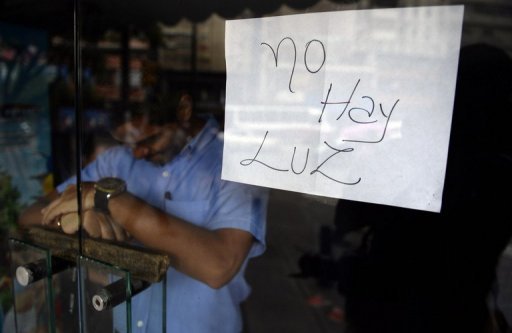
CARACAS—A failure in a transmission line cut power across much of Venezuela on Tuesday, leading the government to blame unidentified saboteurs for the widespread disruption.

Electricity outages struck parts of at least 11 of Venezuela’s 23 states in the early afternoon, mostly in the central and western regions, as well as the capital city, Electricity Development Vice Minister Franco Silva said in comments carried on state television.

Information Minister Delcy Rodríguez said in an address about five hours after the initial outage that power had been restored to several states, adding electricity was in the process of coming back online in the oil-rich western states of Zulia and Táchira, and the greater Caracas area.

A shaky power grid remains a thorn in the side of energy-rich Venezuela, leading critics of the current government to point the finger at mismanagement at state-run utility companies. Authorities have periodically turned to power rationing and levied additional surcharges and penalties on heavy electricity users.

Ms. Rodríguez said “complete restoration of this important service will be done in a progressive manner” without specifying how long it would take.

Messages posted on the Twitter account of President Nicolás Maduro said that the power grid was attacked by unnamed enemies of the government.

“It’s evident that behind [the blackout] is the hand of those that want to weaken our country,” said one post. Mr. Maduro didn’t offer evidence to back up his allegations. Calls seeking further comment from officials weren’t immediately returned.

While the government’s detractors accuse authorities of misappropriating investments into the country’s electricity network and falling behind growing consumer demand, the late leader Hugo Chávez often blamed conspirators against his self-styled socialist “Bolivarian revolution.” Mr. Chávez died in March following a nearly two year battle with cancer. Mr. Chávez nationalized much of the electricity sector in 2007.

In recent weeks, his successor Mr. Maduro has disclosed details of various other alleged plots against Venezuela, including several alleged assassination attempts against his life supposedly masterminded by agents of the U.S. and Colombian governments. Critics accuse him of fabricating plots in a bid to boost support.

Venezuela opposition leader Henrique Capriles, who lost April elections to replace Mr. Chávez, said the power failure underscored mismanagement at state companies. “The blackout today demonstrates one more time the terrible incapacity of this government,” Mr. Capriles said in a post on his official Twitter account. “Now they’ll come up with another story to try to cover up the failure.”

In Caracas, the blackouts briefly hit some key government buildings, including the Energy Ministry, which is also the headquarters of state oil company Petróleos de Venezuela, or PdVSA.

In a statement, Oil Minister Rafael Ramírez said refining and production operations in Venezuela’s vital oil industry were unaffected.

The sprawling capital city was furthered tangled by knotted traffic, disrupted subway service and severed water supplies, as several treatment plants went down, authorities said. Power shortfalls and outages are more common in the interior of the country of 29 million residents, while more rarely reaching Caracas.

Between 2009 and 2010, a drought cut production at Venezuela’s hydroelectric facilities that accounted for some 70% of the country’s power. The country has since had to divert more of its crude oil production and imports gas from Colombia to fulfill its own domestic power needs.

To read this article at The Wall Street Journal, please click here.
 
Jun
18
2013
Posted by
admin
Comments

ICYMI: Breast-feeding is best, so ban bottles, Venezuelan lawmaker proposes

CNN
June 18, 2013
By Catherine E. Shoichet

population e1371580976192 ICYMI: Breast feeding is best, so ban bottles, Venezuelan lawmaker proposes

Courtesy of: Reuters

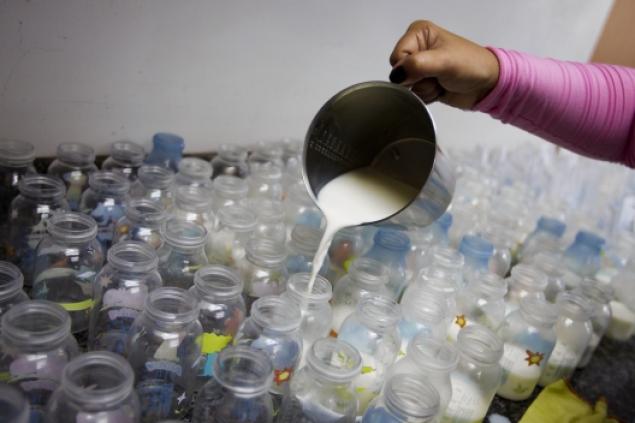
Venezuelan lawmakers are weighing whether to ban the use of baby bottles as part of a push to promote breast-feeding, state media reported.

The proposed measure will be up for debate in the South American country’s National Assembly on Tuesday, lawmaker Odalis Monzon said in an interview with state-run VTV.

“Every baby has the right to breast-feeding,” said Monzon, a lawmaker from the ruling United Socialist Party of Venezuela.

In addition to banning bottle-feeding, the proposed revisions to Venezuela’s Law of Promotion and Protection of Breastfeeding also include plans to penalize those who advertise baby formula, she said.

Transnational companies that market formula, she said, have interfered with a crucial bond between mother and child.

“The most important is the love, the connection between mother and child, that sometimes is lost because they do not give them the warmth that nursing a baby provides,” Monzon told VTV.

The proposal includes exceptions for mothers who cannot breast-feed due to illness, Monzon said. It would also provide for the creation of more breast-milk banks and require companies to set aside space for mothers to nurse.

She did not provide details about how authorities would enforce the measure if it passes, or what sorts of punishments violators would face.

The measure has drawn sharp criticism from some lawmakers, who argue that the government can promote breast-feeding without prohibiting anything, CNN affiliate Globovision reported.

“This is unacceptable and alarming,” said Eduardo Marin, a lawmaker for the opposition Justice First party.

The 2007 law that Monzon is pushing to amend was aimed at promoting breast-feeding, Marin said, not “questioning, stigmatizing and practically criminalizing those who have opted for (other methods) of feeding.”

Earlier this month, Venezuela’s Health Ministry said that 27.1% of mothers in the country who are able to breast-feed actually do so and that officials aimed to increase that number to 70% by 2019,VTV reported.

To read this article at CNN, please click here.

 
Jun
14
2013
Posted by
admin
Comments

As Venezuelans Struggle to Find Food, Maduro to Receive UN Award for Food Production

WO AN794 VENEZU G 20130516180502 e1371227734904 As Venezuelans Struggle to Find Food, Maduro to Receive UN Award for Food Production

Courtesy of: Reuters

For months, What’s Next Venezuela and other major news outlets have been reporting on the rampant shortages plaguing Venezuela. In light of this reality, we and many others were stunned to learn this week that President Nicolás Maduro is expected to receive an award from the Food and Agriculture Organization of the United Nations (FAO) for the “progress” Venezuela has made in food-related matters. The irony is palpable; shortages in Venezuela are now so severe that Venezuelans have turned to a mobile app that helps them locate basic goods like milk and toilet paper.

Maduro’s troubling two months in office and record shortages have caused many, including Congresswoman Ileana Ros-Lehtinen, to wonder aloud whether the award is indeed justified. While the FAO argues advances have been made with regards to food development and consumption in Venezuela, the facts and figures beg to differ.

The Venezuelan Central Bank reported that shortages in May rose to 21.3 percent, its highest level in 64 months. In other words, two out of 10 products were not in stock in grocery stores and supermarkets. Furthermore, that same month Venezuelan consumer prices increased at a record pace after a devaluation of the currency pushed up the cost of imports. Prices climbed 6.1 percent from April, accelerating the annual inflation rate to a record-high 35.2 percent.

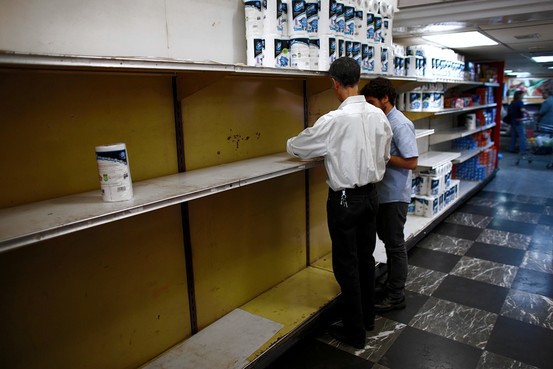
Price controls and foreign exchange restrictions in the import-dependent nation have triggered shortages in every sector of the Venezuelan economy. Basic food products such as chicken, milk, sugar and toilet paper have become an ordeal to find. Not even the Catholic Church has been exempt of the country’s growing scarcities. Wheat flour used for the sacramental wafers is scarce, while the supply of altar wine used for Holy Communion is threatened, likely forcing the Church to ration supplies.

Maduro’s only solution to the problem has been to blame Venezuelans for “overconsumption.” Such a charge stands in utter contrast to the scenes of hungry Venezuelans swarming a grocery truck when it finally arrived with the food they needed. Maduro, meanwhile, has responded by telling Venezuelans not to “panic” and to “regularize consumption,” accusing the public for the government’s failed policies.

Thus far, the free mobile application – which uses crowdsourcing to pinpoint areas that actually have basic necessities – has been the most successful solution for everyday Venezuelans.  After struggling to find milk, an enterprising 21-year-old Venezuelan student decided to develop the app, which has been downloaded over 12,000 times. In a country where citizens are forced to rely on their smart phones to find basic food products, the rationale behind this award is difficult to understand.