Apr
2
2013
Posted by
admin
Comments

ICYMI: Tough times ahead in post-Chavez Venezuela

The Associated Press
April 1, 2013
By Fabiola Sanchez

ijKok4dzw3DM e1364924737530 ICYMI: Tough times ahead in post Chavez Venezuela

Courtesy of: Bloomberg

CARACAS, Venezuela (AP) — Doing business in post-Hugo Chavez Venezuela is not for the faint of heart.

Thousands of companies suffer under currency controls that all but deny them the U.S. dollars they need to import vital items into this oil-rich country, from food to cars to spare parts — even gasoline. Venezuelan firms must sell their wares at state-controlled prices that don’t reflect the 22 percent inflation rate, the highest in Latin America. Even Venezuela’s socialist government admits the controls don’t work — but its attention is focused on the April 14 election to replace the late President Hugo Chavez.

It’s a largely improvised economic policy that, despite oil earnings, has turned people’s lives upside down and produced shortages of flour, coffee, butter and medicines. It’s also a mess that will immediately challenge whoever becomes the president of this 28 million-person country.

Jeni Suarez, a 51-year-old Caracas homemaker, experienced the crisis first hand after waiting three months for a colonoscopy at a public hospital. When she got there, doctors told her they needed new parts from abroad to perform the procedure, and the deliveries weren’t coming any time soon because the hospital didn’t get dollars from Venezuela’s government to buy them.

“I have an intense pain, and I don’t know what to do,” Suarez said after the appointment at Jose Maria Vargas Hospital.

Such economic headaches have, in fact, defined much of the late president’s legacy here.

Chavez imposed draconian currency controls a decade ago to punish business leaders who had mounted a crippling opposition strike. He was also trying to stem the flight of dollars abroad as political instability spooked investors.

“The policy of currency controls is very negative for the country and hasn’t met any of its objectives,” said Alejandro Grisanti, an analyst at investment bank Barclays Capital. “It hasn’t stopped capital flight. It hasn’t stopped inflation, (and) it has been very costly for the treasury.”

Neither Chavez successor Nicolas Maduro nor opposition candidate Gov. Henrique Capriles has delivered specific proposals to address the crisis, said Alejandro Gutierrez, an economics professor at the University of the Andes. The most effective solution would likely involve unpopular measures such as a mass devaluation of the currency to spur exports, or an end to price controls.

Capriles has spent much of the campaign trying to assure Chavistas he will not take away their government-funded social programs, while Maduro vows to continue the late leader’s legacy, which would include the controls.

“We are facing a transition situation, and they are going to wait until this situation is cleared up,” Gutierrez said Monday.

Only Capriles has suggested a possible way of injecting more dollars into the economy: Ending subsidized oil exports to Cuba that began under Chavez.

The late leader had aided his allies by providing oil at preferential terms to more than a dozen countries in Latin America and the Caribbean. Cuba receives Venezuelan oil worth around $3.2 billion a year, estimates Jorge Pinon, a University of Texas energy analyst. Nicaragua gets about $1.2 billion worth of oil, according to economist Nestor Avendano.

Yet whoever wins the vote won’t be able to put off action indefinitely. The wave of national mourning for Chavez and the heated campaign have so far masked the plight of dollar-poor food makers, dairy farmers, ranchers and auto manufacturers. But consumers are feeling the shortages of appliances, automobiles and staples such as flour, coffee, butter and medicines.

Venezuela’s automakers are operating at 50 percent capacity because they don’t have dollars needed for auto parts made abroad, according to Omar Bautista, president of a national carmakers group that includes Ford, General Motors and Mitsubishi. And foreign suppliers are hesitant to sell to Venezuela because they don’t know when or if they’ll be paid, Bautista said in remarks reported by Caracas’ El Universal newspaper.

“New (parts) shipments are being held back as long as we cannot honor these contracts,” Bautista said.

Even as Venezuelans fight for dollars, the country sits atop the world’s largest proven oil reserves, with those exports delivering nearly $1 trillion in revenues to the country since Chavez was elected in 1999.

Thanks to oil, Chavez’s government had invested $500 billion on social programs since 1999, according to Planning Minister Jorge Giordani. Venezuela’s poverty rate fell from 50 percent in 1999 to 32 percent in 2011 while unemployment dropped from 13 to 8 percent.

After the 2002-03 strike, Chavez began using the enormous influx of dollars as a political weapon, with the government selling businesses limited quantities of dollars at a rate that didn’t reflect the bolivar’s real black market value. The official rate is now about a quarter of what the dollar sells for on the black market.

At the same time, the government’s own dollar supply may be diminishing. Oil income trailed off from $5.6 billion in 2008 to $3.8 billion in 2012, partly because of slumps in production and refining. The government also spent heavily to re-elect Chavez in October and help Maduro’s candidacy after the president’s March 5 death, further squeezing the dollar supply to private businesses.

As long as government dollar sales are frozen, “foreign exporters are not going to start selling to us,” said Carlos Larrazabal, president of one of Venezuela’s largest business chambers. “We cannot understand how it can be that we have a country with an oil price of more than 100 dollars per barrel and we have this scarcity of currency.”

In a bid to inject some liquidity into the economy — and a tacit admission that the currency controls aren’t working — Maduro’s interim government held a one-day auction of $200 million last week.

Jorge Roig, vice president of the Fedecamaras business chamber, said the rules for bidders were late in coming, overly complicated and discouraged small and medium-size firms from participating. At least $1 billion more is needed to keep companies rolling, Roig told Caracas’ Union Radio on Wednesday.

The Venezuelan Association of Medical, Dental and Laboratory Equipment says its members collectively owe $300 million for past imports, which were suspended in November because they couldn’t pay.

“There are no test tubes to collect blood samples. There are no colostomy bags. No electrocardiogram paper. No X-ray plates,” said Anerlin Garcia, the group’s executive director.

Simon Nobile, president of the Venezuelan Association of Pasta Foods, says more dollars alone won’t help. The government also must raise its official prices on hundreds of products because they don’t reflect the effects of inflation, he said.

Eleven manufacturers in Nobile’s association employ 5,000 people but are close to shutting down because the price of pasta has been frozen for two years. The official selling price of 68 U.S. cents per kilogram (2.2 pounds) makes up only half the production cost, Nobile said. He said firings could happen at his company as early as April.

“If the government doesn’t make a decision,” he said, “this is the end.”

To read this article at Associated Press, please click here.
 
Mar
7
2013
Posted by
admin
Comments

ICYMI: Venezuela’s Economy Under Chavez, by the Numbers

Wall Street Journal
March 6, 2013
By Charles Roth

 ICYMI: Venezuela’s Economy Under Chavez, by the Numbers

Courtesy of: TalCual

Many Venezuelans, mainly among the poor, are intensely mourning the passing Tuesday of President Hugo Chávez, whom they viewed as their “champion”, a father figure who after 14 years in power is taking on near saint-like meaning for them.

In their name, the charismatic Mr. Chávez implemented what he called “21-Century Socialism,” which in practice involved nationalization of broad swaths of the economy, especially in “strategic sectors” such as all the important oil industry — Venezuela sits atop the world’s largest oil deposits — telecommunications and power. He expropriated more than 1,000 businesses, sundry farmlands and urban properties, often without compensation, arguing that the seizures were justified either because the owners were in various ways corrupt or the seizures would improve the lots of the poor, usually both. In the process, he engaged in class warfare, demonizing the country’s middle- and upper classes as the “Squalid Ones.”

In his push to build a socialist system Mr. Chávez — who had Venezuela’s armed forces adopt the motto, “Country, Socialism or Death” — greatly ramped up government spending off the back of historically high oil revenues and a massive increase in national external debt, which went from around $28 billion during his first year in power to around $90 billion currently. Much spending has gone into subsidized food, housing, health, education and other welfare programs that have no doubt to varying degrees benefited the poor.

But a look at the available data — and it’s limited, as Venezuela hasn’t held an Article IV consultation with the International Monetary Fund in 87 months and has stopped reporting a number of standard indicators — the economy hasn’t exactly produced a socialist paradise.

Heavy government spending has fueled rampant inflation, which averaged an annual 22% during Mr. Chávez’s tenure. Its anticapitalist rhetoric and broad state intervention into the economy have led to a dearth of investment. Gross fixed capital formation declined to 18% of gross domestic product in 2011, from 24% in 1999, according to the World Bank. Net inflows of foreign direct investment stood at 2.9% of GDP during that same year, his first in office, nearly double the 1.7% in 2011. Capital flight from Venezuela intensified as Mr. Chávez pursued more interventionist policies, including capital controls and a fixed official exchange rate that — if you can get it — offers dollars at a quarter of the exchange rate that the greenback fetches in the black market. Stock market capitalization of companies listed on the Caracas Stock Exchange has gone from a paltry 7.6% of GDP in 1999 to a minuscule 1.6%.

Rather than pursue policies that might stimulate investment, the government’s response to shrinking productive capacity and high inflation has been price caps. The result? Shortages of food and other basic necessities, periodic electric brown- and blackouts, and far fewer jobs: the labor force participation rate has dropped from 52% to 46% in the Chávez era.

In countries less blessed with natural resources, Mr. Chávez might have been forced to be more welcoming of private-sector investment. But Venezuela’s oil bounty permitted his pursuit of highly unorthodox policies and inefficient use of resources. Yet not without cost to its oil industry.

Venezuela’s oil production has fallen to around 2.5 million barrels a day from about 3.2 million, according to most industry estimates. Downstream refinery accidents have increased sharply amid a lack of investment and upkeep, with one last year at the Amuay complex proving among the most deadly the energy industry has seen. Energy-rich Venezuela has since been importing more fuels. Still, prices for the country’s crude have risen about 10-fold during Mr. Chávez’s time in office, enabling him to borrow and spend aggressively.

That has helped the economy grow, albeit at a lackluster annual average of 3% since 1999. GDP per capita rose to an estimated $11,131 last year, from $4,132 in 1999, according to the IMF, but there are no data available on income distribution, which by all accounts still displays high disparities among the population. Venezuela is also now far more dependent on oil revenues that it was when Chávez first took office: Oil now accounts for about 95% of all exports, compared to about 80% in 1999, and represents nearly two-thirds of fiscal revenue, versus about half 14 years ago.

It’s well known that inflation and basic necessity shortages hit the poor the hardest, as does crime, which has skyrocketed in Venezuela. According to InSight Crime, an American University-sponsored think tank in Washington DC, the country has seen a sharp rise in violence, “with murder rates doubling or tripling over a decade, according to different figures.” For the first time in several years, the government reported homicide data, noting over 16,000 murders last year. But the Venezuelan Observatory of Violence, a local non-government organization that tracks crime, put the number at nearly 21,700, for a national homicide rate of 73 per 100,000, more than double the 31 per 100,000 in Colombia, which is fighting two guerilla insurgencies.

It remains to be seen whether the next government will be able to manage the economic distortions and social problems that continue to plague Venezuelans. Snap elections must be called within a month, Mr. Chávez’s vice president, Nicolás Maduro, is expected to win.

“Vice-President Maduro is perceived as close to the Cuban regime and committed to the revolutionary ideals spearheaded by President Chávez,” wrote Goldman Sachs economist Alberto Ramos in a research note. “However, like virtually every other senior figure of Chavismo, Mr. Maduro lacks the charisma and broad popular support enjoyed by President Chávez.”

Mr. Maduro has vowed to maintain the “revolutionary” policies of Mr. Chávez. Given the many economic and social challenges facing Venezuela’s poor, it remains to be seen whether populism alone will, from now on, be enough.

To read this article at the Wall Street Journal, please click here.

 
Feb
25
2013
Posted by
admin
Comments

ICYMI: Living through Venezuela’s currency madness

Foreign Policy
February 22, 2013
By Juan Nagel

devaluation electronics edited 0 e1361823011751 ICYMI: Living through Venezuelas currency madness

Courtesy of: Agence France Presse

The U.S. dollar is facing competition from other currencies, but there is still one place, ironically, where the greenback is king: the streets of socialist, anti-imperialist Caracas. Everyone here wants dollars — from the importer looking to stay in business, to the mid-level professional wanting to save his Christmas bonus.

Venezuela has had a fixed exchange rate of 4.3 Bolivars (BsF) per dollar for years. By selling dollars in exchange for so few Bolivars, the local currency was severely overvalued. Propped up by oil exports (hence the term “petrodollars”), the government was effectively subsidizing imports and travel abroad. A few weeks ago, the government decided to devalue to 6.3 BsF per dollar.

But devaluation was not the only thing rocking the market. The official dollar is only available for procurement if you are buying some imports — food, medicine, airplane tickets, and the like. You can’t get them unless it’s for one of those approved purposes, leaving out many people who need them. The artificially low prices, combined with the scarcity of dollars, creates the perfect opportunity for a black market where you can buy USD at the official rate, and then sell them underhandedly at a jacked-up price for an easy profit. In the last few weeks, following the devaluation, the price of the dollar in the black market has shot up to BsF 22 per dollar, up from BsF 18 the week prior to devaluation.

Stroll through the streets of this chaotic capital, and it is not difficult to figure out how both of these events are affecting people.

I stop by a local café and order some breakfast. The owner, Aída, in her mid-50s, is in a mood to talk. She says that she doesn’t have “pastelitos,” a local pastry, because she cannot find the flour to make them. Flour, you see, is imported, and given the differential between official and black market rates, flour vendors would rather take their subsidized dollars and make money by selling them in the black market instead of using them to buy the flour they’re intended for.  Economists I’ve spoken with estimate that roughly 50 percent of the dollars approved to import basic staples end up in the black market instead.

I ask Aída if there is a black market for flour. She says she doesn’t know of any. The price of flour is controlled, so flour vendors can’t really use the black market for dollars to import flour and sell it a profit. The end result is that Aída, like thousands of other small business people, can’t sell her pastelitos. The flour is simply not there.

Devaluation supposedly means that flour prices will have to go up, as local businesses have to pass the cost increase to their customers, but the government has already signaled that prices will remain fixed. It may be weeks before flour is on the shelves again. And even if it is, there is no guarantee that the government will allow Aída to transfer the increase in the cost of flour to her customers.

Everyone who imports something has been affected. Everything from the wrappers that you use to store potato chips to the metal linings you put on the coffins you sell is affected by the government’s decision. Vendors lucky enough not to be under the government’s magnifying glass are simply jacking up prices to reflect the black market rate. Some furniture vendors, for example, will quote prices in dollars, and then will whip out a calculator to translate it to local currency at the day’s black market rate.

Ordinary chavistas say that devaluation doesn’t affect them since they do not use dollars. This, however, ignores the reality that the dollar plays in the distribution channel of most consumer goods in the country.

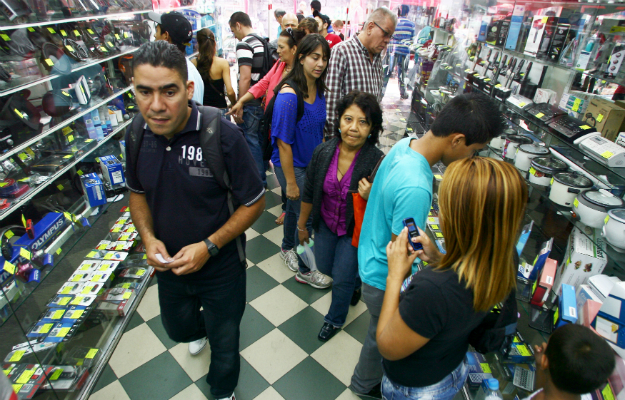
In effect, when the value of the U.S. dollar goes up compared to the BsF, what people are able to buy for their money (i.e. their wage value) goes down. The less ideologically pure are already seeing the effect of devaluation when they go to stores.(As seen in the photo above, Venezuelans are making a run to electronics stores, to buy what they can before already expensive goods become unaffordable.)

Using the black market, of course, is not an easy proposition. Selling small amounts revolves around people you trust — relatives, or friends. Selling dollars to people on the street could lead to a mugging or getting counterfeit money in return.

Finding dollars in small amounts is easier than finding them in large quantities. Multinational companies wishing to repatriate dividends, for example, have a difficult time finding people willing to sell large amounts of dollars. There are stories of “shadow traders,” companies who are able to illegally exchange large amounts of dollars at the black market rate via a complicated scheme of international transfers. Local economists say that the supply of those dollars comes from two main sources: importers with access to official dollars, and the government itself.

The dollar may be losing luster in other parts of the world, but in Venezuela it remains the benchmark for price-setting and the preferred means to store wealth. Here, green still rules.

To read this article at Foreign Policy, please click here.