Jun
11
2013
Posted by
admin
Comments

ICYMI: Looking for toilet paper in Venezuela? There’s an app for that

Financial Times
June 10, 2013
By Benedict Mander

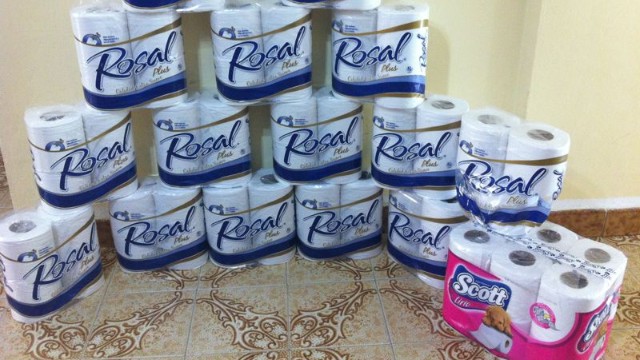
venezuela toilet paper reuters 1200 ICYMI: Looking for toilet paper in Venezuela? There’s an app for that

Courtesy of: Reuters

It turns out that President Nicolas Maduro thinks that the plan to introduce food rationing in Zulia, Venezuela’s most populous state, is “crazy”.

Regardless of whether he always thought that, or whether, perhaps, the increasingly unpopular president was responding to widespread rejection of the plan, he’s right – it is not the way to put an end to the problem of shortages that has become so acute that someone has even invented an app to help Venezuelans locate specific goods they are having difficulty finding.

Maduro was also right when he said that “the answer to our problems is to produce more”.

Let’s just forget for the moment that in saying this he was rather undermining the Zulia governor, Francisco Arias Cardenas, who had denied that the scheme even amounted to rationing in the first place, and that in fact it was aimed at preventing smuggling (if you wanted to do something about that, you probably wouldn’t produce more, but instead perhaps try and do something about the irresistible arbitrage opportunities in Colombia thanks to Venezuela’s price controls, or at the very least introduce stronger controls on the border).

Let’s also ignore the fact that the government has already put in place another rationing scheme in Zulia, for petrol, which by Maduro’s logic ought probably be pretty “crazy” too. Again, officials insist the idea is to prevent gasoline contraband, which is indeed rife in Zulia since it is magnificently profitable – some suggest it is an even bigger business in Venezuela than the cocaine trade.

In any case, increased production would certainly go a long way to solving Venezuela’s shortages problem. Ideally it would be an increase in the production of the goods that are scarce, especially food, but increased oil production might do too, as crude exports could provide the dollars needed to import more. This would probably be more practical in the shorter term, given the problems Venezuela has producing just about anything that is not oil (although that is not to say state oil company PDVSA does not have serious challenges of its own).

The problem is that, in the current conditions, Venezuelan businesses are unlikely to start producing much more. In order for this to happen, a lot needs to change: for starters, the business climate must improve, and that includes doing something about price and currency controls, something which Maduro has shown no signs of doing. And don’t expect state companies to pick up the slack – the government is even said to have seriously considered the offer of Venezuela’s largest private company, Polar, to help run underperforming state-owned food processing plants.

The app that aims to help Venezuela’s long-suffering shoppers, known as Abasteceme (or Supply Me) and which uses Google Maps and “crowdsourcing” to enable users to notify one another where a certain product is for sale, has so far only been downloaded 12,000 times. It is a scheme that promises to be infinitely more successful than Zulia’s still-born rationing plans.

To read this article at Financial Times, please click here.
 
May
16
2013
Posted by
admin
Comments

ICYMI: Venezuela is Running Out of Toilet Paper

Associated Press
May 16, 2013
By Fabiola Sanchez and Karl Ritter

130515171546 toilet paper caracas story top e1368722217422 ICYMI: Venezuela is Running Out of Toilet Paper

Courtesy of: CNN

CARACAS, Venezuela (AP) — First milk, butter, coffee and cornmeal ran short. Now Venezuela is running out of the most basic of necessities — toilet paper.

Blaming political opponents for the shortfall, as it does for other shortages, the embattled socialist government says it will import 50 million rolls to boost supplies.

That was little comfort to consumers struggling to find toilet paper on Wednesday.

“This is the last straw,” said Manuel Fagundes, a shopper hunting for tissue in downtown Caracas. “I’m 71 years old and this is the first time I’ve seen this.”

One supermarket visited by The Associated Press in the capital on Wednesday was out of toilet paper. Another had just received a fresh batch, and it quickly filled up with shoppers as the word spread.

“I’ve been looking for it for two weeks,” said Cristina Ramos. “I was told that they had some here and now I’m in line.”

Economists say Venezuela’s shortages stem from price controls meant to make basic goods available to the poorest parts of society and the government’s controls on foreign currency.

“State-controlled prices — prices that are set below market-clearing price — always result in shortages. The shortage problem will only get worse, as it did over the years in the Soviet Union,” said Steve Hanke, professor of economics at Johns Hopkins University.

President Nicolas Maduro, who was selected by the dying Hugo Chavez to carry on his “Bolivarian revolution,” claims that anti-government forces, including the private sector, are causing the shortages in an effort to destabilize the country.

The government this week announced it would import 760,000 tons of food and 50 million rolls of toilet paper.

Commerce Minister Alejandro Fleming blamed the shortage of toilet tissue on “excessive demand” built up as a result of “a media campaign that has been generated to disrupt the country.”

“The revolution will bring the country the equivalent of 50 million rolls of toilet paper,” he was quoted as saying Tuesday by state news agency AVN. “We are going to saturate the market so that our people calm down.”

Finance Minister Nelson Merentes said the government was also addressing the lack of foreign currency, which has resulted in the suspension of foreign supplies of raw materials, equipment and spare parts to Venezuelan companies, disrupting their production.

“We are making progress … we have to work very hard,” Merentes told reporters Wednesday.

Many factories operate at half capacity because the currency controls make it hard for them to pay for imported parts and materials. Business leaders say some companies verge on bankruptcy because they cannot extend lines of credit with foreign suppliers.

Merentes said the government had met the U.S. dollar requests of some 1,500 small- and medium-sized companies facing supply problems, and was reviewing requests from a similar number of larger companies.

Chavez imposed currency controls a decade ago trying to stem capital flight as his government expropriated large land parcels and dozens of businesses.

Anointed by Chavez as his successor before the president died from cancer, Maduro won a close presidential election April 14 against opposition candidate Henrique Capriles, who refused to accept the result, claiming Maduro won through fraud and voter intimidation. He filed a complaint to the Supreme Court, asking for the vote to be annulled, though that’s highly unlikely to happen since the court is packed with government-friendly justices.

Patience is wearing thin among consumers who face shortages and long lines at supermarkets and pharmacies. Last month, Venezuela’s scarcity index reached its highest level since 2009, while the 12-month inflation rate has risen to nearly 30 percent. Shoppers often spend several days looking for basic items, and stock up when they find them.

Fleming, the commerce minister, said monthly consumption of toilet paper was normally 125 million rolls, but that current demand “leads us to think that 40 million more are required.”

“We will bring in 50 million to show those groups that they won’t make us bow down,” he said.

To read this article at Associated Press, please click here.

 
May
13
2013
Posted by
admin
Comments

With the Economy in Dire Straits, Maduro Scapegoats a Beloved Venezuelan Company

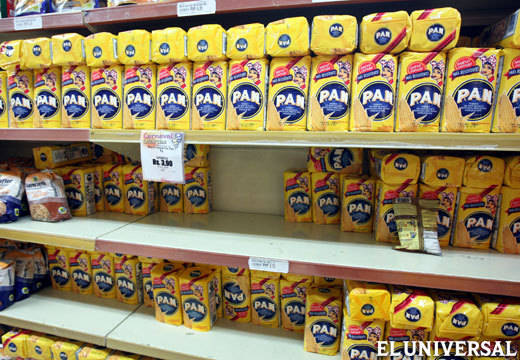
pan0.jpg.520.360.thumb  e1368469039817 With the Economy in Dire Straits, Maduro Scapegoats a Beloved Venezuelan Company

Courtesy of: El Universal

Nicolás Maduro and his socialist government cannot claim that they were not warned. Economists have long predicted that a Venezuelan economy propped up by excessive borrowing and an unsustainably high oil market would collapse spectacularly. Hugo Chávez, his cancer kept at bay just long enough to secure reelection, spent enough borrowed money in his final months to postpone the crash until Maduro had taken control. But the reckoning was inevitable. Now Maduro, eager for a scapegoat, is intensifying his attacks on the private sector, taking aim at Venezuelans’ most beloved company: Empresas Polar.

Polar is a pillar of the Venezuelan economy, producing staple goods from cornflour to household supplies and the nation’s most popular beer. Maduro issued his latest threat against the company on Saturday, when he accused the company of economic “sabotage” and demanded company President Lorenzo Mendoza to appear before the government to “explain the situation.” It was the latest in a series of escalating rhetoric against Polar, and a disturbing sign that Maduro refuses to learn the lessons inflicted on Venezuelans by years of failed socialist policies. Mendoza is scheduled meet with Vice-president Jorge Arreaza on Monday and with Maduro on Tuesday.

In a press conference held on Monday before the scheduled meetings, Mendoza addressed Maduro’s statements. He noted that Polar’s cornflour brand, PAN, operates at 100 percent capacity, but has only a 48 percent stake in the Venezuelan market, making it impossible to meet the country’s full demand. Thus far this year, Polar has produced 10 percent – 15,000 tons – more than last year. The remaining 52 percent of the market is comprised primarily of government-owned businesses, which are producing at less than 40 percent of their capacity. In response to Maduro’s accusation of “hoarding,” Mendoza stressed that Polar simply cannot hoard products to begin with since every step of the production and distribution process is regulated by government overseers.

As economists have noted, the shortages and inflation Maduro blames on the private sector are in fact caused by the government’s own policies. Rampant expropriations, price controls and other heavy-handed policies have harmed business and left farmland idle, sapping more than 11 percent from the country’s gross domestic product between 2005 and 2010.

Inflation is soaring, the nation’s debt continues to mount, and a currency devaluation has crippled Venezuelan’s purchasing power. As What’s Next contributor Joel Hirst observed, the economic crisis has left Maduro in the “awkward position of blaming Venezuela’s hobbled private sector for the failure of his own socialist policies.” The Central Bank’s scarcity index for Venezuela, which measures the percentage of goods unavailable in the market, rose to its highest number since it began tracking in April, 2009.

The facts, of course, could not be clearer. The company persevered under the yoke of Chávez’s policies, and continues to provide the goods Venezuelans need even as government controls force Polar and other companies to operate at a loss. These private companies are Venezuela’s best hope for brighter economic days; Maduro, in a desperate bid to save his own political skin, has chosen to marginalize them even further. It is ordinary Venezuelans, however, who will suffer the consequences.