Jun
5
2013
Posted by
admin
Comments

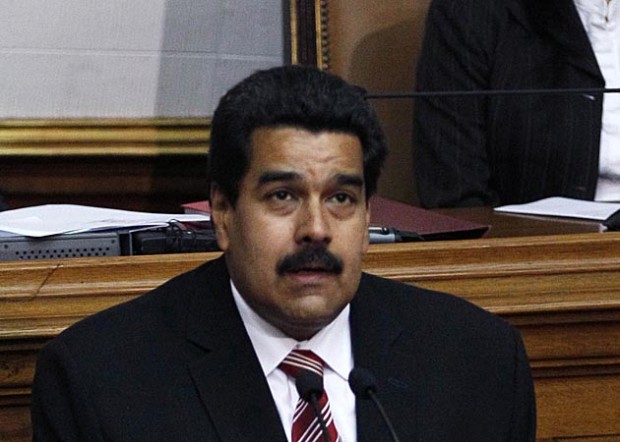
Nicolas Maduro’s Embarrassing Week

Nicolas Maduro1 620x442 e1370466156876 Nicolas Maduro’s Embarrassing Week

Courtesy of: Associated Prses

The presidency of former bus driver Nicolás Maduro began inauspiciously, his government using intimidation and threats to consolidate power.  Now, two months after he claimed victory in an election fraught by irregularities, things have only gotten worse for Maduro. The aftermath of Venezuela’s election controversy have caused Maduro to lose support and popularity among his own people. And as violence and a sinking economy continue to take their toll on Venezuelans, Maduro is now coming face-to-face with the consequences of years of Chávez’s failed socialist policies.

Maduro reacted like a spurned child when news emerged that opposition leader Henrique Capriles had traveled to Colombia and had been received there by President Juan Manuel Santos. As Venezuela’s socialist policies have kept the country in economic squalor, Colombia is one of Latin America’s success stories, and a strong U.S. ally in the region. Capriles met with President Santos, along with members of the Colombian parliament, where the leaders discussed Venezuela’s narrow presidential election along with the country’s dire economic situation.

“We are taking the voice of millions of Venezuelans beyond our borders,” Capriles said in Colombia. “The fight for democracy has to be everyone’s fight.” Indeed, news emerged this week that voter rolls indicate that deceased Venezuelans had “voted” in recent elections – the latest in a series of disturbing revelations about the state of democracy in Venezuela.

Economically, the situation is perilous and getting worse. With inflation near 30 percent and Venezuelans struggling to find basic goods like toilet paper, the country’s economy is heading for a recession sure to make matters worse. The Venezuelan government plans to institute restrictions on the sale of 20 basic items subject to price controls in Zulia, the country’s most populous state. Starting next week, the state will issue computer chip cards that will limit consumer purchases of certain products. Though the government has spun the move as a fight against contraband on the Colombian border, it is another clear sign that Venezuela’s shortages are worsening.

Meanwhile Venezuela’s bonds have bottomed out; Moody’s now rates them as junk status, a sign that the financial community has lost faith in Maduro’s government.

Indeed, criticism from the international community and from watchdogs continues to ratchet up. The meeting between President Santos and Capriles embarrassed Maduro on the world stage; the shootings of two U.S. embassy officials only further underscored the dreadful violence that plagues Venezuela. Desperate to quell the concerns of the international community, Venezuela has requested a meeting with top U.S. Diplomat John Kerry. Kerry will meet with Foreign Minster Elías Jaua at the ongoing Organization of American States General Assembly session in Guatemala. The meeting – the first at the cabinet level between the nations in several years – will explore ways to improve fractured relations between the two nations.

The only hope for Venezuela’s economy and her people lies in moderation, yet the signs often point in the opposite direction. Maduro has grasped for scapegoats, blaming Venezuela’s scant remaining private industry for the problems caused by the government. Venezuela’s last independent television station, Globovisión, was recently purchased by a group of businessmen with ties to the country’s ruling party. Now, as if on cue, the station has pledged to curb criticism of the government on its airwaves.

With Venezuela’s media already almost entirely controlled by the government, Globivision represented the last semblance of free media in the country. Its sale “appears to represent a new extension of the Venezuelan government’s control over broadcast media,” write Latin America experts Hugo Pérez Hernáiz and David Smilde.

All in all: it paints an embarrassing picture for Venezuela’s new president. Lacking in legitimacy before the international community and his own people, his government unable to reverse the economic calamity it caused, Nicolas Maduro’s first months in office started poorly, and have only gotten worse. And the Venezuelan people are feeling the consequences.
 
May
13
2013
Posted by
admin
Comments

With the Economy in Dire Straits, Maduro Scapegoats a Beloved Venezuelan Company

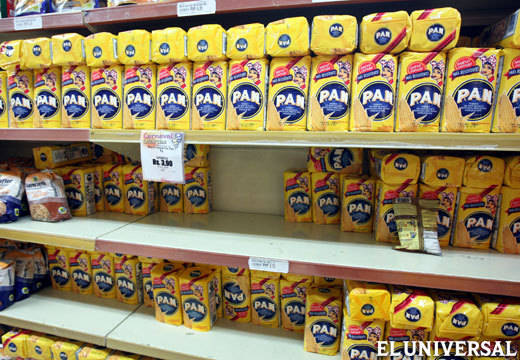
pan0.jpg.520.360.thumb  e1368469039817 With the Economy in Dire Straits, Maduro Scapegoats a Beloved Venezuelan Company

Courtesy of: El Universal

Nicolás Maduro and his socialist government cannot claim that they were not warned. Economists have long predicted that a Venezuelan economy propped up by excessive borrowing and an unsustainably high oil market would collapse spectacularly. Hugo Chávez, his cancer kept at bay just long enough to secure reelection, spent enough borrowed money in his final months to postpone the crash until Maduro had taken control. But the reckoning was inevitable. Now Maduro, eager for a scapegoat, is intensifying his attacks on the private sector, taking aim at Venezuelans’ most beloved company: Empresas Polar.

Polar is a pillar of the Venezuelan economy, producing staple goods from cornflour to household supplies and the nation’s most popular beer. Maduro issued his latest threat against the company on Saturday, when he accused the company of economic “sabotage” and demanded company President Lorenzo Mendoza to appear before the government to “explain the situation.” It was the latest in a series of escalating rhetoric against Polar, and a disturbing sign that Maduro refuses to learn the lessons inflicted on Venezuelans by years of failed socialist policies. Mendoza is scheduled meet with Vice-president Jorge Arreaza on Monday and with Maduro on Tuesday.

In a press conference held on Monday before the scheduled meetings, Mendoza addressed Maduro’s statements. He noted that Polar’s cornflour brand, PAN, operates at 100 percent capacity, but has only a 48 percent stake in the Venezuelan market, making it impossible to meet the country’s full demand. Thus far this year, Polar has produced 10 percent – 15,000 tons – more than last year. The remaining 52 percent of the market is comprised primarily of government-owned businesses, which are producing at less than 40 percent of their capacity. In response to Maduro’s accusation of “hoarding,” Mendoza stressed that Polar simply cannot hoard products to begin with since every step of the production and distribution process is regulated by government overseers.

As economists have noted, the shortages and inflation Maduro blames on the private sector are in fact caused by the government’s own policies. Rampant expropriations, price controls and other heavy-handed policies have harmed business and left farmland idle, sapping more than 11 percent from the country’s gross domestic product between 2005 and 2010.

Inflation is soaring, the nation’s debt continues to mount, and a currency devaluation has crippled Venezuelan’s purchasing power. As What’s Next contributor Joel Hirst observed, the economic crisis has left Maduro in the “awkward position of blaming Venezuela’s hobbled private sector for the failure of his own socialist policies.” The Central Bank’s scarcity index for Venezuela, which measures the percentage of goods unavailable in the market, rose to its highest number since it began tracking in April, 2009.

The facts, of course, could not be clearer. The company persevered under the yoke of Chávez’s policies, and continues to provide the goods Venezuelans need even as government controls force Polar and other companies to operate at a loss. These private companies are Venezuela’s best hope for brighter economic days; Maduro, in a desperate bid to save his own political skin, has chosen to marginalize them even further. It is ordinary Venezuelans, however, who will suffer the consequences.

 
Apr
2
2013
Posted by
admin
Comments

ICYMI: Tough times ahead in post-Chavez Venezuela

The Associated Press
April 1, 2013
By Fabiola Sanchez

ijKok4dzw3DM e1364924737530 ICYMI: Tough times ahead in post Chavez Venezuela

Courtesy of: Bloomberg

CARACAS, Venezuela (AP) — Doing business in post-Hugo Chavez Venezuela is not for the faint of heart.

Thousands of companies suffer under currency controls that all but deny them the U.S. dollars they need to import vital items into this oil-rich country, from food to cars to spare parts — even gasoline. Venezuelan firms must sell their wares at state-controlled prices that don’t reflect the 22 percent inflation rate, the highest in Latin America. Even Venezuela’s socialist government admits the controls don’t work — but its attention is focused on the April 14 election to replace the late President Hugo Chavez.

It’s a largely improvised economic policy that, despite oil earnings, has turned people’s lives upside down and produced shortages of flour, coffee, butter and medicines. It’s also a mess that will immediately challenge whoever becomes the president of this 28 million-person country.

Jeni Suarez, a 51-year-old Caracas homemaker, experienced the crisis first hand after waiting three months for a colonoscopy at a public hospital. When she got there, doctors told her they needed new parts from abroad to perform the procedure, and the deliveries weren’t coming any time soon because the hospital didn’t get dollars from Venezuela’s government to buy them.

“I have an intense pain, and I don’t know what to do,” Suarez said after the appointment at Jose Maria Vargas Hospital.

Such economic headaches have, in fact, defined much of the late president’s legacy here.

Chavez imposed draconian currency controls a decade ago to punish business leaders who had mounted a crippling opposition strike. He was also trying to stem the flight of dollars abroad as political instability spooked investors.

“The policy of currency controls is very negative for the country and hasn’t met any of its objectives,” said Alejandro Grisanti, an analyst at investment bank Barclays Capital. “It hasn’t stopped capital flight. It hasn’t stopped inflation, (and) it has been very costly for the treasury.”

Neither Chavez successor Nicolas Maduro nor opposition candidate Gov. Henrique Capriles has delivered specific proposals to address the crisis, said Alejandro Gutierrez, an economics professor at the University of the Andes. The most effective solution would likely involve unpopular measures such as a mass devaluation of the currency to spur exports, or an end to price controls.

Capriles has spent much of the campaign trying to assure Chavistas he will not take away their government-funded social programs, while Maduro vows to continue the late leader’s legacy, which would include the controls.

“We are facing a transition situation, and they are going to wait until this situation is cleared up,” Gutierrez said Monday.

Only Capriles has suggested a possible way of injecting more dollars into the economy: Ending subsidized oil exports to Cuba that began under Chavez.

The late leader had aided his allies by providing oil at preferential terms to more than a dozen countries in Latin America and the Caribbean. Cuba receives Venezuelan oil worth around $3.2 billion a year, estimates Jorge Pinon, a University of Texas energy analyst. Nicaragua gets about $1.2 billion worth of oil, according to economist Nestor Avendano.

Yet whoever wins the vote won’t be able to put off action indefinitely. The wave of national mourning for Chavez and the heated campaign have so far masked the plight of dollar-poor food makers, dairy farmers, ranchers and auto manufacturers. But consumers are feeling the shortages of appliances, automobiles and staples such as flour, coffee, butter and medicines.

Venezuela’s automakers are operating at 50 percent capacity because they don’t have dollars needed for auto parts made abroad, according to Omar Bautista, president of a national carmakers group that includes Ford, General Motors and Mitsubishi. And foreign suppliers are hesitant to sell to Venezuela because they don’t know when or if they’ll be paid, Bautista said in remarks reported by Caracas’ El Universal newspaper.

“New (parts) shipments are being held back as long as we cannot honor these contracts,” Bautista said.

Even as Venezuelans fight for dollars, the country sits atop the world’s largest proven oil reserves, with those exports delivering nearly $1 trillion in revenues to the country since Chavez was elected in 1999.

Thanks to oil, Chavez’s government had invested $500 billion on social programs since 1999, according to Planning Minister Jorge Giordani. Venezuela’s poverty rate fell from 50 percent in 1999 to 32 percent in 2011 while unemployment dropped from 13 to 8 percent.

After the 2002-03 strike, Chavez began using the enormous influx of dollars as a political weapon, with the government selling businesses limited quantities of dollars at a rate that didn’t reflect the bolivar’s real black market value. The official rate is now about a quarter of what the dollar sells for on the black market.

At the same time, the government’s own dollar supply may be diminishing. Oil income trailed off from $5.6 billion in 2008 to $3.8 billion in 2012, partly because of slumps in production and refining. The government also spent heavily to re-elect Chavez in October and help Maduro’s candidacy after the president’s March 5 death, further squeezing the dollar supply to private businesses.

As long as government dollar sales are frozen, “foreign exporters are not going to start selling to us,” said Carlos Larrazabal, president of one of Venezuela’s largest business chambers. “We cannot understand how it can be that we have a country with an oil price of more than 100 dollars per barrel and we have this scarcity of currency.”

In a bid to inject some liquidity into the economy — and a tacit admission that the currency controls aren’t working — Maduro’s interim government held a one-day auction of $200 million last week.

Jorge Roig, vice president of the Fedecamaras business chamber, said the rules for bidders were late in coming, overly complicated and discouraged small and medium-size firms from participating. At least $1 billion more is needed to keep companies rolling, Roig told Caracas’ Union Radio on Wednesday.

The Venezuelan Association of Medical, Dental and Laboratory Equipment says its members collectively owe $300 million for past imports, which were suspended in November because they couldn’t pay.

“There are no test tubes to collect blood samples. There are no colostomy bags. No electrocardiogram paper. No X-ray plates,” said Anerlin Garcia, the group’s executive director.

Simon Nobile, president of the Venezuelan Association of Pasta Foods, says more dollars alone won’t help. The government also must raise its official prices on hundreds of products because they don’t reflect the effects of inflation, he said.

Eleven manufacturers in Nobile’s association employ 5,000 people but are close to shutting down because the price of pasta has been frozen for two years. The official selling price of 68 U.S. cents per kilogram (2.2 pounds) makes up only half the production cost, Nobile said. He said firings could happen at his company as early as April.

“If the government doesn’t make a decision,” he said, “this is the end.”

To read this article at Associated Press, please click here.