Oct
1
2013
Posted by
admin
Comments

ICYMI: With Accusations of Sabotage, Venezuela Expels 3 US Embassy Officials

The New York Times
September 30, 2013
By William Neuman
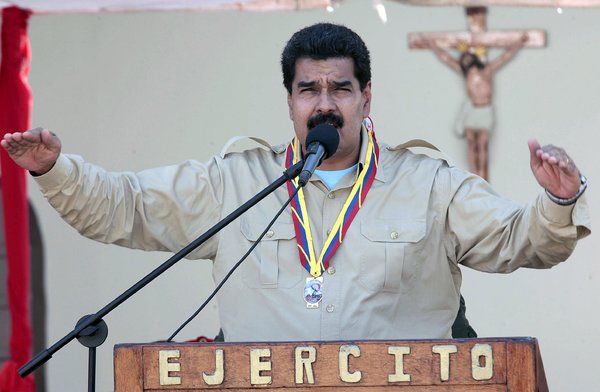
VENEZ articleLarge e1380645570814 ICYMI: With Accusations of Sabotage, Venezuela Expels 3 US Embassy Officials

Courtesy of: Agence France Presse

CARACAS, Venezuela — Stepping up hostilities with the United States, President Nicolás Maduro of Venezuela expelled the top American diplomat and two other embassy officials from the country on Monday, accusing them of supporting plots to sabotage the country’s electrical grid and the economy.

“Get out of Venezuela! Yankee go home!” Mr. Maduro shouted as he announced the expulsions at a military event to commemorate the bicentennial of a battle in Venezuela’s war of independence.

“We have detected a group of officials of the United States Embassy in Caracas, in Venezuela, and we have been tracking them for several months,” Mr. Maduro said during a live television broadcast. “These officials spend their time meeting with the Venezuelan extreme right wing, financing them and encouraging them to take actions to sabotage the electrical system, to sabotage the Venezuelan economy.”

The expulsions were the latest diplomatic swipe at Washington by Mr. Maduro since he took over for the country’s longtime president, Hugo Chávez, who died in March. Late last year, as Mr. Chávez grew increasingly ill, the two nations held informal talks aimed at improving the long-strained relations between them, and there was some optimism on the American side that Mr. Maduro, a former foreign minister sometimes described as pragmatic, would be amenable to a thaw.

But it quickly became clear that Mr. Maduro intended to stick closely to Mr. Chávez’s example, painting the United States as an imperialist aggressor out to undermine his government. Early on, he accused the Obama administration of plotting against him, and hours before he announced the death of Mr. Chávez on March 5, he kicked out two American military attachés, saying they had tried to recruit Venezuelan military personnel to conspire against the government.

The diplomats expelled on Monday included Kelly Keiderling, the chargé d’affaires, who runs the embassy in the absence of an ambassador here. The United States has not had an ambassador in Caracas since 2010, when Mr. Chávez refused to accept the new one proposed by Washington because of remarks that Mr. Chávez said were disrespectful.

Mr. Chávez had already expelled the American ambassador, Patrick Duddy, in 2008, saying that his government had discovered an American-supported plot by military officers to topple him. Mr. Duddy was later allowed to return to Caracas.

Another one of the diplomats expelled on Monday was Elizabeth Hoffman, an official in the embassy’s political section, whom Mr. Maduro had publicly accused at least as early as April of meeting with opposition figures to plot sabotage of the electrical system. He said at the time that he had proof but took no action until Monday. The third official being expelled is David Moo, the vice consul.

Foreign Minister Elías Jaua later said on television that the evidence against the American diplomats included meetings held in recent weeks with democracy advocates, union members and elected officials belonging to the political opposition, whom he accused of planning to destabilize the country.

Mr. Maduro said the officials had 48 hours to leave the country.

“We completely reject the Venezuelan government’s allegations of U.S. government involvement in any type of conspiracy to destabilize the Venezuelan government,” the American Embassy said in a statement. It called the meetings held by the officials “normal diplomatic engagements,” adding, “We maintain regular contacts across the Venezuelan political spectrum.”

Ever since he was elected by a narrow margin in April in a special election to replace Mr. Chávez, Mr. Maduro has struggled with intense economic woes and a deeply divided populace. He has often accused plotters and saboteurs of being responsible for a variety of the nation’s ills, including electrical blackouts and the deadly explosion at the national oil company’s enormous Amuay refinery.

“He needs diversions and distractions,” said Michael Shifter, president of the Inter-American Dialogue, a policy group in Washington. “The situation is so dire in Venezuela that he needs to find a scapegoat, and it’s convenient and politically so tempting to kick out U.S. diplomats.”

But Mr. Shifter said that describing the United States as the source of the country’s problems might not have the same effect it did for Mr. Chávez, who was beloved by many of his supporters. Mr. Maduro does not inspire nearly the same devotion, and the country’s economic woes are getting worse, with inflation over 45 percent a year and shortages of many basic foods and goods, including toilet paper.

“I doubt that it has the resonance it used to have,” Mr. Shifter said of the diplomatic expulsions.

To read this article at The New York Times, please click here.
 
Aug
30
2013
Posted by
admin
Comments

In Case You Missed It…Articles Roundup Week of 8/30/13

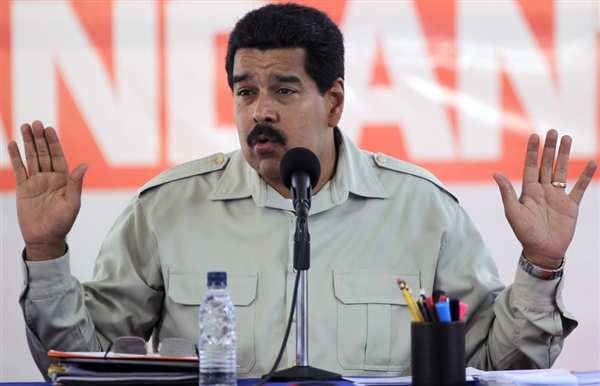
130830 maduro 4a.photoblog600 e1377895796289 In Case You Missed It…Articles Roundup Week of 8/30/13

Courtesy of: Associated Press

This week: Nicolás Maduro airs his own hypocrisy by seeking enhanced powers to “tackle corruption;” leading Venezuelan TV news channel Globovisión receives a volley of resignations amid government censorship; the Venezuelan daily newspaper Versión Final is sold to a government supporter,  likely leading to staff dismissals; and ex-managers for Venezuelan oil-giant Pdvsa are charged with corruption. Maduro claims that two Colombian men planned to kill him at the same time as the attack in Syria; despite a lack of evidence, Maduro demands an explanation, arguing President Barack Obama knew of the plot to assassinate him; Henrique Capriles, on the other hand, dismisses the government’s claims of an assassination plot; and Maduro misquotes a Biblical passage, saying “Christ multiplied the penises.” With the bolivar collapsing and prices spiraling higher, the government turns to political witch hunts to distract people from reality; Venezuela is again on the verge of another currency devaluation, likely after December’s municipal elections; Venezuelan authorities insist the country will become an exporting giant, yet non-oil exports are down 20.6% from last year; according to Central Bank statistics, the GDP of Venezuela’s public sector doubles that of the private sector;  and the public debt in Venezuela has drastically increased over the past two years, rising 53% since 2011.

In Venezuela, Absolute Power Corrupts Absolutely, Bloomberg

Venezuelan President Nicolas Maduro has lately been accused of hypocrisy for seeking enhanced powers to rule by decree so that he can tackle the corruption that rots Venezuela’s political institutions. The accusation is fitting. Maduro is finally admitting that the Venezuela he inherited from the late Hugo Chavez is wracked by corruption, just five months after he famously claimed, “There is no corruption, for the first time in the history of Venezuela, in 180 years.”

Venezuelan news TV channel Globovisión receives a volley of resignations, El Universal

“I am only left with job uncertainty, but have the peace of mind that comes with knowing that I always did the right thing,” journalist Román Lozinski read out on his radio show from a personal statement he wrote following his resignation from Globovisión. Resignations have been piling up at the television news network after the retirement of call-in show host Leopoldo Castillo on August 16.

Pressure over sale of Venezuelan daily newspaper Versión Final, El Universal

Workers from Versión Final are likely to be dismissed upon the sale of the daily newspaper to an alleged relative of Francisco Arias Cárdenas, ruling party governor of the state of Zulia, northwest Venezuela. There are reports that the company underwent a lot of pressure prior to the negotiation: it first experienced restrictions related to newsprint, then economic pressure that finally ended in the sale of the company to Carlos Alaimo, the father-in-law of Cárdenas’ son.

Pdvsa’s ex managers in Monagas charged with corruption, El Universal

The Public Prosecutor Ministry charged two former managers of Petróleos de Venezuela (Pdvsa) for the collection of VEB 600,000 (US$ 95.279,40) from a contractor. Defendants are Jannimett de Los Ángeles Flores Quijada (37), former legal counsel of Pdvsa in Punta de Mata, and Jorge Natera Barrios(35), former super intendant of litigation at same division.

Maduro: “The plan was to kill me in parallel with the Syria attack”, El Universal

Venezuelan President Nicolás Maduro reported on Wednesday that two Colombian individuals “hired by drug traffickers to kill the Head of State” were arrested. In that sense, Maduro rejected the remarks made by opposition deputy Julio Borges about the assassination claims aired on Monday. “Borges made an irresponsible and anxious statement, saying that (the hit men) that were arrested did not even have firearms to accomplish their task.

Venezuela demands US explanation over alleged assassination plot, The Telegraph

Nicolas Maduro called on the American president to explain what he knew of the alleged assassination plan. President Maduro said that besides Colombia, it was hatched by far-right Venezuelan opposition figures in Miami. The Venezuelan president is a frequent and fiery critic of Washington, as was his predecessor, the late Hugo Chavez.

Capriles: “The people laugh about assassination plots”, El Universal

On Monday, on a meeting with “Miranda’s entrepreneurs,” in Caucagua, Miranda state, Henrique Capriles, Governor of Miranda state and opposition leader, referred to the announcement of the arrest of a gang who allegedly wanted to assassinate President Nicolás Maduro and Deputy Diosdado Cabello.  “Nobody believes that tall story.

Nicolas Maduro Says ‘Christ Multiplied The Penises’ In Major Screw Up (VIDEO), Huffington Post

Christ did WHAT?!? The man who once gave us “Chavez came to me as a little bird” has uttered another phrase that is getting a lot of chatter online. Venezuelan president, Nicolas Maduro, seriously screwed up an iconic biblical anecdote while speaking at the Miranda Stadium when he said: “Multiply ourselves, like Christ multiplied the penises.”

Chavez’s Inflation Bites His Successor, Wall Street Journal

Hyperinflation and political witch hunts seem to go together. Just ask the Venezuelan opposition. With the bolivar collapsing and prices spiraling higher, the government alleged this month that its No. 1 adversary, former presidential candidate Henrique Capriles, is linked to a prostitution ring that was using minors in the state of Miranda, where he is governor.

Venezuela is on the verge of another devaluation, El Universal

Imbalances ailing Nicolás Maduro’s government are so pronounced that most financial entities agree that the country, after undergoing stringent adjustments last February 8 through which the official exchange rate jumped from VEB 4.30 to VEB 6.30, is heading towards another devaluation likely to take place after December’s elections for mayors.

Venezuelan non oil exports down 20.6%, El Universal

Venezuelan authorities insist on saying: Venezuela will become an exporting giant. However, official records say the opposite. According to the figures from the Central Bank of Venezuela, non oil exports accounted for just USD 810 million in the second quarter, 20.6% down with respect to a year earlier.

GDP of the public sector doubles that of the private sector, El Universal

The statistics of the Central Bank of Venezuela (BCV) suggest that the loss of dynamism of the Venezuelan economy has exerted a heavier impact on the private sector rather than the public sector with growth reported at 1.1% and 2.6%, respectively. Such great disparity between the sectors is attributed to the existing imbalance in the sale of US dollars aimed at importing raw materials, machinery, and finished products to supply the domestic market.

Debt of the Venezuelan gov’t soars 53% in two years, El Universal

Since 2011, the Venezuelan oil basket price has been above the USD 100 ceiling. In this context of high oil revenues, the Government has spurred indebtedness. Based on the figures of the Ministry of Finance, the public debt grows rapidly with liabilities jumping 53% from the first half of 2011 through 2013. Such increase is mainly attributed to heavy expenditure exceeding regular income, a situation that has made authorities seek other founding sources.

Venezuelan unemployment hits 7.6% in July, El Universal

Venezuelan unemployment rate stood at 7.6% in July, according to a monthly report on the workforce issued by the National Statistics Institute (INE). The information was released by Professor Elías Eljuri, president of the institute, who also said the unemployment rate reported in July was actually lower than that of 2012 (7.9) and 2011 (8.0%).

 
Aug
20
2010
Posted by
admin
Comments

VenEconomy: Another of Chávez’s Prisoners

This article was originally posted by Latin American Tribune

While on Venezuela’s streets thousands of people fall victim to criminals, who act under the cloak of impunity and, now, censorship, it is becoming increasingly frequent for the prisons to take in fresh political prisoners.

There are already dozens of people doing time in prison simply for dissenting, one way or another, from Hugo Chávez’s Castro-communist regime, including some who militated with the commander in favor of the revolutionary cause, others who refused to give up their rights, and others who witnessed the President’s sobbing and moaning.

The excuses used to send them to prison are mixed, from alleged administrative corruption to the alleged commission of murder, despite the lack of any proof implicating them, to imaginary conspiracies to commit an assassination and treason.

Read More