Jul
8
2013
Posted by
admin
Comments

ICYMI: A circus without a ringmaster

The Economist
July 6, 2013
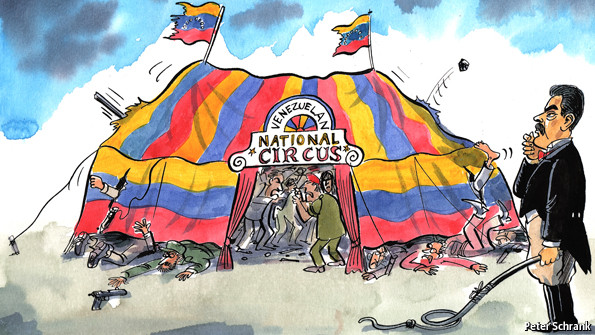
20130706 AMD001 0 e1373308466257 ICYMI: A circus without a ringmaster

Courtesy of: The Economist/Peter Schrank

During the presidency of Hugo Chávez, who ruled from 1999 until his death from cancer in March, the domineering personality of the comandante left no doubt as to who was in charge of Venezuela. By contrast Chávez’s successor, Nicolás Maduro, a former foreign minister, has yet to convince people that he is the one running the show. His disputed, razor-thin election victory on April 14th undermined his legitimacy (indeed, the supreme court has yet to resolve the opposition’s claim of fraud). Now the president faces problems within the ranks of the ruling coalition, and in particular his United Socialist Party of Venezuela (PSUV). In the absence of Chávez, there are worries that the PSUV will turn out to be held together, as the colourful Venezuelan metaphor has it, “with parrot spit”.

Fourteen years of chavismo have left the country in a mess. Despite the high price of oil, growth this year will be minimal or negative. Thousands of private companies have gone under, dragged down by regulations and threatened with fines, temporary closure or expropriation. Others have switched from production to importing. Even that is losing its appeal, now that foreign-exchange control mechanisms have seized up and dollars are scarce. Mr Maduro has sought to deal with the concerns of ordinary Venezuelans, as well as striking radical poses to please hard-core chavistas. Crime, poor public services, corruption and food-scarcity have been targeted with loudly trumpeted initiatives. But actually solving these problems will mean confronting powerful interests, and here Mr Maduro has little room for manoeuvre.

Moderates were encouraged when early in his presidency Mr Maduro sidelined Jorge Giordani, Chávez’s Marxist finance minister, and brought in Nelson Merentes, a former governor of the Central Bank who is seen as more ideologically flexible. But subsequent appointments seem designed to appease other interests. Amid talks with the private sector on how to get the wheels of commerce turning again, Mr Maduro last month reappointed Eduardo Samán head of the powerful consumer-protection body, a post he held under Chávez. A self-proclaimed “ultra-radical”, Mr Samán believes that inflation (heading for 40% a year) and empty supermarket shelves are caused by private-sector hoarding and speculation. “Humanity”, he has written, “will succeed in solving the food crisis only with the end of capitalism.”

Tentative efforts to tame corruption have also been undermined by a need to stay on friendly terms with the Chávez clan. On June 12th Argenis Chávez, the late president’s crafty youngest brother, was appointed head of the body that controls the administration of the justice system. On his brother’s watch, the younger Chávez had led the electricity ministry as well as Corpoelec, the graft-riddled state-run electricity giant. On becoming president, Mr Maduro quickly booted him out of both jobs. His return to office demonstrates the enduring power of the Chávez clan, as well as Mr Maduro’s willingness to subordinate the justice system to his political requirements.

Managing these rival factions has forced the PSUV to suspend internal party democracy. Grass-roots chavista radicals had backed Mr Samán’s bid to stand for mayor of Caracas. But party leaders, who see Mr Samán as a loose cannon, ruled out holding a primary that he might have won. Now the PSUV has cancelled all the primaries that were to have been held ahead of local elections, which have been postponed until December 8th. It remains to be seen whether choosing candidates by executive fiat will ruffle fewer feathers than the primaries would have done.

Our man in Havana

Rumours swirl that Mr Maduro could face a more immediate challenge to his own leadership. In a recorded conversation that was leaked on May 20th Mario Silva, the presenter of a state-television talk-show called “The Razor Blade”, was heard apparently passing information to a Cuban intelligence officer. In the recording Mr Silva warned the spy that Diosdado Cabello, the speaker of the National Assembly, wanted to overthrow Mr Maduro. It was a matter of urgency, he said, to cut off Mr Cabello’s sources of income, including the tax authority, which is run by his brother, José David Cabello. A few weeks later police arrested members of an alleged gang within the customs agency, which is part of the tax authority.

A former lieutenant who took part in a failed coup by Chávez in 1992, Mr Cabello has powerful friends in the army. The annual round of military promotions, due to be announced as The Economist went to press, may strengthen his hand. Henrique Capriles, the leader of the opposition, jeers that Mr Maduro’s role is confined to signing the promotions list. “Nicolás, you’re a laughing stock in the armed forces,” Mr Capriles tweeted.

During the presidential election campaign, Mr Maduro was seen as the favoured candidate not just of his predecessor but also of Cuba, Venezuela’s closest ally. A month ago, however, Mr Cabello made a three-day visit to Havana, holding meetings with President Raúl Castro and his brother, Fidel. The trip came shortly after the leaking of the Silva recording. No one knows what sort of deal the Cubans may have struck with Mr Cabello. For the moment, he and Mr Maduro are locked in a macho Latin embrace, of the kind some say was devised as a way for each man to frisk the other for weapons.

To read this article at The Economist, please click here.

 
Feb
26
2013
Posted by
admin
Comments

ICYMI: Hugo Chavez’s legacy of economic chaos; Tough times ahead for Venezuela

José Cardenas is a former senior official at the U.S. State Department, National Security Council and the U.S. Agency for International Development, where he served as Acting Assistant Administrator for Latin America and the Caribbean. He is a regular What’s Next Venezuela contributor.

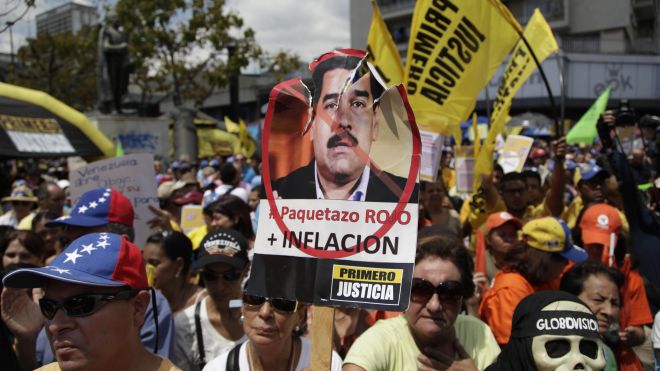
Venezuela Protest e1361899707868 ICYMI: Hugo Chavezs legacy of economic chaos; Tough times ahead for Venezuela

Courtesy of: Associated Press

Washington Times
February 26, 2013
By José Cardenas

The recent return home from Cuba in the dead of night of cancer-stricken Venezuelan President Hugo Chavez is likely not a sign that his condition is improving. In fact, it is more likely that his doctors have decided there is nothing more they can do than to allow him to go home to die peacefully, surrounded by family.

That suits just fine senior Venezuelan officials and their Cuban minders, who need Mr. Chavez’s physical presence nearby to better stage-manage a chavista succession. They now can tell the Venezuelan people, with whom Mr. Chavez maintains a deeply emotional connection, that the “comandante” remains intimately involved in the process, “approving” all decisions.

It appears the only decision to be made at this point, however, is whether Mr. Chavez’s inner circle declares the ailing leader “incapacitated” or whether they wait out the inevitable before calling elections within 30 days, as the constitution mandates.

If they have their wits about them, they probably will move to “retire” the Venezuelan leader sooner rather than later. A few months down the road, they are likely to be facing a much less favorable political climate than they are enjoying today. That’s because Mr. Chavez has bequeathed to them a ticking economic time bomb, which is set to blow up in the faces of the very people Mr. Chavez has claimed to represent — the poor and working masses.

Much will be written in the coming weeks that Mr. Chavez’s legacy is that he transformed Latin American politics by giving a voice to the voiceless. Less will be focused on just what the cost will be to those very same people, as well as their children.

Once the emotion of the moment passes, Venezuelans will be left to pick up the pieces from Mr. Chavez’s gross mismanagement of the Venezuelan economy. To squander Venezuela’s vast oil wealth takes real effort, but Mr. Chavez and his profligate spending proved up to the task. In what has been an abject lesson in the perils of populist economics, his actual legacy will be soaring inflation, a bloated public sector, a crippled private one, electricity blackouts, shortages of basic goods and one of the highest homicide rates in the world.

The first sign of more difficult days ahead came on Feb. 8, when the government ordered a 46 percent devaluation of the country’s currency. Inflation, already running at 22 percent, is now expected to surge, prices of goods will increase, and shortages of items such as toilet paper and cornmeal (the staple of arepa cakes) and even automobiles will grow worse.

Of course, the burden of such economic dysfunction always falls on the poor and working classes, who devote a higher portion of their incomes to basic necessities. As a result of the devaluation, Venezuelans’ real income is expected to decrease by 20 percent this year, at the time when their purchasing power already has dropped to 1966 levels.

What’s more, it will only get worse. Analysts say another devaluation is almost inevitable, given that this latest one will not come close to balancing the government’s books. Rumors are also rampant that the government will soon introduce rationing measures for basic food items.

Nor is any relief likely to come from the private sector, which has been plagued by price and currency controls, expropriations, government interventions, legal uncertainty and oppressive labor laws. Indeed, under Mr. Chavez, the number of private companies has dropped from 14,000 to 9,000. While a decade ago, 8 out of 10 jobs were generated by the private sector, today that figure is 6 out of 10.

Neither does it appear that China is willing to continue to pay Venezuela’s bills. Having already lent Mr. Chavez $39 billion against future oil sales, it recently sent home Venezuelan Foreign Minister Elias Jaua empty-handed, with no indication that further loans were in the offing.

The fix is already in that the uncharismatic Nicolas Maduro will be entrusted with trying to keep chavismo alive without Mr. Chavez. Whether he and his Cuban advisers can successfully exploit Mr. Chavez’s image to confront formidable challenges on the horizon remains to be seen. One thing is certain, however: As opposition leader Henrique Capriles tweeted upon Mr. Chavez’s return to Venezuela, “Hopefully the president’s return means that Mr. Maduro and his ministers can get to work. There are thousands of problems to resolve.” Without a doubt.

To read this article at The Washington Times, please click here.

 
Jun
26
2012
Posted by
admin
Comments

Venezuela election ads glorifying Chavez irk foes

Chicago Tribune via Reuters
June 26, 2012
Andrew Cawthorne

70698710 Venezuela election ads glorifying Chavez irk foes

Courtesy of: Reuters

CARACAS (Reuters) – Political ads exalting Venezuela’s socialist President Hugo Chavez as second only to God have offended opponents and added further controversy to an already spicy election campaign.

State TV is repeatedly playing a minute-long publicity spot highlighting the story of Andres Ospino, who was granted a new home for his family by a state building program. (To view the ad, click on http://bit.ly/O5YTuh)

“I have a saying: ‘First God, second my Comandante,’” waxes Ospino in his new apartment after a moody opening sequence of dawn breaking over Caracas. He also calls Chavez “this Bolivar,” in reference to 19th century South American independence hero Simon Bolivar.

The publicity goes to the heart of Chavez’s push for re-election on October 7. The campaign is built around his personality and depends heavily on the government’s popular welfare policies that are paid for by oil revenue.

While the promise of a new home is a vote-winner among Venezuela’s poor majority, opponents scoff at it as crass electioneering and say the quasi-religious adulation of Chavez is offensive in a Roman Catholic nation.

“It’s a vulgar copy of what they did in the Soviet Union under Stalin, of what they still do in Communist Cuba and North Korea,” wrote columnist Geronimo Figueroa in a provincial Venezuelan newspaper.

The charismatic 57-year-old former soldier, who has dominated the South American nation since assuming office in 1999, will face a single opposition “unity” candidate, Henrique Capriles, in the election.

CHAVEZ LEADS POLLS

Chavez leads most opinion polls by a double-digit margin thanks to his strong personality and enduring emotional connection with the poor, sympathy over his battle with cancer, the popularity of welfare programs and an uptick in the economy.

The “housing mission” is wildly popular with working-class Venezuelans, and state TV repeatedly churns out statistics of how many homes have been built around the nation.

Capriles, 39, is successfully projecting an image of youth and energy in contrast to the president – who is largely confined to his palace due to his illness – and is drawing large crowds on a nationwide campaign tour.

In the growing publicity war, the opposition cannot match the resources of Chavez, who frequently obliges both state and private TV stations to carry his speeches and appearances live in so-called “cadena,” or “chain,” broadcasts.

Capriles’ supporters did strike a chord with one tongue-in-cheek Internet ad mimicking a sports company’s publicity in Venezuela. In the original spot, a young soccer fan is seen reluctantly removing a Brazil shirt – then joyfully donning the colors of his “real passion,” Venezuela’s national team.

In the satirical version, a man wearing the red of Chavez’s ruling Socialist Party says a long farewell, before swapping it for a blue T-shirt emblazoned with Capriles’ campaign slogan, “There Is A Way,” then running off with a skip in his step. (To view the ad, click on http://bit.ly/KeOFq4)

While reducing opposition activists to tears of laughter, the ad has drawn derision from the government.

“That loser needs to go the gym and do some exercise,” mocked Chavez’s campaign head Jorge Rodriguez, in reference to the actor’s generous waistline.

(Additional reporting by Marianna Parraga; Editing by Brian Ellsworth and Will Dunham)

To read this article on the Chicago Tribune, please click here.