Jul
8
2013
Posted by
admin
Comments

ICYMI: A circus without a ringmaster

The Economist
July 6, 2013
20130706 AMD001 0 e1373308466257 ICYMI: A circus without a ringmaster

Courtesy of: The Economist/Peter Schrank

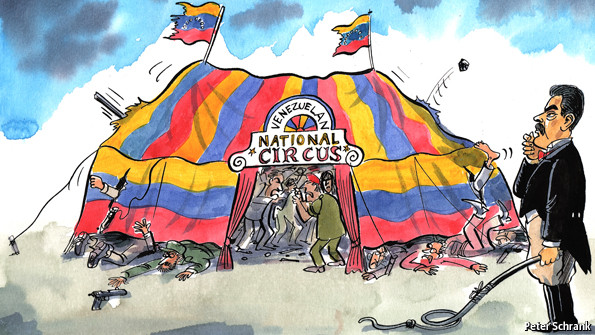
During the presidency of Hugo Chávez, who ruled from 1999 until his death from cancer in March, the domineering personality of the comandante left no doubt as to who was in charge of Venezuela. By contrast Chávez’s successor, Nicolás Maduro, a former foreign minister, has yet to convince people that he is the one running the show. His disputed, razor-thin election victory on April 14th undermined his legitimacy (indeed, the supreme court has yet to resolve the opposition’s claim of fraud). Now the president faces problems within the ranks of the ruling coalition, and in particular his United Socialist Party of Venezuela (PSUV). In the absence of Chávez, there are worries that the PSUV will turn out to be held together, as the colourful Venezuelan metaphor has it, “with parrot spit”.

Fourteen years of chavismo have left the country in a mess. Despite the high price of oil, growth this year will be minimal or negative. Thousands of private companies have gone under, dragged down by regulations and threatened with fines, temporary closure or expropriation. Others have switched from production to importing. Even that is losing its appeal, now that foreign-exchange control mechanisms have seized up and dollars are scarce. Mr Maduro has sought to deal with the concerns of ordinary Venezuelans, as well as striking radical poses to please hard-core chavistas. Crime, poor public services, corruption and food-scarcity have been targeted with loudly trumpeted initiatives. But actually solving these problems will mean confronting powerful interests, and here Mr Maduro has little room for manoeuvre.

Moderates were encouraged when early in his presidency Mr Maduro sidelined Jorge Giordani, Chávez’s Marxist finance minister, and brought in Nelson Merentes, a former governor of the Central Bank who is seen as more ideologically flexible. But subsequent appointments seem designed to appease other interests. Amid talks with the private sector on how to get the wheels of commerce turning again, Mr Maduro last month reappointed Eduardo Samán head of the powerful consumer-protection body, a post he held under Chávez. A self-proclaimed “ultra-radical”, Mr Samán believes that inflation (heading for 40% a year) and empty supermarket shelves are caused by private-sector hoarding and speculation. “Humanity”, he has written, “will succeed in solving the food crisis only with the end of capitalism.”

Tentative efforts to tame corruption have also been undermined by a need to stay on friendly terms with the Chávez clan. On June 12th Argenis Chávez, the late president’s crafty youngest brother, was appointed head of the body that controls the administration of the justice system. On his brother’s watch, the younger Chávez had led the electricity ministry as well as Corpoelec, the graft-riddled state-run electricity giant. On becoming president, Mr Maduro quickly booted him out of both jobs. His return to office demonstrates the enduring power of the Chávez clan, as well as Mr Maduro’s willingness to subordinate the justice system to his political requirements.

Managing these rival factions has forced the PSUV to suspend internal party democracy. Grass-roots chavista radicals had backed Mr Samán’s bid to stand for mayor of Caracas. But party leaders, who see Mr Samán as a loose cannon, ruled out holding a primary that he might have won. Now the PSUV has cancelled all the primaries that were to have been held ahead of local elections, which have been postponed until December 8th. It remains to be seen whether choosing candidates by executive fiat will ruffle fewer feathers than the primaries would have done.

Our man in Havana

Rumours swirl that Mr Maduro could face a more immediate challenge to his own leadership. In a recorded conversation that was leaked on May 20th Mario Silva, the presenter of a state-television talk-show called “The Razor Blade”, was heard apparently passing information to a Cuban intelligence officer. In the recording Mr Silva warned the spy that Diosdado Cabello, the speaker of the National Assembly, wanted to overthrow Mr Maduro. It was a matter of urgency, he said, to cut off Mr Cabello’s sources of income, including the tax authority, which is run by his brother, José David Cabello. A few weeks later police arrested members of an alleged gang within the customs agency, which is part of the tax authority.

A former lieutenant who took part in a failed coup by Chávez in 1992, Mr Cabello has powerful friends in the army. The annual round of military promotions, due to be announced as The Economist went to press, may strengthen his hand. Henrique Capriles, the leader of the opposition, jeers that Mr Maduro’s role is confined to signing the promotions list. “Nicolás, you’re a laughing stock in the armed forces,” Mr Capriles tweeted.

During the presidential election campaign, Mr Maduro was seen as the favoured candidate not just of his predecessor but also of Cuba, Venezuela’s closest ally. A month ago, however, Mr Cabello made a three-day visit to Havana, holding meetings with President Raúl Castro and his brother, Fidel. The trip came shortly after the leaking of the Silva recording. No one knows what sort of deal the Cubans may have struck with Mr Cabello. For the moment, he and Mr Maduro are locked in a macho Latin embrace, of the kind some say was devised as a way for each man to frisk the other for weapons.

To read this article at The Economist, please click here.

 
Jun
18
2013
Posted by
admin
Comments

ICYMI: Breast-feeding is best, so ban bottles, Venezuelan lawmaker proposes

CNN
June 18, 2013
By Catherine E. Shoichet

population e1371580976192 ICYMI: Breast feeding is best, so ban bottles, Venezuelan lawmaker proposes

Courtesy of: Reuters

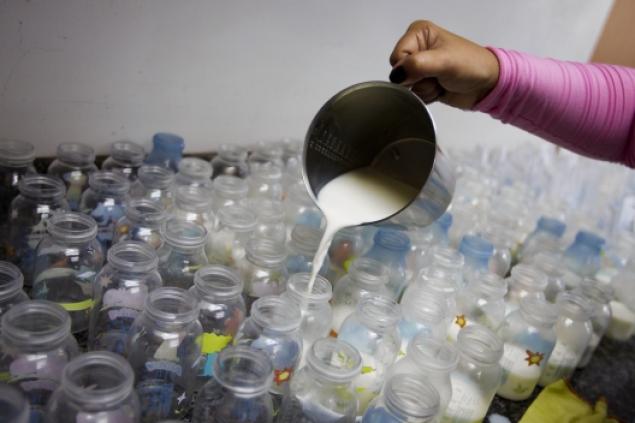
Venezuelan lawmakers are weighing whether to ban the use of baby bottles as part of a push to promote breast-feeding, state media reported.

The proposed measure will be up for debate in the South American country’s National Assembly on Tuesday, lawmaker Odalis Monzon said in an interview with state-run VTV.

“Every baby has the right to breast-feeding,” said Monzon, a lawmaker from the ruling United Socialist Party of Venezuela.

In addition to banning bottle-feeding, the proposed revisions to Venezuela’s Law of Promotion and Protection of Breastfeeding also include plans to penalize those who advertise baby formula, she said.

Transnational companies that market formula, she said, have interfered with a crucial bond between mother and child.

“The most important is the love, the connection between mother and child, that sometimes is lost because they do not give them the warmth that nursing a baby provides,” Monzon told VTV.

The proposal includes exceptions for mothers who cannot breast-feed due to illness, Monzon said. It would also provide for the creation of more breast-milk banks and require companies to set aside space for mothers to nurse.

She did not provide details about how authorities would enforce the measure if it passes, or what sorts of punishments violators would face.

The measure has drawn sharp criticism from some lawmakers, who argue that the government can promote breast-feeding without prohibiting anything, CNN affiliate Globovision reported.

“This is unacceptable and alarming,” said Eduardo Marin, a lawmaker for the opposition Justice First party.

The 2007 law that Monzon is pushing to amend was aimed at promoting breast-feeding, Marin said, not “questioning, stigmatizing and practically criminalizing those who have opted for (other methods) of feeding.”

Earlier this month, Venezuela’s Health Ministry said that 27.1% of mothers in the country who are able to breast-feed actually do so and that officials aimed to increase that number to 70% by 2019,VTV reported.

To read this article at CNN, please click here.

 
Feb
21
2013
Posted by
admin
Comments

ICYMI: The homecoming

The Economist
February 23, 2013
By Fabiola Sanchez and Ian James

hospital chavistas celebraban presidente AFP NACIMA20130221 0259 19 ICYMI: The homecoming

Courtesy of: AFP

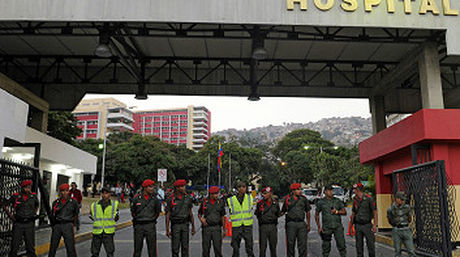
Ten weeks after flying to Cuba for his fourth cancer operation since June 2011, President Hugo Chávez returned to Venezuela in the early hours of February 18th. But the manner of his arrival suggested that he remains far too ill to govern. Only his closest aides, including a medical team, were on hand. Even senior cabinet members and leaders of the ruling United Socialist Party of Venezuela (PSUV) were kept in the dark. The president was taken to a military hospital, and installed in a tightly guarded ninth-floor ward reserved for senior officers. No images of his return were made available, but the party organised “spontaneous” demonstrations of joy on the part of his supporters once the news had been announced on the president’s Twitter account.

Since leaving Caracas for Havana on December 10th Mr Chávez, who has ruled his country in a hyperactive fashion for 14 years, has been neither seen nor heard. In a series of vaguely worded official communiqués, the government admitted that a severe post-operative lung infection left him with breathing difficulties. On February 15th it belatedly presented a “proof of life”, in the form of several photographs of the president with his eldest daughters, holding a copy of the Cuban government newspaper Granma from the previous day. But the photos (one of them is above) raised more questions than they answered. An accompanying statement said Mr Chávez is barely able to speak, thanks to a tracheotomy to ease his breathing (no tube was visible in the photos).

Despite all this, officials continue to insist that the president is in day-to-day control of the administration. They said, for example, that he had authorised a 32% devaluation of the currency, the bolívar, announced on February 8th, the eve of the Carnival holiday, when most Venezuelans are thinking about the beach. The president’s return has also served to distract attention temporarily from the deteriorating economy.

Nicolás Maduro, the vice-president, is to all intents and purposes running the country, but vehemently denies that he is the acting president. Mr Chávez’s return will at least obviate the need for ministers to make frequent visits to Havana for bedside consultations. Those visits fuelled speculation that instructions were being imparted by Cuba’s communist leaders, rather than by Mr Chávez. The homecoming cut short a growing protest against Cuban interference staged by students outside the island’s embassy in Caracas.

But in other ways Venezuela remains in the constitutional limbo that began on January 10th. That was the date on which Mr Chávez should have been sworn in for his fourth consecutive term after an election on October 7th. The supreme court, which Mr Chávez has turned into an appendage of the executive, ruled that as a re-elected president he could be sworn in whenever his doctors deemed him fit enough. More controversially still, they extended indefinitely the tenure of the existing cabinet, including the unelected Mr Maduro, whom Mr Chávez before his operation had anointed as his chosen successor. The court thus brushed aside constitutional stipulations concerning the president-elect’s incapacitation, which include the appointment of a medical board to determine his fitness for office.

Nevertheless, Mr Chávez’s return to Caracas makes possible his swearing-in, which is likely to be administered by a delegation from the court in private, rather than before the National Assembly. That in turn would give constitutional legitimacy to Mr Maduro’s role as vice-president (which technically lapsed on January 10th). But the government seems in no immediate hurry to take this step, perhaps because of the gravity of the president’s condition, including his speech impairment. Mr Chávez “will be sworn in when he’s good and healthy,” said Aristóbulo Istúriz, a state governor and leading PSUV member. The opposition Democratic Unity alliance is wondering aloud whether a man who is not fit enough to be sworn in can be considered fit enough to run the country.

Few but the president’s most fervent supporters believe he will recover sufficiently to serve his six-year term of office. Mr Chávez’s son-in-law, Jorge Arreaza, who is also the science minister, referred last week to “palliative treatments”, which suggested that the president has come home to die.

Foreign diplomats in close touch with the regime expect a fresh presidential election by June at the latest. This would almost certainly pit Mr Maduro against the opposition’s Henrique Capriles, who lost to Mr Chávez in October. The president’s death, his resignation or other “permanent absence” would, according to the constitution, trigger an election within 30 days. But the supreme court is skilled in creative interpretation of the constitution so as to suit the government’s cause.

Some analysts suggested that the devaluation, which is bound to spark an increase in inflation (already at 20% a year), was a sign that the regime had ruled out an early election. Rather, it may be an indication of the gravity of Venezuela’s economic plight. Wild spending ahead of the October election and the economy’s mismanagement pushed the fiscal deficit to 8.5% of GDP last year. Several staple goods are in short supply and the Central Bank’s liquid reserves are down to about $4.5 billion. In the illegal black market, the dollar buys 23 bolívares, compared with the new official rate of 6.3.

One indication that an election may come soon is that government newspapers have begun to publicise polls which suggest that Mr Maduro would easily beat Mr Capriles in a vote. Mr Maduro himself has been engaged in an undeclared campaign for some time: he blamed the devaluation and shortages on speculation and sabotage by what remains of Venezuela’s battered private sector. Some in the opposition coalition want to name their candidate so as to be ready for a snap election. Barring a miraculous recovery by Mr Chávez, Venezuelans may soon be going to the polls again.

To read this article at The Economist, please click here.