October 3, 2012
By What’s Next Venezuela
Courtesy of: AP / Getty Images
In the 14 years Hugo Chávez has ruled Venezuela, he has never before faced a political challenge like the one he will confront on October 7. Despite the president’s enormous electoral advantage, opposition candidate Henrique Capriles has steadily risen in the polls since the campaign kicked off on July 1. He now holds a slight advantage in several well-respected polls.
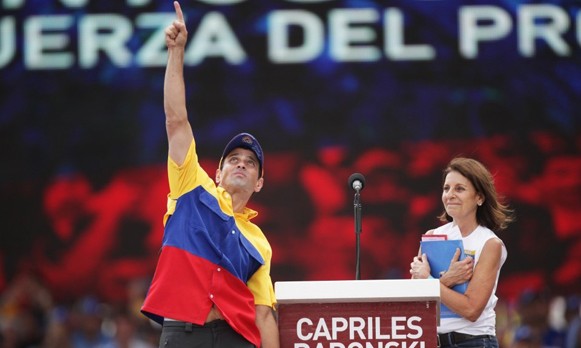
Capriles’ success is the result of his campaign based on personal, “retail” politics, a stark contrast with Chávez’s staged events and extended discourses on socialist ideology. The young lawyer and former governor, mayor, and youngest ever president of the now defunct Chamber of Deputies has spent the last months on an exhausting town-to-town campaign through Venezuela. Capriles has visited more than 250 towns, speaking to individual Venezuelans about their everyday problems. He also enjoys the support of a united opposition which, for the first time, selected a single candidate to run against Chávez.
The strategy is a departure from the ideological battles that long defined Venezuelan politics. Capriles has instead focused on the crime, scarcity and unemployment that are the scourges of daily life for ordinary Venezuelans. As Chávez continues to extol the moral superiority of his revolution while offering little evidence to support it, Capriles offers solutions to the immediate problems that the nation faces. In doing so he has created personal connections with disillusioned Venezuelans and a strong – and growing – following.
His campaign’s success is reflected in the latest polls. A respected poll released just this week gives Capriles a three-point lead, and another recent poll had his advantage at two. A third puts the opposition 10 points behind, but puts undecided voters at 15 percent, leaving Capriles the opportunity to close the gap in the campaign’s final week.
The deep polarization in Venezuela makes the elections especially difficult to predict, as voters are sometimes unwilling to divulge their intentions for fear of losing their government jobs. Some polls register high numbers of undecided voters, more than enough to cover the widest gap between the candidates. Other polls, meanwhile, are baldly partisan and offer mere propaganda with little basis in real data.
More telling than the polls, perhaps, is the enthusiasm that Capriles is able to generate. Last weekend he attracted hundreds of thousands of supporters to his final campaign march in Caracas. Despite limited access to mass media due to the state control of most of the country’s television stations and an only recently united opposition party, Capriles has managed to inspire Venezuelans in a way that no other candidate has in the past 14 years.
What is certain is that Chávez is in the toughest election battle of his political career. What remains to be seen is whether Capriles is able to turn his rousing campaign into an electoral victory.