Jan
4
2013
Posted by
admin
Comments

ICYMI: Venezuelans demand answers on Chavez’s health

Washington Post
January 3, 2013
By Olga Khazan

Venezuelan officials have been tight-lipped about the health status of President Hugo Chavez, causing rumors about Chavez’s health status to swirl on Twitter and in the Latin American media.

Chavez has not been seen or heard from since a Dec. 11 surgery for an undisclosed type of cancer, and his administration has released few details about his status other than saying his condition remains “delicate” due to complications from a respiratory infection.

Chavez, 58, was elected for a fourth term in office with 54 percent of the vote in October and is due to be sworn in on January 10. If he dies before that date, the chairman of the National Assembly, Diosdado Cabello, will succeed him until new elections are held, but if he dies after that date, the vice president, Nicolas Maduro, would take over.

In the meantime, the suspense is killing Venezuela.

Spanish daily ABC kicked things off with this analysis of Chavez’s condition yesterday (translated from the Spanish):

Hugo Chavez has entered an induced coma in the last few days, with his vital signs very weakened, and maintained only through artificial assistance by the Havana hospital where he was admitted. Sources consulted by ABC confirmed Monday that they were soon planning to disconnect the artificial assistance that prolongs the life of the Venezuelan president.

The article goes on to say that Chavez “has a constant fever, won’t respond to antibiotics, hasn’t eaten solid food for three weeks, had 43.4 centimeters of intestine removed and a tracheotomy, among other health complications,” according to the Huffington Post.

Members of Chavez’s family, on the other hand, say his condition is stable. Chavez’s son-in-law Jorge Arreaza, who serves as minister of science, technology and innovation, tweeted, “Compatriots, DO NOT believe the ill intentioned rumors. President Chavez has spent the day calm and stable, accompanied by his children.”

But armchair oncologists have already weighed in:

“[Chavez] continues on artificial support at this point they are only prolonging unnecessary suffering,” José Rafael Marquina, a Venezuelan doctor who lives in Florida and is an opponent of Chavez, tweeted Wednesday.

“Most likely, he is showing signs of renal failure and a lung infection. But the biggest problem is that, with the delicate situation of the patient, his immune system must be weakened,” Marquina, who claims to receive inside information from the Venezuelan president’s medical team, told Colombian radio station Caracol.

On Twitter, the hashtag #TellTheTruthAboutChavez, as well as its Spanish equivalent, trended in Venezuela this week. Chavez supporters posted messages wishing for a speedy recovery:

“If all of us Venezuelans ask GOD with fervor and faith, surely he will have tend to our pleas, let us pray for Hugo Chavez and for his health,” tweeted Enrique Padron, a Venezuelan musician.

While others simply speculated as to who would take his place:

“People were saying the problem wasn’t Chavez but those that surrounded him . . . and now that’s exactly who we’re in the hands of #TellTheTruthAboutChavez,” tweeted Marcos Rodriguez.

The information vacuum has also provided fodder for Chavez’s opposition, which has called for the government to schedule constitutionally-mandated elections within 30 days if Chavez is too ill to return from Cuba, where his most recent surgery took place.

“To make us believe the president is governing shows a lack of seriousness that borders on irresponsibility,” opposition leader Ramon Guillermo Aveledo said at a news conference in Caracas, according to the Los Angeles Times.

Because Chavez’s vice president is more pro-Cuban than the National Assembly chair, Cuba may have an incentive to delay reporting Chavez’s condition for another week, argues Venezuela blogger Francisco Toro.

“And given the impenetrability of Cuban state secrecy, it’s hard not to speculate that even if the president has already died, we would have no way of knowing it,” Toro writes.

On the other hand, Venezuela is in poor financial shape, with large deficits that will likely necessitate unpopular austerity measures soon. In that case, National Assembly head Cabello may not be interested in running Venezuela — and fixing its economy — anyway.

Meanwhile, Arreaza has continued his optimistic Twitter campaign: Don’t worry, nothing to see here.

“Commander Chavez still battling hard and sends all his love to our people. Perseverance and patience!!!”

To read this article on the Washington Post, please click here.
 
Dec
17
2012
Posted by
admin
Comments

ICYMI: Venezuela’s Capriles Solidifies Threat to Chávez

Wall Street Journal
December 17, 2012
By Kejal Vyas

OB VS154 velect G 20121217024727 ICYMI: Venezuelas Capriles Solidifies Threat to Chávez

Courtesy of: Associated Press

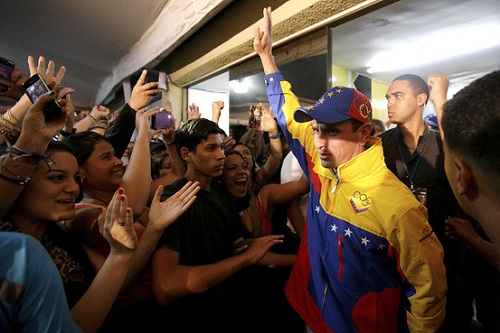
CARACAS—Henrique Capriles held on to his governorship in state elections Sunday, solidifying his place as the opposition’s most likely candidate if President Hugo Chávez’s illness forces a new race for Venezuela’s presidency.

The center-left Mr. Capriles, who lost to Mr. Chávez in a presidential race in October, has pledged to maintain nearly all of the current president’s social programs, but says he wants to run them more efficiently.

The opposition suffered a blow in the state polls Sunday, winning only three of the country’s 23 governor seats and losing four they had held before the vote.

“This has been a total victory” for Mr. Chávez’s ruling party, Miguel Perez Pirela, host of a pro-government political program, said on state television as the president’s supporters celebrated.

Despite its strong performance, the ruling party remains at a crossroads because of the health problems facing Mr. Chávez, the charismatic leftist leader who has dominated Venezuelan politics for 14 years.

The 58-year-old former army officer was re-elected in early October and announced a recurrence of his cancer a week ago, raising uncertainty about his future at the helm of the oil-rich South American country of 29 million people. Venezuela’s constitution requires new elections to be called within 30 days if a president dies or is incapacitated.

With his victory Sunday, Mr. Capriles has emerged as the strongest likely opposition candidate in a possible presidential vote. Analysts had said a loss in the Miranda state governor’s race would have been a devastating blow to his political future after his unsuccessful run against Mr. Chávez in October.

The 40-year-old governor won just over 50% of the votes in the state race Sunday, fighting off a challenge from former Vice President Elias Jaua—whom Mr. Chávez had handpicked to run against Mr. Capriles. Mr. Jaua took 46% of the vote.

“I feel happy for the people of Miranda, but in the rest of the country we didn’t achieve what we set out for,” Mr. Capriles said late Sunday at his campaign headquarters in Caracas.

A week ago Mr. Chávez tapped his longtime ally and vice president, Nicolas Maduro, as his preferred successor to lead his self-styled “socialist revolution.” Analysts are at odds over how Mr. Maduro, who has never been tested in an election, would fare against the opposition.

Mr. Capriles lost to Mr. Chávez by about 11 percentage points in the Oct. 7 presidential vote—but polls show Mr. Capriles winning if he were to face off against the president’s top allies. The governor has run a hectic door-to-door campaign during much of this year in a bid to attract voters from Mr. Chávez’s traditional strongholds in slums and the countryside.

Still, Sunday’s election results are “overall a negative for the opposition’s chances in any potential presidential election that could occur in the months ahead,” said Bret Rosen, a Latin America strategist at Standard Chartered. He said the ruling United Socialist Party of Venezuela, or PSUV, won more states than analysts had expected.

Venezuelan authorities said Mr. Chávez continued recovering from his operation in Cuba over the weekend. Few details about his condition have been released.

The president was “of full mental capacity” and was already “giving instructions and governing,” Science Minister Jorge Arreaza, who is also Mr. Chávez’s son-in-law, said from Havana in a phone call aired on state television.

However, government officials said throughout the week that Mr. Chávez’s recovery could take time, and asked Venezuelans to understand if he were unable to return before Jan. 10, when he is scheduled to be sworn in for his next six-year term.

Mr. Chávez has never said what kind of cancer he faces. He said on Dec. 8 that there had been a recurrence of malignant cells that required him to undergo surgery in Havana last week, his fourth operation for the illness since June 2011. He has also received several rounds of chemotherapy and radiation treatment.

 
Jul
5
2012
Posted by
admin
Comments

Who’s Next Venezuela: Another Potential Successor

Over the past several months, What’s Next Venezuela has reported on the uncertainty surrounding Hugo Chávez’s health, including the speculation about who will take Chávez’s place on the ballot should he be unable to stand for re-election on October 7. We continue examining potential successors today, with a profile of Foreign Minister Nicolás Maduro.

Nicolás Maduro, Foreign Minister

Nicolas Maduro Who’s Next Venezuela: Another Potential Successor

Courtesy of: AVN

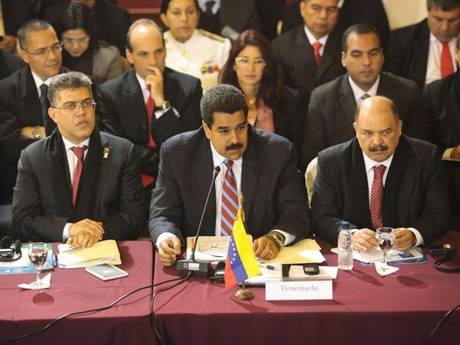
From lowly beginnings as a bus driver for political campaigns, Nicolas Maduro has risen to power and influence as the Foreign Minister in Hugo Chávez’s administration and a leading candidate to succeed the president.

Since June 2011, around the time Venezuelans first learned of Chávez’s cancer, Maduro has emerged as one of Chávez’s closest officials and advisors, both in Cuba and in Venezuela, and the one in charge of announcing the president’s messages to the Venezuelan public. He took a leading role after Chávez announced his intent to leave the Inter-American Commission on Human Rights (IACHR), voicing accusations against the IACHR and making headlines while Chávez received treatment in Cuba. Speculation intensified earlier this year as rumors swirled that Chávez was poised to name Maduro as Venezuela’s new Vice President.

That Chávez trusts Maduro with his most important assignments is corroborated by a Wikileaks cable which suggests Maduro may be at the top of the list because of his fierce loyalty to Chávez. The two have a long history, going back to the founding of the PSUV and Maduro’s work on Chávez’s 1998 presidential campaign. Maduro has already spent six years as chancellor, an unprecedentedly long spell in Chávez’s administration.

The leaked e-mail also asserts that Maduro is a more pragmatic leader than others in the PSUV, which might be necessary to keep the party from fracturing during the transition. It may help him to prevent infighting within the PSUV, which could cause serious problems in addition to any opposition challenges the transition leader will face.

Moreover, through the foreign ministry, Maduro has become the darling of Havana, establishing strong ties with the Castros. This may be critical, as recent news stories have shown that maintaining the relationship between Venezuela and the Castros will be a key expectation of any Chávez successor.

He has popular appeal as well, and charisma that technocrat Elias Jaua lacks. He has fared better than other PSUV members in polls when pitted against opposition candidate Henrique Capriles, although he would still have to make up a significant gap in just a few short months. Meanwhile, Maduro’s profile within Venezuela has continued to grow as he routinely appears both in pictures and videos next to the president, both in Cuba and during the recent announcement of Chávez’s signature new labor law.

However, several things indicate that Maduro may not be the chosen one. Many argue that although he has gained international approval needed to be president, he has not done the same within his own party. He is also untested in close elections; his only electoral victory was in a 2005 legislative race in which he ran unopposed.

In fact, many analysts believe that Maduro’s best shot at the presidency came last year when Chávez first got sick. He quickly took charge of the leadership of Venezuela. Now it appears that he is slated to run for governor of Carabobo, a state now run by a member of the MUD. Maduro himself has even denied that he is being considered as a successor to Chávez.

For his part, Maduro argues that the majority of Venezuelans will reelect Chávez on October 7. Should Chávez’s health take a turn for the worst, however, we may yet learn if he is as trusted as the Wikileaks cable claims.