May
13
2013
Posted by
admin
Comments

With the Economy in Dire Straits, Maduro Scapegoats a Beloved Venezuelan Company

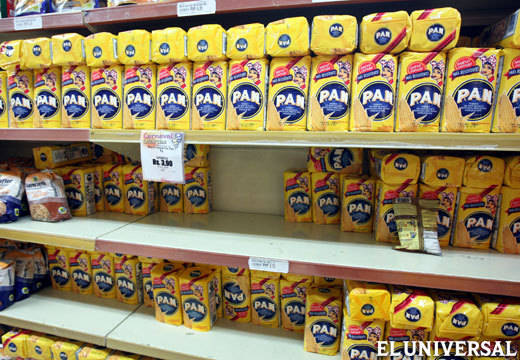
pan0.jpg.520.360.thumb  e1368469039817 With the Economy in Dire Straits, Maduro Scapegoats a Beloved Venezuelan Company

Courtesy of: El Universal

Nicolás Maduro and his socialist government cannot claim that they were not warned. Economists have long predicted that a Venezuelan economy propped up by excessive borrowing and an unsustainably high oil market would collapse spectacularly. Hugo Chávez, his cancer kept at bay just long enough to secure reelection, spent enough borrowed money in his final months to postpone the crash until Maduro had taken control. But the reckoning was inevitable. Now Maduro, eager for a scapegoat, is intensifying his attacks on the private sector, taking aim at Venezuelans’ most beloved company: Empresas Polar.

Polar is a pillar of the Venezuelan economy, producing staple goods from cornflour to household supplies and the nation’s most popular beer. Maduro issued his latest threat against the company on Saturday, when he accused the company of economic “sabotage” and demanded company President Lorenzo Mendoza to appear before the government to “explain the situation.” It was the latest in a series of escalating rhetoric against Polar, and a disturbing sign that Maduro refuses to learn the lessons inflicted on Venezuelans by years of failed socialist policies. Mendoza is scheduled meet with Vice-president Jorge Arreaza on Monday and with Maduro on Tuesday.

In a press conference held on Monday before the scheduled meetings, Mendoza addressed Maduro’s statements. He noted that Polar’s cornflour brand, PAN, operates at 100 percent capacity, but has only a 48 percent stake in the Venezuelan market, making it impossible to meet the country’s full demand. Thus far this year, Polar has produced 10 percent – 15,000 tons – more than last year. The remaining 52 percent of the market is comprised primarily of government-owned businesses, which are producing at less than 40 percent of their capacity. In response to Maduro’s accusation of “hoarding,” Mendoza stressed that Polar simply cannot hoard products to begin with since every step of the production and distribution process is regulated by government overseers.

As economists have noted, the shortages and inflation Maduro blames on the private sector are in fact caused by the government’s own policies. Rampant expropriations, price controls and other heavy-handed policies have harmed business and left farmland idle, sapping more than 11 percent from the country’s gross domestic product between 2005 and 2010.

Inflation is soaring, the nation’s debt continues to mount, and a currency devaluation has crippled Venezuelan’s purchasing power. As What’s Next contributor Joel Hirst observed, the economic crisis has left Maduro in the “awkward position of blaming Venezuela’s hobbled private sector for the failure of his own socialist policies.” The Central Bank’s scarcity index for Venezuela, which measures the percentage of goods unavailable in the market, rose to its highest number since it began tracking in April, 2009.

The facts, of course, could not be clearer. The company persevered under the yoke of Chávez’s policies, and continues to provide the goods Venezuelans need even as government controls force Polar and other companies to operate at a loss. These private companies are Venezuela’s best hope for brighter economic days; Maduro, in a desperate bid to save his own political skin, has chosen to marginalize them even further. It is ordinary Venezuelans, however, who will suffer the consequences.
 
Dec
17
2012
Posted by
admin
Comments

ICYMI: Venezuela’s Capriles Solidifies Threat to Chávez

Wall Street Journal
December 17, 2012
By Kejal Vyas

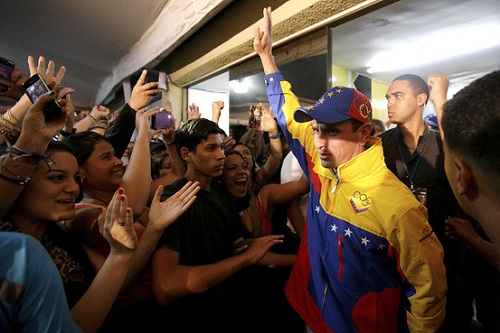
OB VS154 velect G 20121217024727 ICYMI: Venezuelas Capriles Solidifies Threat to Chávez

Courtesy of: Associated Press

CARACAS—Henrique Capriles held on to his governorship in state elections Sunday, solidifying his place as the opposition’s most likely candidate if President Hugo Chávez’s illness forces a new race for Venezuela’s presidency.

The center-left Mr. Capriles, who lost to Mr. Chávez in a presidential race in October, has pledged to maintain nearly all of the current president’s social programs, but says he wants to run them more efficiently.

The opposition suffered a blow in the state polls Sunday, winning only three of the country’s 23 governor seats and losing four they had held before the vote.

“This has been a total victory” for Mr. Chávez’s ruling party, Miguel Perez Pirela, host of a pro-government political program, said on state television as the president’s supporters celebrated.

Despite its strong performance, the ruling party remains at a crossroads because of the health problems facing Mr. Chávez, the charismatic leftist leader who has dominated Venezuelan politics for 14 years.

The 58-year-old former army officer was re-elected in early October and announced a recurrence of his cancer a week ago, raising uncertainty about his future at the helm of the oil-rich South American country of 29 million people. Venezuela’s constitution requires new elections to be called within 30 days if a president dies or is incapacitated.

With his victory Sunday, Mr. Capriles has emerged as the strongest likely opposition candidate in a possible presidential vote. Analysts had said a loss in the Miranda state governor’s race would have been a devastating blow to his political future after his unsuccessful run against Mr. Chávez in October.

The 40-year-old governor won just over 50% of the votes in the state race Sunday, fighting off a challenge from former Vice President Elias Jaua—whom Mr. Chávez had handpicked to run against Mr. Capriles. Mr. Jaua took 46% of the vote.

“I feel happy for the people of Miranda, but in the rest of the country we didn’t achieve what we set out for,” Mr. Capriles said late Sunday at his campaign headquarters in Caracas.

A week ago Mr. Chávez tapped his longtime ally and vice president, Nicolas Maduro, as his preferred successor to lead his self-styled “socialist revolution.” Analysts are at odds over how Mr. Maduro, who has never been tested in an election, would fare against the opposition.

Mr. Capriles lost to Mr. Chávez by about 11 percentage points in the Oct. 7 presidential vote—but polls show Mr. Capriles winning if he were to face off against the president’s top allies. The governor has run a hectic door-to-door campaign during much of this year in a bid to attract voters from Mr. Chávez’s traditional strongholds in slums and the countryside.

Still, Sunday’s election results are “overall a negative for the opposition’s chances in any potential presidential election that could occur in the months ahead,” said Bret Rosen, a Latin America strategist at Standard Chartered. He said the ruling United Socialist Party of Venezuela, or PSUV, won more states than analysts had expected.

Venezuelan authorities said Mr. Chávez continued recovering from his operation in Cuba over the weekend. Few details about his condition have been released.

The president was “of full mental capacity” and was already “giving instructions and governing,” Science Minister Jorge Arreaza, who is also Mr. Chávez’s son-in-law, said from Havana in a phone call aired on state television.

However, government officials said throughout the week that Mr. Chávez’s recovery could take time, and asked Venezuelans to understand if he were unable to return before Jan. 10, when he is scheduled to be sworn in for his next six-year term.

Mr. Chávez has never said what kind of cancer he faces. He said on Dec. 8 that there had been a recurrence of malignant cells that required him to undergo surgery in Havana last week, his fourth operation for the illness since June 2011. He has also received several rounds of chemotherapy and radiation treatment.