Aug
23
2013
Posted by
admin
Comments

In Case You Missed It…Articles Roundup Week of 8/23/13

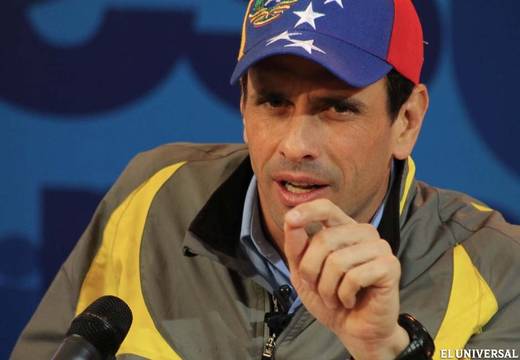
capriles.520.360 e1377285185692 In Case You Missed It…Articles Roundup Week of 8/23/13

Courtesy of: El Universal

This week: Nicolás Maduro tries to pass an Enabling Law, which would grant him increased decree powers in his alleged fight against corruption; and Henrique Capriles says that if they law was somehow passed, Venezuelans would disregard it. The Venezuelan government hurls anti-gay slurs at the opposition as part of their “war on corruption,” while continuing to preach social inclusion; eight senior journalists quit Venezuela’s former opposition news channel, Globovisión, in protest of government manipulation; and due to increasing government control of the media, Venezuelan officials are communicating first through Twitter, not TV or radio. PSUV members are angry at Maduro for skipping the grassroots election preceding December’s municipal election; infighting and corruption in Maduro’s party threaten Hugo Chávez’s socialist legacy in Venezuela;   the Central Bank issues more bonds to curb liquidity and attempts to boost the failing economy by auctioning $300 million in the currency exchange system; and Venezuelan doctors demand that the government declare a health emergency in the county.

Showdown looms in Venezuela over decree powers plan, Reuters

Venezuelan politicians traded insults over the weekend with a showdown looming in the National Assembly over President Nicolas Maduro’s plans to ask for fast-track decree powers he says he needs to combat corruption. Maduro, who narrowly won an April election to replace his late mentor Hugo Chavez, says he is ready to change “all the laws” if necessary to stamp out widespread graft that is denting his popularity with some core supporters.

Capriles: “If passed, Venezuelans would disregard the Enabling Law”, El Universal

“I say responsibly to the country that if they (pro-government officials) want to pass an Enabling Law throughout abuses and disregarding the Constitution, we, Venezuelans would disregard such law,” Henrique Capriles Radonski, Miranda state Governor and opposition leader stressed on Tuesday on his live web show Venezuela Somos Todos (“Venezuela is all of us”) as he commented that President Nicolás Maduro would request special legislative powers via an Enabling Law to the National Assembly in order to allegedly fight against corruption.

Venezuela Government Under Fire for Anti-Gay Slurs, Wall Street Journal

Venezuela’s leftist government, which often touts its social inclusion and antidiscrimination policies, is under fire from rights groups after a tirade of antigay slurs in the National Assembly, prompting President Nicolas Maduro to take to the airwaves waving a conciliatory gay-pride flag—before continuing to attack his political opponents. Lawmakers from Mr. Maduro’s United Socialist Party of Venezuela released photos that appeared to be from a private gathering in which a top aide to the opposition’s former presidential candidate is seen hugging other men and, in others, mugging for the camera while wearing a shawl and a feathered head piece.

Journalists Quit Venezuela TV News Channel in Censorship Protest, Bloomberg

Eight senior journalists quit Venezuela’s main television news channel Globovision in the past week in protest at alleged government manipulation of coverage. “We have progressively seen changes and unacceptable conditions to the free exercise of our profession,” the anchors and reporters at the broadcaster said in a joint e-mailed statement late yesterday. The journalists resigned in solidarity with director Leopoldo Castillo, who announced his exit from Globovision on Aug. 16 after 12 years at the channel.

Latin American presidents and their often love affair with Twitter, Associated Press

Whenever Argentina’s President Cristina Fernandez uses Twitter, controversy often follows. Although tweet discussions range in content and frequency, there’s never a lack of debate. Fernandez, who almost never gives interviews or takes questions from reporters, often uses her official Twitter account, https://twitter.com/CFKArgentina , which claims more than 2.2 million followers, to have a direct connection to the people.

Maduro’s explanation for skipping grassroots election is rebutted, El Universal

Since its foundation in 2007, the ruling United Party of Venezuela (Psuv) has gone through at least four grassroots elections in preparation of  several municipal, state and parliamentary polls, even for the election of Psuv authorities. This is not the case for the municipal election to be held next December 8. This time, top authorities took care of it. The decision, ultimately in the hands of the High Political Command of the Revolution, was justified recently by Venezuelan President Nicolás Maduro.

Hugo Chávez: His legacy at stake, Financial Times

When almost 500 families invaded the estate owned by the Santa Teresa rum company in 2000, Alberto Vollmer decided that using brute force to expel them would be futile. Hugo Chávez had just won the presidency and was encouraging Venezuelans to squat on private land. So instead, Mr Vollmer devised a plan to allow some families to remain, so long as the government paid for their housing.

Venezuela Opens Bidding Process for Latest Dollar Auction, Wall Street Journal

Venezuela authorities began accepting bids Wednesday for the government’s latest hard currency auction, which will offer for the first time dollar-denominated bonds issued last year among the $330 million slated to be injected into the import-heavy economy. The central bank will take bids until Thursday from companies in the food sector, those importing goods for the holiday season in December and firms looking to buy textiles and chemicals, among a limited group of permitted participants.

Venezuelan Doctors Say Country Faces Health Emergency, Latin American Herald Tribune

The president of the Venezuelan Medical Association asked the Venezuelan government Tuesday to declare a health emergency and take steps to address serious problems with the Andean nation’s healthcare system. “We demand… a healthcare emergency be declared here in Venezuela,” Dr. Douglas Leon said during a press conference in Caracas.
 
Nov
12
2012
Posted by
admin
Comments

Having Secured a Third Term, Chávez pushes Commune System

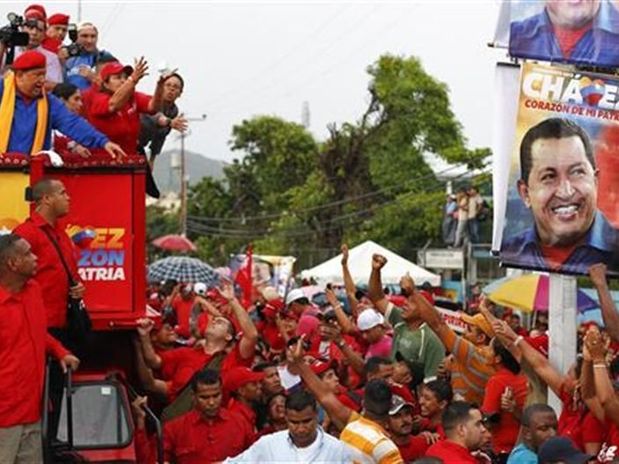
chavez Having Secured a Third Term, Chávez pushes Commune System

Courtesy of: Reuters

On the night of his reelection, Hugo Chávez said in his acceptance speech that he planned to advance his vision of “21st century socialism” in the next term of his presidency. Now, just one month later, it has become clear that the plan involves the massive expansion of the “commune” system, which experts say is a plot to diminish the power of the opposition.

Communes are a standard feature of the socialist model of government. Chávez touts them as essential to his agenda, as he claims they will give people the power to manage their own resources. But many believe that his renewed interest in them – following an election in which he was victorious by a narrower margin than ever before – is not as ideological as he claims. Instead, many characterize the push for communes as motivated by a desire to reclaim power for his own party on the state and local levels.

To date, Chávez has attempted to weaken the power of state and municipal authorities merely by withholding the share of the national budget they are guaranteed by the constitution. He’s effectively accomplished this by significantly underreporting oil revenue, which limits the amount paid to municipal leaders, many of which are his political foes. But the commune proposal now on the table has been criticized as an offensive to further destabilize the country’s pluralist constitution and decimate any remaining shreds of capitalism.

The implementation of communes could prove disastrous for the opposition by absorbing and ultimately diminishing much of the power of mayors and governors. Already, as part of its most recent budget proposal, Chávez’s party proposed a far greater increase (37 percent) in the amount of funding going to the communes than to either the state or municipal governments (22 and 23 percent, respectively). A logical next step could potentially involve the assignment of the few remaining political responsibilities from local authorities to the communes.

In 2007, the people of Venezuela rejected an amendment to the constitution that would have provided for the legal establishment of the communes. However, in December of 2010 the National Assembly passed the Enabling Law, which granted the president broad authority to mandate by decree following the flooding that left approximately 100,000 Venezuelans homeless. The law gave Chávez unchecked power for eighteen months, through which he created a ministry charged with setting up the communes. However, creation of communes had stalled until October 20 – just 13 days after his reelection – when he urged the National Assembly to implement of the Communes Law.

But implementation has been slow because the act is unconstitutional. It illegally changes the very nature of Venezuela’s government by shifting responsibilities from democratically-elected local officials to a central authority. According to the constitution, the deadline has passed for making such dramatic changes this year.

If realized, millions of Venezuelans would be affected by these changes. By the numbers, Chávez is looking to grow the communes at a record-breaking pace: 3,000 between 2013 and 2019 at the rate of 450 per year. Ultimately this will incorporate more than 21 million citizens – nearly 68 percent of the country’s population. By consolidating local power into the communes, the president is ensuring that these Venezuelans are largely controlled by the central government – not their locally elected officials.

 
Jun
1
2012
Posted by
admin
Comments

The Truth About Venezuela’s New Labor Law

On April 30, before departing to Cuba to receive additional cancer treatment, President Hugo Chávez signed Venezuela’s new labor law on national television, in commemoration of Venezuelan Labor Day. The ceremony was — as most of his recent speeches have been — short, revealing few details about what the law actually entails.

After being reviewed by the Supreme Court, the 554 articles and 7 transitional provisions were formally approved and published on May 7. The ambiguity surrounding the details has left many wondering about the finer points of the new law, however. Critics, including opposition candidate Henrique Capriles, have argued that the law was approved primarily for political posturing, only seeking the consultation of his ministers and bureaucrats on such a sweeping reform, not business advocates or even the National Assembly itself.

The law’s enactment came less than two months away from the expiration of the 2010 passage of Venezuela’s “enabling law,” which gave the president 18 months to govern through issue decrees carrying the full force and effect of a measure passed by the Assembly. While the power was bestowed upon him to give him authority necessary to cope with the heavy rains and flooding that ravaged the country, as few as about six of 33 approved laws have to do with the reasons for requesting the enabling law. Despite its lack of relevance, Chávez circumvented the Assembly, unilaterally enacting this law. On the cusp of his most challenging election ever, he continues to tout it as a fundamental tool for the continuation of his socialist project.

The law does have populist appeal – reducing the working hours from 44 to 40 hours per week, limiting night shifts to 35 hours per week, raising minimum wage by nearly one-third, entitling women to an additional two months of maternity leave, and protecting new parents from dismissal for up to two years after the child’s birth.

In addition, it seeks to implement absolute job stability; in the absence of due cause, the only way for employers to terminate any employment relationship is via a workers’ resignation. The law reestablishes a rule calling for a retirement bonus of a worker’s last monthly wage multiplied by their years of service, while also requiring that employers compensate unfairly dismissed workers with double their retirement bonus.

Finally, the measure seeks to abolish private sub-contracted labor in Venezuela.

To the naked eye, many of these provisions would appear to be beneficial to working-class Venezuelans. However, many critics argue that law also promotes a regulatory scheme that many believe will hinder production and adversely impact small and medium sized enterprises, especially if the government is unable to reduce inflation in the coming years.

Others also fear that if not accompanied by the right policies to stimulate productivity and growth, the new law could inevitably deteriorate real wages, lead to a reduction in jobs availability, and result in lower investment and production, all of which would exacerbate inflation rates and shortages. Furthermore, critics have argued that women could be severely affected by the new regulations, as companies could see the extensive maternity leave as a risk, generating discrimination by employers when hiring female staff.

The most controversial provision, however, seems to be the formation of a government-managed fund from the severance benefits of workers. Severance benefits are the rainy day money Venezuelans deposit into individual trust accounts, which now will be placed into a state-managed fund. Previous to the new law, workers had direct access to these funds when they change jobs, retire or need to cover medical, housing or other expenses. Following rumblings of the proposed change, nervous workers lined up at banks to empty as much as they can out of their severance accounts. But the government, insisting that the new plan was still in development, blocked public sector workers from drawing on the accounts. Indeed, the government’s proposal has sparked widespread concern that could prove to weaken the president this fall.

Ostensibly, the provision’s objective is to establish a mechanism used to guarantee new bonds and finance development projects. But local analysts have cautioned that the private sector will absorb these costs, stoking unemployment. Moreover, analysts have expressed worries over the increased control of these benefits by a government notorious for its lack of transparency.

In addition, the labor law will restore the retroactivity of severance payments from June 1997, for those currently working in private or state-run sectors who decide to quit — a measure some believe will cause further strain on businesses.

As Ismael Pérez Vigil, the executive president of the Venezuelan Confederation of Industries (Conindustria) claims, “obviously, retroactivity (of severance payments) will have a very strong impact; (Venezuelan) businesses will be hardly hit.”

By appealing to workforce and the lower classes, Chávez hopes to use the labor law as an electoral gambit. By failing, however, to integrate many sectors into the discussion, skeptics fear that it will give rise to conflicts between businesses and employees, risk fueling unemployment, and shrink Venezuela’s private sector even further. Its full impact remains unclear, but it is apparent that there is more behind the law than the simple desire of bringing social justice to workers.