Oct
1
2012
Posted by
admin
Comments

Capriles Rally Draws Thousands Against Chavez Ahead of Vote

Bloomberg News
October 01, 2012
By Nathan Crooks and Jose Orozco
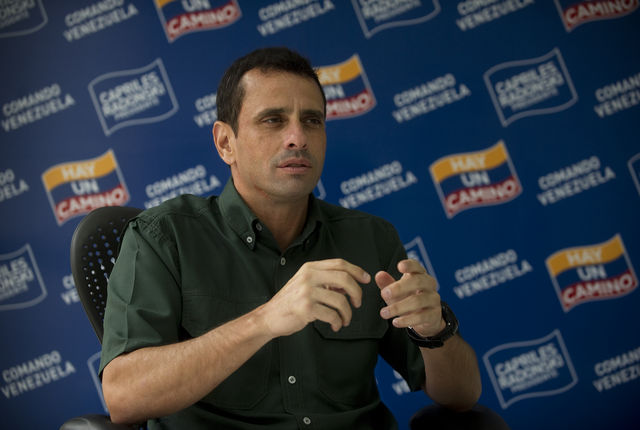
henrique capriles radonski Capriles Rally Draws Thousands Against Chavez Ahead of Vote

Courtesy of: Juan Barreto / AFP / Getty Images

Venezuelan opposition candidate Henrique Capriles Radonski symbolically closed his Caracas campaign against President Hugo Chavez yesterday with a march attended by tens of thousands of supporters.

Capriles, dressed in a shirt styled with the three colors of Venezuela’s flag, promised to confront growing violence in the South American country after he said three supporters were shot and killed over the weekend in Barinas state. He asked voters to judge Chavez’s priorities after 13 years in power and decide if they were happy with their lives today.

“This government gives away resources to every other country,” Capriles said. “There is no gauze in the hospitals here, but they give money away to sponsor samba dancing at the carnival in Rio.”

Capriles, 40, has held large rallies across Venezuela over the past month to close his campaign and build momentum after making house-to-house visits to offer what he described as a message of unity, progress and private investment. He filled the stadium used by Chavez’s favorite baseball team on Sept. 27 in a rally to close his campaign in the central state of Carabobo.

“This has to be one of the largest marches in the history of Caracas,” Capriles said yesterday to a throng filling the length of Bolivar Avenue in downtown Caracas, a symbolic space often used by Chavez for campaign rallies, waving party flags, chanting, dancing to campaign music and blowing vuvuzelas.

Leopoldo Lopez, a member of Capriles’ campaign team, said on the Globovision television network Sept. 28 that he hoped as many as a million people would attend the march. The campaign didn’t provide an estimate on the size of the march afterward.

Three Dead

Shots were fired at a caravan of cars in eastern Barinas state on Sept. 29 when Capriles supporters tried to pass a checkpoint, the Primero Justicia political party said in a statement, adding that the barricade had been set up by “presumed” Chavez supporters.

Police have detained three suspects, the Venezuelan government said yesterday in an e-mailed statement, without providing additional details. Chavez, who spoke at a rally yesterday in western Zulia state, said the incident was “regrettable” and urged his supporters not to fall into “provocations.”

Chavez, who also spoke at a rally on Sept. 29 in central Miranda state, said he himself is one of the biggest critics of his government and that there were reasons for some people to be “discontent.”

Insecurity, Crime

“There have been failures and problems, but what is at stake on Oct. 7 is not about the small or medium problems including water or electricity problems,” said Chavez. “We’ll solve the problems of insecurity and crime.”

Andrea Thadino, who lives in Caracas slum of San Agustin where a cousin was killed by a gunfight three years ago, said she works at a street nail salon because she can’t get a job teaching at a public school after signing a petition against Chavez.

“Despite studying for five years, I have to work as a street vendor to survive,” she said in an interview at yesterday’s march while carrying her 2-year-old son. “I voted for Chavez the first time but not anymore. I think Capriles is a sincere man who is going to make a change.”

Fitness for Office

Capriles, a former governor of Miranda state, has played up his youth and fitness to offer a stark contrast to the condition of his 58-year-old opponent, who is coming off three operations related to an unknown cancer in the past 15 months. He is ahead in several polls while trailing by as much as 15 percentage points in others.

“There are two options here. One we already know and has been in power for 14 years,” Capriles said. “I lead the other option that aims to solve your problems.”

Capriles, who arrived on a truck with “Progress” written on its windshield, said Chavez had dashed the hopes of many Venezuelans.

“There was a lot of hope, wherever you went, there were rivers of people full of hope,” said Capriles, referring to the period after Chavez was first elected. “Almost 14 years later, you be the judge of who is in the process of change and who is sick with power. Because the man in Miraflores defrauded the Venezuelan people.”

After his speech, Capriles hugged his mother and tossed his trademark baseball caps with the Venezuelan colors into the crowd.

Middle Class Votes

Chavez, a self-professed socialist who is traditionally supported by the country’s poor, has spent his final days on campaign trying to attract middle class and rich voters.

“Those with a big house and two or three cars in the garage, a good job, their kids in a good school, the ones who go to the club on Friday night and take their plane to Miami or Margarita Island on Saturday, those people should vote for Chavez,” the former paratrooper said in an interview broadcast yesterday on the Televen television network. “We are the guarantee of tranquility. Think about it well. It’s not for me, it’s for you.”

Armando Briquet, head of the Capriles campaign, said the government is trying to make the vote difficult for the opposition with actions including the closing of Venezuela’s Miami consulate, which will require thousands of voters to travel to the nearest voting center in New Orleans.

“Even with all that, we are going to win by more than 10 percentage points,” Briquet said backstage after the rally, citing the campaign’s polling numbers.

“On Oct. 7, Chavez wins!” Chavez told supporters yesterday in Zulia state. “It will be a grand victory, I don’t have a doubt.”

To contact the reporters on this story: Nathan Crooks in Caracas at [email protected]; Jose Orozco in Caracas at [email protected].

To contact the editor responsible for this story: Joshua Goodman at [email protected].

To read this article on Bloomberg News, please click here.

 
Aug
23
2012
Posted by
admin
Comments

Hope and Anxiety: Six Weeks until Venezuelans Vote

venezolanos acuden a primarias de la oposicion Hope and Anxiety: Six Weeks until Venezuelans Vote

Courtesy of: AVN

Almost two months since Venezuela’s presidential campaign “officially” began, many polls suggest the race is nearly tied. Doubts about Chávez’s health and continued skepticism about assertions he is “free of cancer” have kept the polls close and the number of undecided voters high. Venezuelans are perhaps beginning to suspect a vote for Chávez is a de facto vote for Elias Jaua, Nicholas Maduro or whichever subordinate would succeed him the president if he does succumb to his cancer.

Meanwhile, opposition candidate Henrique Capriles has won over many Venezuelans by infusing a palpable optimism into his promises of a more effective government. He has run a two-pronged campaign, supplementing his dogged “town-by-town” march throughout the country with a robust social media presence.

It’s a strategy born as much as of necessity as the candidate’s preference, as Chávez’s stranglehold of Venezuela’s traditional media prevents Capriles from getting much traction over the airwaves or in the papers. Capriles’ criss-crossing march circumvents the regime’s control of the media and allows Venezuelans to meet the candidate himself; his use of Facebook and other online forums provides voters an alternative to Chávez’s government-mandated “cadenas.” And, so far, the strategy appears to be working.

Nevertheless, the deck remains stacked in Hugo Chávez’s favor. Despite Capriles’ success, his government still controls the media. He continues to borrow money to prop up the economy – racking up debts which analysts say will result in a currency devaluation after the election. He has compelled government employees to donate a day’s wages or to “volunteer” for his campaign. Most troublingly, concerns remain that the October elections may not be conducted as freely and fairly as the government has promised.

One must carefully skirt the line between alertness and cynicism here, but there is indeed reason for concern. Chávez has not invited OAS election monitors and other credible observers from supervising the election – claiming speciously that Venezuela doesn’t need election monitors. News outlets within Venezuela report that the government has packed Chávez-friendly neighborhoods with extra polling stations. Electronic thumbprint readers installed at ballot boxes may prevent opposition supporters weary of government surveillance from voting at all. To top it all off, The Economist pondered this month whether Venezuela’s military generals would even acknowledge an opposition victory in October.

Chávez’s health muddies the picture still further, as the International Crisis Group explained:

Chávez’s illness takes Venezuela onto unknown – and unpredictable – terrain. One scenario, were the president or a late stand-in defeated in an upset, would see the ruling party seek to force the electoral authorities to suppress results. A second, especially if the president’s health should decline rapidly, would have it delay the vote in order to buy time to select and mobilise support for a replacement. Either scenario could spark opposition protests and escalating confrontation with government loyalists.

Such nightmare scenarios are far from predetermined. Venezuela may yet acquit itself on the global stage by holding an open, fairly administered election. But the international community must watch closely – as all democracies have a responsibility to ensure that the will of the Venezuelan people is respected.

 
Aug
21
2012
Posted by
admin
Comments

Carter Center Says It Won’t Witness Venezuela Vote

ABC News via Associated Press
August 21, 2012
By Ian James

The Carter Center Carter Center Says It Wont Witness Venezuela Vote

Courtesy of: Carter Center

The Carter Center said on Monday that it declined an invitation from Venezuela’s National Electoral Council to have a team at the country’s Oct. 7 presidential election.

The Atlanta-based Carter Center was among the organizations that sent observer missions to monitor Venezuela’s last presidential vote in 2006, along with the European Union and the Organization of American States. Venezuelan electoral authorities have since stopped inviting full international observer missions and have instead asked some foreign individuals to witness voting in smaller-scale “accompaniment” visits.

The Carter Center said in a statement that the council invited it to “form an intermediate option” and send a small group of experts to join in pre-election audits and be present on voting day. But the organization said it received the invitation too late “to evaluate it and organize the necessary experts and financing.”

“My understanding is that the (electoral council) has come to the conclusion that they no longer need international observation to give confidence to the process,” said Jennifer McCoy, director of the center’s Americas program. “Since 2006 they’ve been in consultation with the political parties to establish a number of security mechanisms and audits with the participation of the political parties to give confidence to the process.”

McCoy said in a telephone interview that Venezuelan domestic observer groups, political parties and voters themselves will have a number of ways to participate in monitoring the vote.

President Hugo Chavez is seeking another six-year term in the election, and is facing a challenge from opposition leader Henrique Capriles.

Venezuela isn’t alone in Latin America in not hosting full international observer missions. Argentina and Brazil don’t have a tradition of inviting international observers, McCoy said.

“For the international community, the difficulty comes if there are competing interpretations of what happened … if different parties within the countries do not agree on the results,” McCoy said. “Then it’s just more difficult for the international community to know how to react.”

To read this article on ABC News, please click here.