Jun
11
2013
Posted by
admin
Comments

ICYMI: Looking for toilet paper in Venezuela? There’s an app for that

Financial Times
June 10, 2013
By Benedict Mander

venezuela toilet paper reuters 1200 ICYMI: Looking for toilet paper in Venezuela? There’s an app for that

Courtesy of: Reuters

It turns out that President Nicolas Maduro thinks that the plan to introduce food rationing in Zulia, Venezuela’s most populous state, is “crazy”.

Regardless of whether he always thought that, or whether, perhaps, the increasingly unpopular president was responding to widespread rejection of the plan, he’s right – it is not the way to put an end to the problem of shortages that has become so acute that someone has even invented an app to help Venezuelans locate specific goods they are having difficulty finding.

Maduro was also right when he said that “the answer to our problems is to produce more”.

Let’s just forget for the moment that in saying this he was rather undermining the Zulia governor, Francisco Arias Cardenas, who had denied that the scheme even amounted to rationing in the first place, and that in fact it was aimed at preventing smuggling (if you wanted to do something about that, you probably wouldn’t produce more, but instead perhaps try and do something about the irresistible arbitrage opportunities in Colombia thanks to Venezuela’s price controls, or at the very least introduce stronger controls on the border).

Let’s also ignore the fact that the government has already put in place another rationing scheme in Zulia, for petrol, which by Maduro’s logic ought probably be pretty “crazy” too. Again, officials insist the idea is to prevent gasoline contraband, which is indeed rife in Zulia since it is magnificently profitable – some suggest it is an even bigger business in Venezuela than the cocaine trade.

In any case, increased production would certainly go a long way to solving Venezuela’s shortages problem. Ideally it would be an increase in the production of the goods that are scarce, especially food, but increased oil production might do too, as crude exports could provide the dollars needed to import more. This would probably be more practical in the shorter term, given the problems Venezuela has producing just about anything that is not oil (although that is not to say state oil company PDVSA does not have serious challenges of its own).

The problem is that, in the current conditions, Venezuelan businesses are unlikely to start producing much more. In order for this to happen, a lot needs to change: for starters, the business climate must improve, and that includes doing something about price and currency controls, something which Maduro has shown no signs of doing. And don’t expect state companies to pick up the slack – the government is even said to have seriously considered the offer of Venezuela’s largest private company, Polar, to help run underperforming state-owned food processing plants.

The app that aims to help Venezuela’s long-suffering shoppers, known as Abasteceme (or Supply Me) and which uses Google Maps and “crowdsourcing” to enable users to notify one another where a certain product is for sale, has so far only been downloaded 12,000 times. It is a scheme that promises to be infinitely more successful than Zulia’s still-born rationing plans.

To read this article at Financial Times, please click here.
 
Oct
1
2012
Posted by
admin
Comments

Capriles Rally Draws Thousands Against Chavez Ahead of Vote

Bloomberg News
October 01, 2012
By Nathan Crooks and Jose Orozco

henrique capriles radonski Capriles Rally Draws Thousands Against Chavez Ahead of Vote

Courtesy of: Juan Barreto / AFP / Getty Images

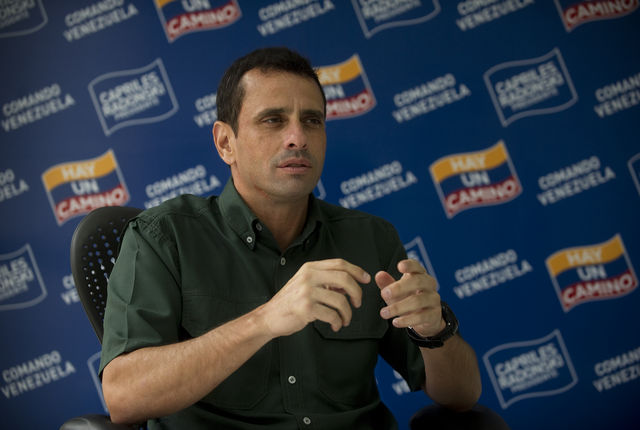
Venezuelan opposition candidate Henrique Capriles Radonski symbolically closed his Caracas campaign against President Hugo Chavez yesterday with a march attended by tens of thousands of supporters.

Capriles, dressed in a shirt styled with the three colors of Venezuela’s flag, promised to confront growing violence in the South American country after he said three supporters were shot and killed over the weekend in Barinas state. He asked voters to judge Chavez’s priorities after 13 years in power and decide if they were happy with their lives today.

“This government gives away resources to every other country,” Capriles said. “There is no gauze in the hospitals here, but they give money away to sponsor samba dancing at the carnival in Rio.”

Capriles, 40, has held large rallies across Venezuela over the past month to close his campaign and build momentum after making house-to-house visits to offer what he described as a message of unity, progress and private investment. He filled the stadium used by Chavez’s favorite baseball team on Sept. 27 in a rally to close his campaign in the central state of Carabobo.

“This has to be one of the largest marches in the history of Caracas,” Capriles said yesterday to a throng filling the length of Bolivar Avenue in downtown Caracas, a symbolic space often used by Chavez for campaign rallies, waving party flags, chanting, dancing to campaign music and blowing vuvuzelas.

Leopoldo Lopez, a member of Capriles’ campaign team, said on the Globovision television network Sept. 28 that he hoped as many as a million people would attend the march. The campaign didn’t provide an estimate on the size of the march afterward.

Three Dead

Shots were fired at a caravan of cars in eastern Barinas state on Sept. 29 when Capriles supporters tried to pass a checkpoint, the Primero Justicia political party said in a statement, adding that the barricade had been set up by “presumed” Chavez supporters.

Police have detained three suspects, the Venezuelan government said yesterday in an e-mailed statement, without providing additional details. Chavez, who spoke at a rally yesterday in western Zulia state, said the incident was “regrettable” and urged his supporters not to fall into “provocations.”

Chavez, who also spoke at a rally on Sept. 29 in central Miranda state, said he himself is one of the biggest critics of his government and that there were reasons for some people to be “discontent.”

Insecurity, Crime

“There have been failures and problems, but what is at stake on Oct. 7 is not about the small or medium problems including water or electricity problems,” said Chavez. “We’ll solve the problems of insecurity and crime.”

Andrea Thadino, who lives in Caracas slum of San Agustin where a cousin was killed by a gunfight three years ago, said she works at a street nail salon because she can’t get a job teaching at a public school after signing a petition against Chavez.

“Despite studying for five years, I have to work as a street vendor to survive,” she said in an interview at yesterday’s march while carrying her 2-year-old son. “I voted for Chavez the first time but not anymore. I think Capriles is a sincere man who is going to make a change.”

Fitness for Office

Capriles, a former governor of Miranda state, has played up his youth and fitness to offer a stark contrast to the condition of his 58-year-old opponent, who is coming off three operations related to an unknown cancer in the past 15 months. He is ahead in several polls while trailing by as much as 15 percentage points in others.

“There are two options here. One we already know and has been in power for 14 years,” Capriles said. “I lead the other option that aims to solve your problems.”

Capriles, who arrived on a truck with “Progress” written on its windshield, said Chavez had dashed the hopes of many Venezuelans.

“There was a lot of hope, wherever you went, there were rivers of people full of hope,” said Capriles, referring to the period after Chavez was first elected. “Almost 14 years later, you be the judge of who is in the process of change and who is sick with power. Because the man in Miraflores defrauded the Venezuelan people.”

After his speech, Capriles hugged his mother and tossed his trademark baseball caps with the Venezuelan colors into the crowd.

Middle Class Votes

Chavez, a self-professed socialist who is traditionally supported by the country’s poor, has spent his final days on campaign trying to attract middle class and rich voters.

“Those with a big house and two or three cars in the garage, a good job, their kids in a good school, the ones who go to the club on Friday night and take their plane to Miami or Margarita Island on Saturday, those people should vote for Chavez,” the former paratrooper said in an interview broadcast yesterday on the Televen television network. “We are the guarantee of tranquility. Think about it well. It’s not for me, it’s for you.”

Armando Briquet, head of the Capriles campaign, said the government is trying to make the vote difficult for the opposition with actions including the closing of Venezuela’s Miami consulate, which will require thousands of voters to travel to the nearest voting center in New Orleans.

“Even with all that, we are going to win by more than 10 percentage points,” Briquet said backstage after the rally, citing the campaign’s polling numbers.

“On Oct. 7, Chavez wins!” Chavez told supporters yesterday in Zulia state. “It will be a grand victory, I don’t have a doubt.”

To contact the reporters on this story: Nathan Crooks in Caracas at [email protected]; Jose Orozco in Caracas at [email protected].

To contact the editor responsible for this story: Joshua Goodman at [email protected].

To read this article on Bloomberg News, please click here.

 
Feb
13
2012
Posted by
admin
Comments

In Case You Missed It… Articles Roundup from Primary Election

In a special roundup of coverage from Sunday’s primary elections…Numerous news sources report on Henrique Capriles Radonski’s landslide victory in the first-of-its-kind opposition primary, winning with a large majority (62 percent) of the vote.  Primary turnout exceeded expectations, as approximately 3 million Venezuelans showed up at the polls, sending a clear message of strength to Hugo Chávez ahead of the October 7 general election. Reports discuss the unprecedented commitment to unity by the opposition.

Chávez Opponent Surges in Venezuela, The Wall Street Journal
An intense young governor, part of a new generation of Venezuelan politicians, will be facing off against an ailing President Hugo Chávez after winning a landslide primary victory Sunday.

Venezuela’s Capriles seeks to unseat Chavez, Reuters
Venezuela’s opposition primary winner Henrique Capriles exuded confidence on Monday that he can unseat President Hugo Chavez and end 13 years of socialism that foes say has left the OPEC nation in crisis.

Chavez’s challenger vows to unite Venezuela, Associated Press via CBS News
Now that Henrique Capriles has easily won Venezuela’s first-ever opposition presidential primary, he’s not just up against any other incumbent. The young governor will have to defeat a veritable political phenomenon.

Venezuelan Primary Turnout May Augur Chavez’s Biggest Test, Bloomberg
President Hugo Chavez may face his toughest challenge in 13 years of power after Venezuelans turned out in large numbers to give a landslide victory to Henrique Capriles Radonski in an opposition primary.

And in the blue corner…, The Economist
MORE than a few supporters of the opposition to Hugo Chávez, Venezuela’s president, awoke on February 13th feeling the need to pinch themselves. The results of the open primary elections the night before, designed above all to pick a candidate to frustrate Mr Chávez’s bid for re-election in October, exceeded all expectations.

Venezuela opposition aims for rich electoral reward, BBC News
It was the politest of election campaigns. Well-mannered television debates ended with the candidates raising each other’s hands in victory, and applauding their competitors’ contributions. Long-standing political differences were glossed over as six (and then five, as one withdrew) ambitious politicians competed for a single prize – the chance to compete for the Venezuelan presidency against Hugo Chavez.

Boost for Capriles’ hope to challenge Chavez, The Financial Times
Venezuelan government officials sought to play down a resounding victory for Henrique Capriles Radonski in opposition primary elections, as a turnout of 3m for Sunday’s poll raised hopes he could successfully challenge President Hugo Chavez in elections later this year.

Carlos Ponce: Venezuela Election – Hope is in the Air, Fox News Latino
The impossible challenge for the Venezuelans to built a “Unitarian” opposition to Mr. Hugo Chávez  it is not an utopian goal anymore. The totalitarian and authoritarian regime from Mr. Chávez finally has a young and active contender.

Venezuela’s opposition unites around Capriles. Can he beat Chavez?, The Christian Science Monitor
A record turnout of nearly 3 million people voted in Venezuela’s opposition presidential primary yesterday, selecting Henrique Capriles Radonski as the candidate.

After winning Venezuela primary vote, youthful governor faces tough contest against Chavez, The Associated Press
Now that Henrique Capriles has easily won Venezuela’s first-ever opposition presidential primary, he’s not just up against any other incumbent. The young governor will have to defeat a veritable political phenomenon.

Henrique Capriles, Winner of Venezuela Opposition Primary, Will Face Hugo Chavez, Fox News Latino
Venezuelan President Hugo Chávez officially has an opponent for October’s elections. Youthful state governor Henrique Capriles coasted to victory in the country’s first-ever opposition presidential primary Sunday, campaigning on a center-left platform that some compare to Brazilian leader Luiz Inácio “Lula” da Silva.

Henrique Capriles, Chavez Challenger, Wins Venezuela’s Opposition Presidential Primary, The Associated Press
Youthful state governor Henrique Capriles won Venezuela’s first-ever opposition presidential primary Sunday by a wide margin, emerging as the single candidate who will try to end President Hugo Chavez’s 13 years in power.

Venezuela Bonds Rally as Capriles Wins Presidential Primary: Caracas Mover, Bloomberg
Venezuelan bonds rallied after opposition candidate Henrique Capriles Radonski scored more than 60 percent of the vote in a nationwide primary, a landslide win that analysts said could strengthen his bid to unseat President Hugo Chavez in October elections.

Pérez to Capriles: You are going to be Venezuela’s next president, El Universal
Pablo Pérez, the governor of the state of Zulia, said that the Venezuelan people showed that they have no fear, because 2,900,000 people cast their vote in the opposition primaries on February 12. He acknowledged Henrique Capriles Radonski’s victory. “To Henrique Capriles Radonski, my friend, as I told you since I enrolled as a candidate: My friend, you are going to be Venezuela’s next president.”