Aug
19
2013
Posted by
admin
Comments

ICYMI: Venezuela Government Under Fire for Anti-Gay Slurs

Wall Street Journal
August 15, 2013
By Kejal Vyas and Ezequiel Minaya
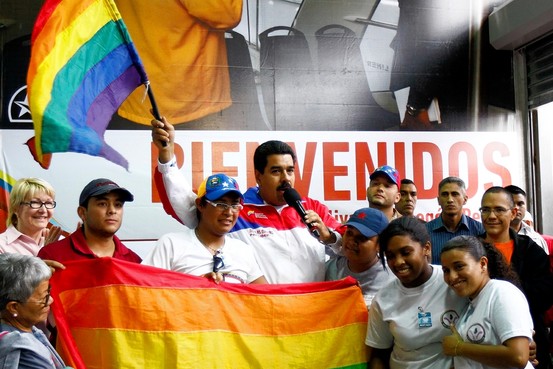
WO AP040 VENGAY G 20130816182829 e1376937194509 ICYMI: Venezuela Government Under Fire for Anti Gay Slurs

Courtesy of: Reuters

CARACAS—Venezuela’s leftist government, which often touts its social inclusion and antidiscrimination policies, is under fire from rights groups after a tirade of antigay slurs in the National Assembly, prompting President Nicolas Maduro to take to the airwaves waving a conciliatory gay-pride flag—before continuing to attack his political opponents.

Lawmakers from Mr. Maduro’s United Socialist Party of Venezuela released photos that appeared to be from a private gathering in which a top aide to the opposition’s former presidential candidate is seen hugging other men and, in others, mugging for the camera while wearing a shawl and a feathered head piece.

Though the pictures showed nothing lurid, the lawmakers charged that they were “unquestionable” proof of the opposition’s “moral degradation” and evidence of their involvement with “prostitutes” and orgies.

Socialist party congressman Pedro Carreño said “we in the revolution accept sexual diversity,” before using antigay slurs and vulgarities to describe the opposition leader Henrique Capriles and his Primero Justicia party.

The following day, Mr. Carreño apologized, adding, “but I had to put them in their place.”

Ramón José Medina, a director of the opposition coalition, dismissed the allegations as trumped-up efforts by government officials to divert attention from the mountain of economic and social problems plaguing Venezuela, including high crime and an inflation rate topping 40%.

“All of this is clearly an attempt to attack those close to Capriles,” he said.

He said some of the photos as well as receipts to a party-services company cited by Socialist party lawmakers to support allegations of corruption came from property seized during the search of the aide’s residence a week ago.

He said they do not prove any wrongdoing and added that officials were violating the law by publicly showcasing private property. “We’re still trying to figure out what offense they say was committed here,” Mr. Medina said.

Activist groups said the slurs followed a pattern of increasing demonization of homosexuals in the political arena during the past year amid a pair of hard-fought presidential elections. Last October, Mr. Capriles came close to beating former President Hugo Chávez, who died of cancer in March.

Politicians in Venezuela use gay and transgender slurs to “destroy” political adversaries, said Yonatan Matheus, director of the gay advocacy group Venezuela Diversa.

Venezuela has one of the least friendly legal environments toward the gay community in the Spanish-speaking Americas, experts said. Homosexual acts are legal but civil-unions aren’t recognized, in contrast to an increasing number of other countries in the region, said Javier Corrales, a political-science professor at Amherst College, who has written on homosexual and transgender issues in Latin America.

Allies of Venezuela like Argentina and Uruguay have both moved forward with legalizing gay marriage. Meanwhile in Ecuador, courts fined a former presidential candidate earlier this year and stripped him of his political rights for one year after he made homophobic comments.

Mr. Chávez, who often celebrated diversity and inclusion policies toward women, blacks and indigenous peoples, steered clear of the issue.

“What happened in the National Assembly will go down in history as one of the most aggressively homophobic acts in contemporary Latin America,” Mr. Corrales said. “The government is hoping that the public becomes more scandalized by issues of ‘indecency’ than by issues of actual money-related corruption.”

On Wednesday, Mr. Maduro appeared on television holding a rainbow-colored flag and said that he was in solidarity with people of different sexual orientation but backed his ally, Mr. Carreño, calling him an “honorable man.”

He then went on the offensive again, accusing Mr. Capriles of holding orgies in his office. What was shown in the National Assembly, “is only 1% of all that has been uncovered. The orgy videos and photos aren’t publishable…it would be denigrating to the human condition,” the president said.

Mr. Maduro, facing growing criticism of alleged government corruption in his regime, has promised to tackle widespread graft but his withering rhetoric so far has focused almost exclusively on his political foes.

During the presidential campaign in April, Mr. Maduro used gay slurs against Mr. Capriles and other political rivals. Mr. Maduro later offered a tacit apology on state television.

“This is what I would call the pattern of a state that’s schizophrenic,” said Tamara Adrián, a Venezuelan lawyer, professor and local gay and transsexual rights advocate.

Ms. Adrián said Venezuela has signed international accords for protection of sexual diversity, “but it’s not what we see every day,” citing frequent cases of harassment and violent crimes against lesbians and gays.

To read this article at Wall Street Journal, please click here.
 
Jun
18
2013
Posted by
admin
Comments

ICYMI: Breast-feeding is best, so ban bottles, Venezuelan lawmaker proposes

CNN
June 18, 2013
By Catherine E. Shoichet

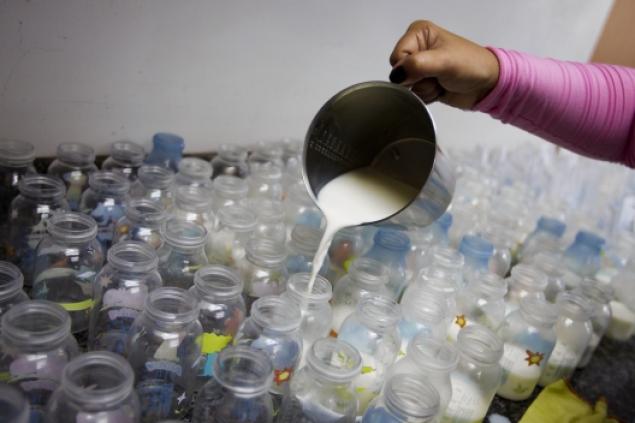
population e1371580976192 ICYMI: Breast feeding is best, so ban bottles, Venezuelan lawmaker proposes

Courtesy of: Reuters

Venezuelan lawmakers are weighing whether to ban the use of baby bottles as part of a push to promote breast-feeding, state media reported.

The proposed measure will be up for debate in the South American country’s National Assembly on Tuesday, lawmaker Odalis Monzon said in an interview with state-run VTV.

“Every baby has the right to breast-feeding,” said Monzon, a lawmaker from the ruling United Socialist Party of Venezuela.

In addition to banning bottle-feeding, the proposed revisions to Venezuela’s Law of Promotion and Protection of Breastfeeding also include plans to penalize those who advertise baby formula, she said.

Transnational companies that market formula, she said, have interfered with a crucial bond between mother and child.

“The most important is the love, the connection between mother and child, that sometimes is lost because they do not give them the warmth that nursing a baby provides,” Monzon told VTV.

The proposal includes exceptions for mothers who cannot breast-feed due to illness, Monzon said. It would also provide for the creation of more breast-milk banks and require companies to set aside space for mothers to nurse.

She did not provide details about how authorities would enforce the measure if it passes, or what sorts of punishments violators would face.

The measure has drawn sharp criticism from some lawmakers, who argue that the government can promote breast-feeding without prohibiting anything, CNN affiliate Globovision reported.

“This is unacceptable and alarming,” said Eduardo Marin, a lawmaker for the opposition Justice First party.

The 2007 law that Monzon is pushing to amend was aimed at promoting breast-feeding, Marin said, not “questioning, stigmatizing and practically criminalizing those who have opted for (other methods) of feeding.”

Earlier this month, Venezuela’s Health Ministry said that 27.1% of mothers in the country who are able to breast-feed actually do so and that officials aimed to increase that number to 70% by 2019,VTV reported.

To read this article at CNN, please click here.

 
Oct
1
2012
Posted by
admin
Comments

Capriles Rally Draws Thousands Against Chavez Ahead of Vote

Bloomberg News
October 01, 2012
By Nathan Crooks and Jose Orozco

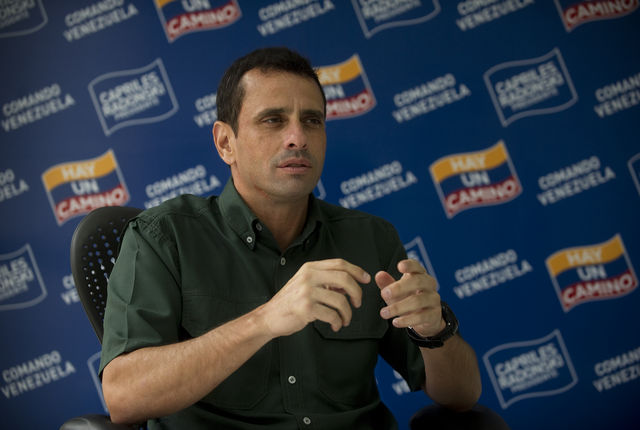
henrique capriles radonski Capriles Rally Draws Thousands Against Chavez Ahead of Vote

Courtesy of: Juan Barreto / AFP / Getty Images

Venezuelan opposition candidate Henrique Capriles Radonski symbolically closed his Caracas campaign against President Hugo Chavez yesterday with a march attended by tens of thousands of supporters.

Capriles, dressed in a shirt styled with the three colors of Venezuela’s flag, promised to confront growing violence in the South American country after he said three supporters were shot and killed over the weekend in Barinas state. He asked voters to judge Chavez’s priorities after 13 years in power and decide if they were happy with their lives today.

“This government gives away resources to every other country,” Capriles said. “There is no gauze in the hospitals here, but they give money away to sponsor samba dancing at the carnival in Rio.”

Capriles, 40, has held large rallies across Venezuela over the past month to close his campaign and build momentum after making house-to-house visits to offer what he described as a message of unity, progress and private investment. He filled the stadium used by Chavez’s favorite baseball team on Sept. 27 in a rally to close his campaign in the central state of Carabobo.

“This has to be one of the largest marches in the history of Caracas,” Capriles said yesterday to a throng filling the length of Bolivar Avenue in downtown Caracas, a symbolic space often used by Chavez for campaign rallies, waving party flags, chanting, dancing to campaign music and blowing vuvuzelas.

Leopoldo Lopez, a member of Capriles’ campaign team, said on the Globovision television network Sept. 28 that he hoped as many as a million people would attend the march. The campaign didn’t provide an estimate on the size of the march afterward.

Three Dead

Shots were fired at a caravan of cars in eastern Barinas state on Sept. 29 when Capriles supporters tried to pass a checkpoint, the Primero Justicia political party said in a statement, adding that the barricade had been set up by “presumed” Chavez supporters.

Police have detained three suspects, the Venezuelan government said yesterday in an e-mailed statement, without providing additional details. Chavez, who spoke at a rally yesterday in western Zulia state, said the incident was “regrettable” and urged his supporters not to fall into “provocations.”

Chavez, who also spoke at a rally on Sept. 29 in central Miranda state, said he himself is one of the biggest critics of his government and that there were reasons for some people to be “discontent.”

Insecurity, Crime

“There have been failures and problems, but what is at stake on Oct. 7 is not about the small or medium problems including water or electricity problems,” said Chavez. “We’ll solve the problems of insecurity and crime.”

Andrea Thadino, who lives in Caracas slum of San Agustin where a cousin was killed by a gunfight three years ago, said she works at a street nail salon because she can’t get a job teaching at a public school after signing a petition against Chavez.

“Despite studying for five years, I have to work as a street vendor to survive,” she said in an interview at yesterday’s march while carrying her 2-year-old son. “I voted for Chavez the first time but not anymore. I think Capriles is a sincere man who is going to make a change.”

Fitness for Office

Capriles, a former governor of Miranda state, has played up his youth and fitness to offer a stark contrast to the condition of his 58-year-old opponent, who is coming off three operations related to an unknown cancer in the past 15 months. He is ahead in several polls while trailing by as much as 15 percentage points in others.

“There are two options here. One we already know and has been in power for 14 years,” Capriles said. “I lead the other option that aims to solve your problems.”

Capriles, who arrived on a truck with “Progress” written on its windshield, said Chavez had dashed the hopes of many Venezuelans.

“There was a lot of hope, wherever you went, there were rivers of people full of hope,” said Capriles, referring to the period after Chavez was first elected. “Almost 14 years later, you be the judge of who is in the process of change and who is sick with power. Because the man in Miraflores defrauded the Venezuelan people.”

After his speech, Capriles hugged his mother and tossed his trademark baseball caps with the Venezuelan colors into the crowd.

Middle Class Votes

Chavez, a self-professed socialist who is traditionally supported by the country’s poor, has spent his final days on campaign trying to attract middle class and rich voters.

“Those with a big house and two or three cars in the garage, a good job, their kids in a good school, the ones who go to the club on Friday night and take their plane to Miami or Margarita Island on Saturday, those people should vote for Chavez,” the former paratrooper said in an interview broadcast yesterday on the Televen television network. “We are the guarantee of tranquility. Think about it well. It’s not for me, it’s for you.”

Armando Briquet, head of the Capriles campaign, said the government is trying to make the vote difficult for the opposition with actions including the closing of Venezuela’s Miami consulate, which will require thousands of voters to travel to the nearest voting center in New Orleans.

“Even with all that, we are going to win by more than 10 percentage points,” Briquet said backstage after the rally, citing the campaign’s polling numbers.

“On Oct. 7, Chavez wins!” Chavez told supporters yesterday in Zulia state. “It will be a grand victory, I don’t have a doubt.”

To contact the reporters on this story: Nathan Crooks in Caracas at [email protected]; Jose Orozco in Caracas at [email protected].

To contact the editor responsible for this story: Joshua Goodman at [email protected].

To read this article on Bloomberg News, please click here.