Apr
19
2013
Posted by
admin
Comments

In Case You Missed It… Articles Roundup Week of 4/19/13

in5fjQpowmnM e1366405340981 In Case You Missed It… Articles Roundup Week of 4/19/13

Courtesy of: Agence France Presse

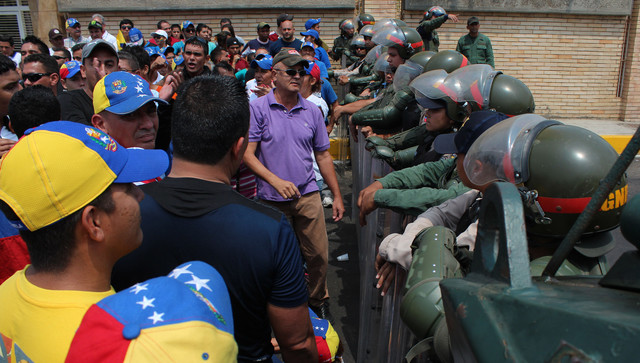
This week:  A narrow margin in the Venezuelan election by Hugo Chávez’s heir Nicolás Maduro spells uncertainty for the country; behind by less than two percent of the vote, opposition candidate Henrique Capriles challenges the election results and demands a full recount; tensions then rise after Venezuela’s government reneges on its promise to carry out the recount of the votes; government security forces and opposition protesters clash in Venezuela over election results; and the news of Maduro’s narrow victory in Venezuela causes bonds to fall and credit-default swaps to rise.  Capriles calls off a march planned to demand an election recount after Maduro and his government threaten a crackdown; U.S. Secretary of State John Kerry encourages a recount of the votes casted in Venezuela’s presidential election; amid post-election violence, Human Rights Watch reports that Venezuela’s government continues to limit citizens’ rights to speak freely and assemble peacefully; and protestors take to the streets with pots and pans to express dissatisfaction towards Maduro and the government’s handling of the election results. Several South American governments hold an emergency meeting to discuss Venezuela’s political crisis; Venezuela’s electoral committee finally agrees to audit – but not fully recount – the presidential vote after demands from the opposition; the aftermath of the presidential election in Venezuela continues to batter the country’s already struggling economy; and the slim election victory represents another sign of the many problems ahead for Maduro and Venezuela. Indeed, the election has further tainted the legitimacy of Maduro and of the government he would represent.

Tight win for Chavez’s heir spells uncertainty for Venezuela, Reuters

Late socialist leader Hugo Chavez’s chosen successor Nicolas Maduro won Venezuela’s presidential election by a whisker but now faces opposition protests plus a host of economic and political challenges in the OPEC nation.

Opposition candidate demands recount after Chavez’s heir Nicolas Maduro wins Venezuela presidency, Fox News

Hugo Chavez’s hand-picked successor, Nicolas Maduro, has officially won Venezuela’s presidential election by a stunningly narrow margin that highlights rising discontent over problems ranging from crime to power blackouts.

Tensions Surge in Venezuela After Vote, The Wall Street Journal

Tension in Venezuela rose sharply Monday after the government reneged on its promise to carry out a full recount of the bitterly contested presidential vote and declared acting President Nicolás Maduro as president-elect.

Protests in Venezuela as opposition disputes Nicolás Maduro’s victory, The Guardian

Venezuelan security forces quelled protests on Monday as Nicolás Maduro – the handpicked heir of Hugo Chávez – was proclaimed president after a wafer-thin and fiercely disputed vote.

Venezuelan Bonds Sink Most in 2 Months on Maduro’s One-Point Win, Bloomberg Businessweek

Venezuela’s bonds tumbled the most in two months and credit-default swaps rose after ex-President Hugo Chavez’s handpicked successor, Nicolas Maduro, won emergency elections by one percentage point over opposition candidate Henrique Capriles.

Capriles Calls Off Protest After Venezuela Threatens Crackdown, Bloomberg Businessweek

Venezuelan opposition leader Henrique Capriles Radonski took a step back from the brink of a mounting confrontation with the government by calling off a march planned for today to protest the results of the April 14 presidential election.

Kerry Encourages Venezuela Recount, The New York Times

Secretary of State John Kerry said Wednesday that Venezuela should hold a recount of votes cast in its presidential election, which the country’s electoral authorities say was narrowly won by a protégé of former President Hugo Chávez.

Venezuela: Respect Free Speech and Assembly, Human Rights Watch

The government of Venezuela should not limit citizens’ rights to freely express their views and assemble peacefully in response to the disputed presidential election, Human Rights Watch said today.

Stand against Venezuela’s new strongman, NY Daily News

There is a stirring sound echoing through Venezuela right now: that of the cacerolazo , a form of protest that involves participants taking to the streets banging pots and pans.

Venezuela dispute prompts urgent meeting of regional leaders, Reuters

Several South American presidents will hold an emergency meeting on Thursday in Lima to discuss the political crisis in Venezuela following the disputed election of President Nicolas Maduro, Peru’s foreign ministry said on Wednesday.

Conceding to opposition, election council to audit Venezuela vote, The Washington Post

Venezuela’s electoral council says it will audit the 46 percent of the vote not scrutinized on election night, a surprise concession that opposition candidate Henrique Capriles says will prove that he won the presidency.

Venezuela’s Election Downshifts Views on Economy, Debt, Wall Street Journal

We hear elections have consequences, which are usually obvious if the winner’s mandate is strong.

Analysis: Venezuela’s Maduro inherits tough economic problems, Reuters

Venezuelan President-elect Nicolas Maduro faces a difficult economic panorama of rising inflation and slowing growth, further complicated by his slim election victory that is being challenged by the opposition.

Maduro’s lousy start, The Economist

Hugo Chávez has been dead for more than a month, but visitors to Caracas could be forgiven for thinking that Venezuela’s bombastic former president was still alive and in power. His image plasters the streets; his speeches fill the airwaves. The blitz was ordered by his anointed successor, Nicolás Maduro, to harness Chávez’s popularity in order to win a landslide in an election on April 14th. The plan failed.

 
Apr
18
2013
Posted by
admin
Comments

ICYMI: Venezuela’s Maduro Fails to Imitate Chávez’ Success

Atlantic Sentinel
April 15, 2013
By Nick Ottens

130414 nicolas maduro ap 605 e1366308092446 ICYMI: Venezuela’s Maduro Fails to Imitate Chávez’ Success

Courtesy of: Associated Press

Acting president Nicolás Maduro was declared the winner in Venezuela’s election on Sunday, defeating the opposition’s candidate Henrique Capriles Radonski by over two hundred thousand votes, according to the state’s election board.

Maduro succeeds the Latin American nation’s fiery socialist leader Hugo Chávez who died of cancer last month after fourteen years in power.

Although Capriles, who won 44 percent of the votes in last year’s election against Chávez and just under 49.1 percent on Sunday, according to the official results, accused the ruling party of fraud and demanded a recount, it is unlikely that Maduro’s victory will be reversed. “We will know what to do if someone raises their insolent voice against the people,” the socialist warned on Sunday night.

Still, Maduro’s unexpectedly narrow win—opinion polls had predicted a landslide—casts doubt on the ruling party’s ability to hold onto power without its popular leader.

Chávez’ protégé lacks the charisma that enabled the deceased former president to win four consecutive elections and influence the politics of neighboring countries, including Bolivia and Ecuador where Presidents Evo Morales and Rafael Correa, respectively, imitated his populist left wing policies.

Risa Grais-Targow, an associate with the Eurasia Group consultancy, expects that Maduro, lacking a base of support of his own, “will struggle to manage internal disputes, especially as social discontent rises in a deteriorating economic environment.”

She writes at Quartz that the new president’s priority will likely be to reverse social discontent, “which means he is unlikely to make needed economic adjustments.”

Foreign exchange and price controls will remain in place. Maduro might pursue even more stringent state controls to “prove his revolutionary credentials,” like pushing an antitrust law through parliament.

The National Assembly is considering a law that would empower the government “to confiscate any business that it deems not acting in the public interest,” writes José R. Cárdenas at Foreign Policy. It would install a panel that decides whether a company has a “decisive domain” over the setting of prices or other market conditions in a particular industry, without stipulating what “decisive domain” means.

In other words, any successful company runs the risk of confiscation at any time by crossing the government’s arbitrary line of being “too successful.” And with the judicial sector also controlled by the government, private companies are left with no outlet to appeal adverse decisions.

Cárdenas predicts that the law will depress private sector production and further tilt the playing field in favor of state owned enterprises which are exempt from it.

Chávez hugely expanded the public sector and nationalized key industries, including oil. But lack of industrial development has forced Venezuela to import refined oil products even if it is the world’s tenth largest petroleum exporter.

The country has also had to cope with energy and food shortages as well as skyrocketing inflation that is projected to top 30 percent this year.

Market reforms are needed to revitalize Venezuela’s economy which the consultancy firm Ecoanalitica projects will expand less than 1 percent this year. Maduro, however, lacks the political credibility and quite probably the will to deviate from the party line and tamper with his predecessor’s legacy.

Significant changes in economic policy are unlikely in the short term even if more Venezuelans than preelection polls suggested apparently agree with Capriles that the current model is “not viable.”

To read this article at the Atlantic Sentinel, please click here.

 
Apr
17
2013
Posted by
admin
Comments

ICYMI: U.S. holds back recognition for Venezuela’s Maduro

Reuters
April 17, 2013
By Patricia Zengerle, Steve Holland and Paul Eckert

Nicolas Maduro 008 ICYMI: U.S. holds back recognition for Venezuelas Maduro

Courtesy of: EPA

The United States on Wednesday held back recognition of leftist President-elect Nicolas Maduro and called on the Venezuelan government to respect the right of free assembly after violence at opposition protests over a disputed election.

Last weekend’s razor-thin election victory by Maduro, the chosen successor of the late socialist President Hugo Chavez, has been rejected by his rival, Henrique Capriles, who is alleging voting irregularities and calling for an audit of the ballots. Seven people have died in opposition-led protests.

Secretary of State John Kerry said the United States had not decided whether to recognize Maduro as president.

“That evaluation has to be made and I haven’t made it,” Kerry told the House of Representatives Foreign Affairs Committee. “We think there ought to be a recount,” he said.

“Obviously, if there are huge irregularities, we are going to have serious questions about the viability of that government,” Kerry added.

White House spokesman Jay Carney urged all to refrain from violence and other actions that could raise tensions in the South American oil-producing nation.

“We call on the Venezuelan government to respect the rights of Venezuelan citizens to peaceful assembly and free speech,” Carney said in a statement.

Carney said that Washington “notes the acceptance by both candidates for an audit of the ballots and supports calls for a credible and transparent process to reassure the Venezuelan people regarding the results.”

Maduro initially accepted the proposal for a full audit of the close election, but backtracked and hardened his stance against it.

During Chavez’s 14-year tenure, Venezuela was the U.S. government’s main irritant in Latin America and the former soldier frequently invoked “imperialist” plots against him.

To read this article at Reuters, please click here.