Aug
12
2013
Posted by
admin
Comments

ICYMI: Venezuela Opposition Comes Under Siege

Wall Street Journal
August 9, 2013
By José de Córdoba and Ezequiel Minaya
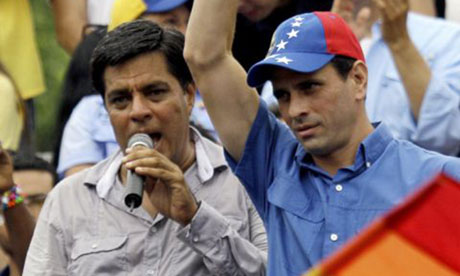
Oscar Lopez left adviser 010 ICYMI: Venezuela Opposition Comes Under Siege

Courtesy of: Associated Press

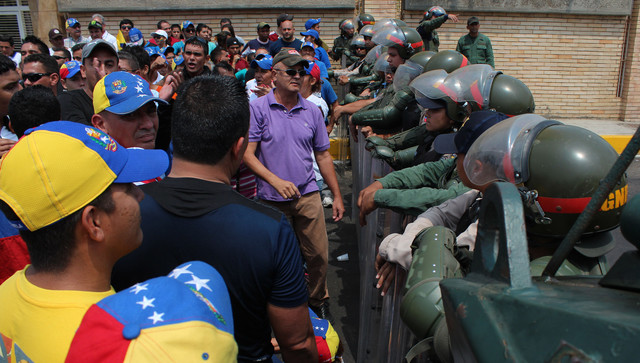
CARACAS—Venezuela’s President Nicolás Maduro, the political heir to late populist Hugo Chávez, is ratcheting up intimidation of his political foes as his government prepares for key municipal elections amid a deteriorating economy.

Oscar López, a senior aide to former opposition presidential candidate Henrique Capriles, was in hiding Friday after a government legislator said a warrant had been issued for the aide’s arrest. Days earlier, the apartment of Mr. López, Mr. Capriles’s chief of staff, was searched by military-intelligence agents, according to opposition officials.

“He doesn’t know what this circus is all about so he is taking care of himself” by going into hiding, said Julio Borges, a legislator and national coordinator of Venezuela’s leading opposition party, Justice First.

Mr. Capriles himself faces possible arrest after the Supreme Court on Wednesday rejected his challenge to Venezuela’s April presidential election, which Mr. Maduro won by a sliver but which was marred by allegations of fraud. The court went on to fine Mr. Capriles $1,700 for what it said was a “disrespectful” filing and said the opposition leader should be prosecuted for trying to undermine the election.

“It’s a way to attack Henrique and his movement,” Mr. Borges said.

A senior U.S. official said Washington is worried about developments in Venezuela. “The Venezuelan government is increasingly taking legal actions against the opposition, a development the United States finds profoundly worrying,” the official said. The wave of actions against opposition leaders like Mr. Capriles “raises legitimate and urgent concerns,” the official said.

Venezuela’s Attorney General’s Office declined to comment as did Venezuela’s Information Ministry.

Venezuelans go to the polls in December to contest some 335 mayors’ posts throughout the country, as well as hundreds of other local offices. The elections will be the first gauge of Mr. Maduro’s popularity since his win in April’s election.

In the run-up to the vote, Venezuela’s economy has shown signs of increasing stress after years of ramped-up public spending under Mr. Chávez, who died in March. The country’s inflation is north of 42%, common consumer goods like toilet paper are scarce, and despite high oil prices, Venezuela just defaulted on the payment of a $100 million bond of a nationalized steel company, spooking bond buyers. Divisions in the Chavista movement, nominally led by Mr. Maduro, are deep.

“This is clearly a wounded government as far as its mandate and its internal dynamics. And like any wounded animal, it can be dangerous. It is taking very severe steps to consolidate power,” said Christopher Sabatini, senior director of policy at the Americas Society and Council of the Americas.

Also this week, authorities jailed and froze the assets of the editor of a small independent paper and website, Leocenis García of Sexto Poder, who has published detailed reports of alleged government corruption. On Thursday, a judge fined two opposition newspapers—including El Nacional, the country’s most influential daily—1% of their 2009 income for showing a photograph of deteriorated conditions in a morgue. The judge said showing the photo was harmful to the welfare of children.

In Caracas, Juan Carlos Zapata, an author and political analyst, said the escalating repression shows a clear government intention to frighten the opposition. “They want to dismantle the opposition, they want Capriles’s aides to flee the country, and for Capriles to throw in the towel before elections,” said Mr. Zapata. “It’s an orchestrated plan to scare off the opposition.”

The Maduro government has said that it is simply rooting out corruption, regardless of political affiliation. Soon after taking office, Mr. Maduro launched an antigraft initiative that has resulted in the arrest of a handful of mid-level state officials.

The latest government moves follow last week’s stripping of parliamentary immunity by government deputies of a popular opposition congressman, by less than the constitutionally required two-thirds majority. Richard Mardo, who has built up a large following in the Chavista state of Aragua, now must face charges of alleged corruption.

Legal moves by the government against its foes are common in Venezuela. A study by Human Rights Watch found that as of May 2012, Venezuela’s Comptroller General’s Office had temporarily disqualified some 800 people, most of them Chávez foes, from running for office due to accusations of corruption—even though charges hadn’t been filed against them. About 300 people are still barred from running for office.

During his time in office Mr. Chavez routinely brushed aside international criticism as attempts to meddle with domestic affairs and plots to topple his government.

Meanwhile, the opposition is struggling to get out its message to ordinary Venezuelans. Globovisión, once a feisty opposition TV channel—and the only one that gave Mr. Capriles significant airtime—was sold earlier this year, and its coverage of Mr. Capriles has fallen sharply. News about Mr. Capriles is now relegated to a recently opened Web channel dubbed “Capriles TV.” Mr. Borges said that the opposition would have to work hard to get its message out by taking a “grass-roots” approach.

Opposition figures as well as analysts say the repressive wave points to the deep divisions in Mr. Chávez’s movement following his death. “Chávez was a kind of crazy glue that was able to keep different elements together,” says Mr. Borges.

Mr. Borges sees different power groups within the government fighting for influence and control. Within these groups are groups of powerful businessmen and executives who control different sectors of the economy such as the state oil industry, food imports, and the country’s other basic industries. “There are no institutions anymore, just different clans balancing each other,” Mr. Borges said. “Maduro is not president of the country, he is the boss of one of these groups.”

Analysts foresee a difficult time ahead for Venezuela. “It’s a disaster in the making because nobody is in charge,” says Riordan Roett, the head of Latin American studies at Johns Hopkins University.

Many analysts believe the most powerful faction is led by Diosdado Cabello, the president of the National Assembly. Mr. Cabello, a burly and bull-necked former army lieutenant who took part in Mr. Chávez’s failed 1992 coup, has close ties to the country’s armed forces and has reportedly built up a considerable personal fortune.

In late April, Mr. Cabello presided over the congress as a number of opposition legislators were beaten in the congressional chamber. At the time, Mr. Cabello didn’t allow opposition deputies to take the floor to speak until they recognized Mr. Maduro’s victory. Mr. Cabello has ruled the chamber with an iron fist ever since.

Javier Corrales, an expert on Venezuelan politics at Amherst College says that while Mr. Maduro has shown some signs of moderation—such as meeting with top businessmen, Mr. Cabello is openly confrontational. “This crackdown seems to come from Diosdado,” he said. “His instinct appears to be brute force.”

Mr. Cabello couldn’t be reached to comment.

To read this article at the Wall Street Journal, please click here.
 
Jul
19
2013
Posted by
admin
Comments

In Case You Missed It…Articles Roundup Week of 7/19/13

capriles denuncia en 16083903 In Case You Missed It…Articles Roundup Week of 7/19/13

Courtesy of: EFE

This week: Henrique Capriles arrives in Chile to meet with President Sebastián Piñera, as well as other ruling party leaders and the Venezuelan community in Santiago; Human Rights Watch says Venezuela should guarantee the right of free speech of its own citizens before offering to defend Edward Snowden; U.S. Secretary of State John Kerry tells Venezuelan Foreign Minister Elías Jaua that Washington will halt all refined-oil sales if Snowden takes refuge in Venezuela; and Nicolás Maduro fumes after U.S. envoy to the United Nations criticizes Venezuela’s regime as “repressive.” Annual inflation reaches 39.6 percent, far exceeding the government’s stated goal of 14 – 16 percent; purchasing power declines 10 percent as a result of rising inflation; and the Venezuelan government recognizes scarcity of dollars as a big problem, but only takes tepid steps to solve it. The devaluation of the bolívar is complete with the Central Bank’s auction of dollars, doubling the exchange rate; a new Fitch Ratings report confirms that the country’s foreign exchange policy continues to face challenges; and Maduro marries his longtime companion and prominent PSUV figure, Cilia Flores.

Capriles arrives in Chile; confirms appointment with Sebastián Piñera, El Universal

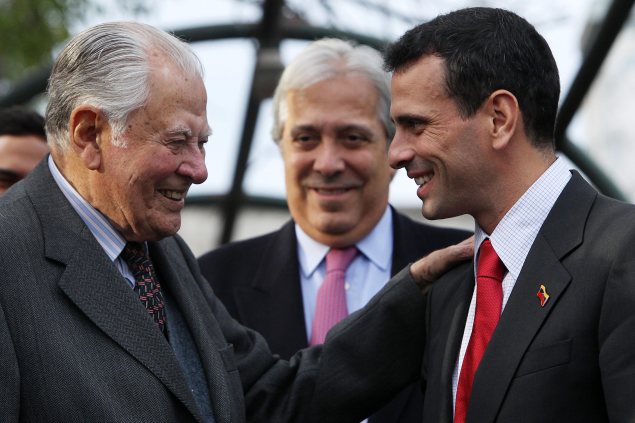
Venezuelan opposition leader Henrique Capriles arrived in Chile on Wednesday in the first leg of a tour that will also take him to Peru. He confirmed that he will meet with President Sebastián Piñera, without specifying the time or place. “It is not important whether we will talk at La Moneda Palace, the seat of the Chilean government, or elsewhere,” Capriles told reporters at the airport of Santiago.

Human Rights Watch: Snowden should steer clear of Venezuela, Salon

If US whistleblower Edward Snowden takes refuge in Venezuela he might quickly wish he hadn’t. At least that’s the verdict of Chilean lawyer Jose Miguel Vivanco, who heads the Americas division of Human Rights Watch, the New York-based advocacy group.

Kerry said to give stern warning to Caracas on Snowden, UPI

Washington is reported to have warned Caracas it would be barred from entering any NATO airspace if it flies U.S. secrets leaker Edward Snowden to Venezuela. Secretary of State John Kerry, who Spanish newspaper ABC said made the warning to Venezuelan Foreign Minister Elias Jaua, also said Washington would halt all sales of vital gasoline and other refined-oil products to Venezuela if Snowden gets refuge in that country, the newspaper said.

Venezuela slams U.S. over ‘repressive regimes’ remarks, Reuters

Venezuelan President Nicolas Maduro demanded the United States apologize on Thursday after the Obama administration’s nominee for envoy to the United Nations said there was a crackdown on civil society in the South American country.

Venezuela Inflation at 39.60%, Latin American Herald Tribune

The inflation rate for the month of June was at 4.7%, lower than that of May’s 6.1%, according to the Venezuelan Central Bank. This brings the rate of inflation for just the first half of 2013 to a total of 25% and the annualized rate at 39.6% — far from the Venezuelan government’s stated goal of keeping it between 14% and 16%.

Purchasing power down 10% due to inflation, El Universal

Venezuela’s minimum wage was increased by 20% on May 1 to USD 390, yet soaring prices have made such increase lose strength rapidly. In May-June this year, inflation shot up reducing purchasing power by 10%.Data from the Central Bank of Venezuela (BCV) indicates that since May 1, prices have swollen 17% in the case of food, 11.2% in transport, and 9% in clothing.

Venezuela: let there be dollars, Financial Times

The Venezuelan toilet paper shortage story says a lot about economic management in a country where the greenback fetches five times its official value on the parallel market. While Venezuelans have struggled to get their hands on everything from loo roll to toothpaste, authorities have been in denial about the grinding liquidity crunch that makes ordinary life – and business life – a daily struggle.

BCV sells US dollars at VEB 10.9 and VEB 11.7 in Sicad auction, El Universal

Devaluation of the bolivar was completed upon the auction sale of US dollars conducted by the Central Bank of Venezuela (BCV) through the Ancillary Foreign Currency Administration System (Sicad), where the exchange rate doubled that of VEB 5.30 per US dollar at its predecessor, the Transaction System for Foreign Currency Denominated Securities (Sitme).

Fitch: Venezuela’s Foreign Exchange Policy Faces Challenges, Reuters

Venezuela’s foreign exchange (FX) policy adjustments in 2013 could reduce fiscal imbalances and limit the need of continued external debt issuance. However, the room to stabilize creditworthiness could be constrained by weaker external buffers, limited upside for oil revenues and non-debt capital inflows, a rapidly decelerating economy, and political changes, according to a new Fitch Ratings report.

Venezuelan President Marries Longtime Companion, Wall Street Journal

Venezuela’s President Nicolás Maduro said on Tuesday that he had married his longtime companion, Cilia Flores, a prominent ruling party figure. Mr. Maduro, speaking during a cabinet meeting broadcast on state television, said the small ceremony was held Monday and was conducted by Jorge Rodríguez, a Caracas-area mayor.

 
Apr
19
2013
Posted by
admin
Comments

In Case You Missed It… Articles Roundup Week of 4/19/13

in5fjQpowmnM e1366405340981 In Case You Missed It… Articles Roundup Week of 4/19/13

Courtesy of: Agence France Presse

This week:  A narrow margin in the Venezuelan election by Hugo Chávez’s heir Nicolás Maduro spells uncertainty for the country; behind by less than two percent of the vote, opposition candidate Henrique Capriles challenges the election results and demands a full recount; tensions then rise after Venezuela’s government reneges on its promise to carry out the recount of the votes; government security forces and opposition protesters clash in Venezuela over election results; and the news of Maduro’s narrow victory in Venezuela causes bonds to fall and credit-default swaps to rise.  Capriles calls off a march planned to demand an election recount after Maduro and his government threaten a crackdown; U.S. Secretary of State John Kerry encourages a recount of the votes casted in Venezuela’s presidential election; amid post-election violence, Human Rights Watch reports that Venezuela’s government continues to limit citizens’ rights to speak freely and assemble peacefully; and protestors take to the streets with pots and pans to express dissatisfaction towards Maduro and the government’s handling of the election results. Several South American governments hold an emergency meeting to discuss Venezuela’s political crisis; Venezuela’s electoral committee finally agrees to audit – but not fully recount – the presidential vote after demands from the opposition; the aftermath of the presidential election in Venezuela continues to batter the country’s already struggling economy; and the slim election victory represents another sign of the many problems ahead for Maduro and Venezuela. Indeed, the election has further tainted the legitimacy of Maduro and of the government he would represent.

Tight win for Chavez’s heir spells uncertainty for Venezuela, Reuters

Late socialist leader Hugo Chavez’s chosen successor Nicolas Maduro won Venezuela’s presidential election by a whisker but now faces opposition protests plus a host of economic and political challenges in the OPEC nation.

Opposition candidate demands recount after Chavez’s heir Nicolas Maduro wins Venezuela presidency, Fox News

Hugo Chavez’s hand-picked successor, Nicolas Maduro, has officially won Venezuela’s presidential election by a stunningly narrow margin that highlights rising discontent over problems ranging from crime to power blackouts.

Tensions Surge in Venezuela After Vote, The Wall Street Journal

Tension in Venezuela rose sharply Monday after the government reneged on its promise to carry out a full recount of the bitterly contested presidential vote and declared acting President Nicolás Maduro as president-elect.

Protests in Venezuela as opposition disputes Nicolás Maduro’s victory, The Guardian

Venezuelan security forces quelled protests on Monday as Nicolás Maduro – the handpicked heir of Hugo Chávez – was proclaimed president after a wafer-thin and fiercely disputed vote.

Venezuelan Bonds Sink Most in 2 Months on Maduro’s One-Point Win, Bloomberg Businessweek

Venezuela’s bonds tumbled the most in two months and credit-default swaps rose after ex-President Hugo Chavez’s handpicked successor, Nicolas Maduro, won emergency elections by one percentage point over opposition candidate Henrique Capriles.

Capriles Calls Off Protest After Venezuela Threatens Crackdown, Bloomberg Businessweek

Venezuelan opposition leader Henrique Capriles Radonski took a step back from the brink of a mounting confrontation with the government by calling off a march planned for today to protest the results of the April 14 presidential election.

Kerry Encourages Venezuela Recount, The New York Times

Secretary of State John Kerry said Wednesday that Venezuela should hold a recount of votes cast in its presidential election, which the country’s electoral authorities say was narrowly won by a protégé of former President Hugo Chávez.

Venezuela: Respect Free Speech and Assembly, Human Rights Watch

The government of Venezuela should not limit citizens’ rights to freely express their views and assemble peacefully in response to the disputed presidential election, Human Rights Watch said today.

Stand against Venezuela’s new strongman, NY Daily News

There is a stirring sound echoing through Venezuela right now: that of the cacerolazo , a form of protest that involves participants taking to the streets banging pots and pans.

Venezuela dispute prompts urgent meeting of regional leaders, Reuters

Several South American presidents will hold an emergency meeting on Thursday in Lima to discuss the political crisis in Venezuela following the disputed election of President Nicolas Maduro, Peru’s foreign ministry said on Wednesday.

Conceding to opposition, election council to audit Venezuela vote, The Washington Post

Venezuela’s electoral council says it will audit the 46 percent of the vote not scrutinized on election night, a surprise concession that opposition candidate Henrique Capriles says will prove that he won the presidency.

Venezuela’s Election Downshifts Views on Economy, Debt, Wall Street Journal

We hear elections have consequences, which are usually obvious if the winner’s mandate is strong.

Analysis: Venezuela’s Maduro inherits tough economic problems, Reuters

Venezuelan President-elect Nicolas Maduro faces a difficult economic panorama of rising inflation and slowing growth, further complicated by his slim election victory that is being challenged by the opposition.

Maduro’s lousy start, The Economist

Hugo Chávez has been dead for more than a month, but visitors to Caracas could be forgiven for thinking that Venezuela’s bombastic former president was still alive and in power. His image plasters the streets; his speeches fill the airwaves. The blitz was ordered by his anointed successor, Nicolás Maduro, to harness Chávez’s popularity in order to win a landslide in an election on April 14th. The plan failed.