Jun
24
2013
Posted by
admin
Comments

U.S. Companies to Chavismo’s Rescue?

jose r cardenas U.S. Companies to Chavismo’s Rescue?

José R. Cárdenas

José R. Cárdenas served in several foreign policy positions during the George W. Bush administration (2004-2009), including on the National Security Council staff. He is a consultant with Vision Americas in Washington, DC.

News that oil giant Chevron is lending $2 billion to the bankrupt regime in Venezuela has raised eyebrows in both Washington and Caracas.  Red flags went up after the parties to the loan issued conflicting cover stories about its intended purpose.  Venezuelan Oil Minister Rafael Ramirez announced that it would be used “to boost production” at the government’s joint venture with Chevron, Petroboscan, in western Venezuela (a line echoed by Chevron’s head of Latin America operations, Ali Moshiri).  However, Chevron CEO John Watson told Spain’s ABC that the loan was instead “designed to facilitate the repatriation of funds and facilitate further operational activity in the Boscan field.”

According to sources in the oil industry, the loan was likely meant to merely maintain operations at the Boscan field and partly to repay PDVSA’s debt to Chevron resulting from non-payment of proceeds from the joint venture.  Indeed, one expert shot down Ramirez’s rosy scenario of increasing production by telling ABC that would require an infusion of at least $8 billion.

Why does this shell game matter?  We know that PDVSA has been bled dry by the late Hugo Chávez and now by his successor Nicolas Maduro, who have siphoned off its revenues to finance massive domestic programs.  Reinvestment in maintenance and oil production has been neglected, which has led to declining output, a shortage of cash, and a failure to repay some $16.5 billion in debts to oil partners.  In other words, this story matters if it means a U.S. company is helping to mask PDVSA’s insolvency.

Chevron is already the only U.S. major oil company to remain in Venezuela after Chávez tore up existing contracts with oil companies to give his government majority control of oil projects.  Chevron’s shareholders have a right to know just what risks the company is taking by lending money to a regime widely recognized for its corruption and mismanagement – not to mention its swelling debt. The Venezuelan people, meanwhile, also have a right to know just what their government is committing to in terms of repayment of the loan.

Here are some of the questions that the Venezuelan people and Chevron shareholders ought to be asking.  What exactly is the $2 billion for?  What is PDVSA’s current debt to Chevron?  What portion of the loan will be used to recoup what PDVSA already owes Chevron?  Given PDVSA’s chronic shortage of dollars, do the terms of repayment include oil, and, if so, at what price per barrel?  Who exactly will receive the proceeds of the loan?  Will it be PDVSA, Petroboscan, or will it remain under Chevron’s control?  In other words, what guarantees are there that the loan will go to its ostensible purpose – whatever that is – and not be squandered by an unaccountable government?  Given the Venezuelan government’s notorious record of abrogating contracts with foreign companies, what guarantees are there that Chevron will recoup its loan?

There are other troubling issues.   It is well-known that the Venezuelan government has for some time been using the threat of canceling its current contracts to strong-arm its oil partners into investing more money in Venezuela. Already this year, Russian and Chinese firms given Venezuela $9 billion in new financing, while the oil services giant Schlumberger has granted Venezuela a revolving credit line of $1 billion.

Finding salvation in Chinese and Russian companies is one thing.  It is quite another when U.S. companies are exposing their shareholders by helping the chavista government dig itself out of the economic hole it has created at great cost to the Venezuelan people and U.S. interests in the region.

That’s why anyone concerned about Venezuela’s future needs to take a hard look at what deals the Maduro government is cutting to keep afloat, especially if it involves U.S. companies.  Maduro’s desperation is great and so likely will be his proclivity to mortgage more of the country’s oil future for short-term political gains.  All concerned should demand transparency and accountability, not only of the Maduro government, but from companies like Chevron, as well.

 
Aug
2
2012
Posted by
admin
Comments

Venezuela’s opposition wants to scrap preferential oil deals

Reuters
August 1, 2012
By Marianna Parraga

Capriles in Anzoategui state Venezuelas opposition wants to scrap preferential oil deals

Courtesy of: Reuters / Carlos Garcia Rawlins

Venezuelan opposition leader Henrique Capriles said on Wednesday he would scrap preferential oil deals with foreign allies if he defeats socialist President Hugo Chavez in an October election to lead the South American OPEC member.

Chavez has sought to boost his influence abroad by offering crude deals to nations in Asia, Latin America and the Caribbean — Venezuela’s state oil company PDVSA was not paid directly for almost half the crude it pumped last year.

In Capriles’ first major speech on his future oil policy, the 40-year-old said stopping Chavez’s deals for crude on credit or in exchange for other goods would save $6.7 billion annually, which would be invested in new social programs.

“To have a friend, you don’t need to buy him,” Capriles said during a campaign stop a few kilometers from the Puerto La Cruz refinery. “From … 2013, not a single free barrel of oil will leave to other countries.”

The youthful former state governor named Belarus, Cuba, Jamaica, Dominican Republic, Uruguay and Argentina as countries that would stop receiving oil on preferential terms.

In 2011, PDVSA — the fiscal motor of Chavez’s socialist policies — was not paid directly for 43 percent of its barrels of crude and oil products, rising from 36.5 percent in 2010 and 32 percent in 2009.

Many of the agreements are criticized by his opponents, especially those signed over the last decade with China, Cuba, Argentina, Uruguay, and the more than a dozen countries that are members of Venezuela’s Petrocaribe supply program.

Chavez — who underwent three operations for cancer over the last year — is seeking re-election for a third term on October 7 to extend his self-styled socialist “revolution” and is spending heavily to beat Capriles.

Most opinion polls give him a double-digit lead.

‘NO LEGAL CHANGES PLANNED’

Capriles is seeking to tap into pent-up frustration among many voters weary of high crime, inefficient public services and high prices. He has been on a months-long “house-by-house tour” through Venezuela meant to win over Chavez supporters and draw a comparison with the recovering president.

Capriles — who frequently cites Norway as an example of a nation that has used its oil wealth properly to diversify the economy — said he planned no legal changes to the oil industry, although there would be more supervision of the activities of public and private companies that are partners of PDVSA.

Chavez ordered the nationalization of dozens of crude projects in 2006 and 2007, but Venezuela has still managed to attract partners from Russia, Vietnam, Belarus and Malaysia to join PDVSA-led projects.

Companies including U.S. major Chevron, Spain’s Repsol and Italy’s ENI have also been drawn by the world’s biggest crude reserves, which are mostly located in the Andean country’s Orinoco Belt.

Oil accounts for more than 90 percent of Venezuela’s exports.

Capriles promised to use the extra resources from stopping preferential deals, plus money from a planned doubling of production between 2013 and 2020, to fund programs such as raising benefits for pensioners, scholarships for mothers of handicapped children, and education.

“Where will all these resources go? Not to tanks, not to a hospital in Nicaragua, not as donations,” Capriles said.

(Writing by Jack Kimball; Editing by Daniel Wallis and M.D. Golan)

To read this article on Reuters, please click here.

 
Jul
30
2012
Posted by
admin
Comments

What’s Next Venezuela Election Update: July 30, 2012

detalle17a41ef10465547e4fba4dc9a35f6775 300x193 What’s Next Venezuela Election Update: July 30, 2012

Courtesy of: El-Nacional.com

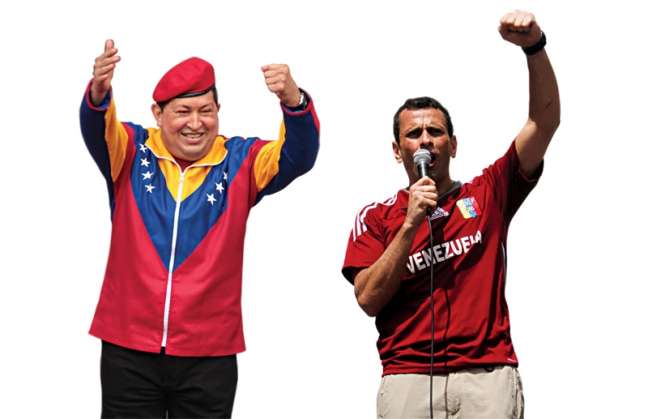
As the election approaches, Hugo Chávez is taking advantage of his access to government resources, both by increasing spending and manipulating the state-owned media to persuade Venezuelan voters to elect him on October 7. Opposition candidate Henrique Capriles turns to Facebook to try to expand his reach. Their styles of speaking, Chávez long-winded and bombastic, Capriles succinct and clear, reflect the differences in their ideologies. While the candidates continue on the campaign trail, one writer wonders where international corporate interests lie.

Facing election, Hugo Chávez ruthlessly consolidates his power, Washington Post

Not for the first time, Venezuelan President Hugo Chávez has declared himself cancer-free and ready to resume a full schedule.

Chávez boasts his own importance while Capriles speaks of teamwork, El Universal

One gloats with being able to ramble on for endless hours. The other retorts, saying that actions speak louder than words.

Chavez opponent takes new campaign approach in Venezuela with online forum on Facebook, Washington Post

Venezuelan opposition presidential candidate Henrique Capriles tried a new campaign tool on Wednesday with a live question-and-answer session on Facebook.

Does oil giant Chevron want Chavez to win reelection in Venezuela?, Christian Science Monitor

A couple days ago, Raúl Gallegos published a decent little column about how Chevron is, if not betting on a Hugo Chávez reelection, at least setting itself up for a long, happy relationship with the Bolivarian Republic.