Jul
12
2013
Posted by
admin
Comments

In Case You Missed It… Articles Roundup Week of 7/12/13

1 photo e1373659882830 In Case You Missed It… Articles Roundup Week of 7/12/13

Courtesy of: Policy Mic

This week: In defiance of Washington, Venezuela offers asylum to NSA leaker Edward Snowden; 44 percent of Venezuelans seek better relations with the United States; if asylum is granted, Venezuela may face economic and diplomatic sanctions by the United States; Maduro faces a potential revolt from radical sectors of his party who think he is negotiating with the United States. Human Rights Watch sends a letter to the United Nations criticizing the Venezuelan government for using criminal investigations to intimidate the opposition; Venezuelan “birther” movement further questions Maduro’s legitimacy; swarms of motorcycles in Venezuela’s capital are linked to violent crime; facing a shortage of hard currency, Christmas toys may be in short supply this year in Venezuela. Venezuelan inflation rises to 4.7 percent in June, reaching a staggering 40 percent for the past year; Venezuelan Central Bank says it will sell $200 million at auction in an attempt to alleviate shortages; the Central Bank of Venezuela removes the cap on the amount of U.S. dollars individuals are allowed to buy via Sicad; Venezuela’s restrictive hiring and firing practices discourage companies from filling openings, further dampening investment in the country; and Venezuelan daily oil exports to US fall 8.3 percent in the first half of 2013.

Venezuela offers asylum to U.S. fugitive Snowden, Reuters

Venezuela’s President Nicolas Maduro offered asylum to Edward Snowden who is believed to be holed up in the transit area of Moscow’s Sheremetyevo international airport; this action was made in defiance of Washington, which is demanding his arrest for divulging details of secret U.S. spy programs.

Many Venezuelans want better relations with the U.S., Pew Research Center

Poll shows that a plurality of Venezuelans (44%) prefer to have a closer relationship with the US than existed during the presidency of Chavez, while Maduro’s offer of asylum to Snowden would entail worsening ties with US, something that the Venezuelan public would avoid.

Venezuela may face economic sanctions if it grants asylum to Snowden, El Universal

Venezuela will face economic and diplomatic sanctions by the United States if Nicolás Maduro’s government grants asylum to former CIA agent Edward Snowden, who formally requested asylum to Venezuela on Monday.

With Snowden offer, Venezuela’s Maduro is on world stage, The Washington Post

American fugitive Edward Snowden’s diminishing possibilities of remaining free to continue releasing information about secret U.S. surveillance programs increasingly appear to hinge on Venezuela, which awaited word Monday on whether the former National Security Agency contractor would accept its offer of asylum and fly to the oil-rich country.

Letter to the UN about post-electoral violence in Venezuela, Human Rights Watch

Human Rights Watch is extremely concerned that Venezuelan authorities are using criminal investigations as a political tool to accuse the opposition, without adequate justification, of the commission of crimes.

Venezuela ‘Birther’ Movement Questions President’s Eligibility, Bloomberg

Venezuela’s opposition has been questioning Maduro’s Venezuelan nationality, since he was born in Colombia to Colombian parents, which would make his presidency fall foul of the constitution.

A circus without a ringmaster, The Economist

During the presidency of Hugo Chávez, who ruled from 1999 until his death from cancer in March, the domineering personality of the comandante left no doubt as to who was in charge of Venezuela.

Swarms of motorcycles in Venezuela’s capital tied to traffic chaos, violent crime, Washington Post

Ronald Alvarez was driving in chaotic, bumper-to-bumper traffic when he heard a throaty buzz and insistent “Beep! Beep! Beep!” approaching rapidly from behind.

Christmas toys may be in short supply in Venezuela, Reuters

Whether they’ve been naughty or nice, Venezuelan children might be stuck without Christmas presents this year.

Venezuela’s 12-Month Inflation Rate Advances to Just Shy of 40% in June, The Wall Street Journal

Venezuela’s 12-month inflation approached 40% in June after jumping 4.7% in June and 6.1% in May, pressured by a rise in government spending last year and in the wake of the country’s latest currency devaluation in February.

Venezuela central bank to sell $200 mln in forex auction, Reuters

Venezuela’s central bank said it will sell $200 mill at auction, of which $170 million would be allocated to businesses and $30 million to individuals, under its revamped currency system as government increases imports to alleviate the product shortages.

Central Bank of Venezuela removes cap in sale of US dollars to individuals, El Universal

The Central Bank of Venezuela (BCV) removed a cap limiting the amount of US dollars that individuals are allowed to buy via the Sicad.

Venezuela Forces Employment Even With Shuttered Factories, Bloomberg

Jean Salero gets up at dawn to clock in for his daily shift at a shuttered beer factory in the Venezuelan city of Barquisimeto.

Venezuela’s oil exports to the US fall in 2013, El Universal

Venezuelan oil exports to the US in the period Jan-Jun 2013 hit their lowest level since the 1990s, hitting 754,000 barrels per day from 823,000 bpd in 2012, amidst Venezuela’s strategy to prioritize clients and allies such as China or India and curb oil shipments to the US.
 
Feb
8
2013
Posted by
admin
Comments

ICYMI: Venezuela’s economy: Out of stock

The Economist
February 9, 2013

27717escasez e1360352874868 ICYMI: Venezuela’s economy: Out of stock

Courtesy of: TalCual

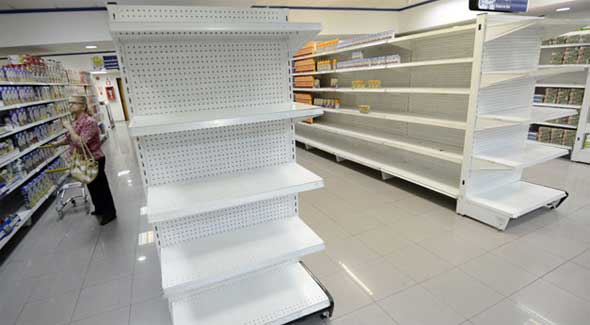
It is now two months since Venezuelans last saw or heard from their president, Hugo Chávez, who remains in intensive care in a high-security Havana hospital, battling what seems to be terminal cancer. But it is an absence of a different kind that is uppermost in many people’s minds. Cooking oil, sugar, wheat flour, coffee and the all-important pre-cooked maize flour that goes into many Venezuelan dishes are among the staple items that have largely disappeared from the shelves. Both the Central Bank, which tracks the level of supply, and private economists reckon that shortages are at their greatest since 2008.

Temporary shortages often occur at the start of the year, thanks to higher demand, reduced output and distribution delays over the Christmas holidays. But this year they are a symptom of bigger distortions, which include a black-market dollar that trades at more than four times the official exchange rate, and chronic inflation (20.1% in 2012 and likely to rise this year).

Economists expected a big devaluation in the early months of this year. That would make revenue from oil exports go further in local currency, bridging a fiscal deficit which reached 8.5% of GDP last year after an increase in spending of 26% in real terms in the 12 months before a presidential election in October, won by Mr Chávez. But there is no sign of it, probably because the president’s agony means that a fresh election is just around the corner.

The underlying problem is a shortage of cash at the state oil monopoly, Petróleos de Venezuela (PDVSA), which provides 94% of the country’s foreign earnings. Under a plan announced in 2005, Venezuela should have produced 5.8m barrels a day by 2012. Even by the government’s reckoning, it pumped little more than 3m; private sources suggest the number was around 2.8m. Local consumption has risen sharply, partly because petrol is provided almost free to Venezuelans but also because power plants have switched to fuel oil because PDVSA is unable to supply them with gas. Around 270,000 b/d of oil goes to China, to repay loans to the government, and almost 400,000 b/d at a big discount to Cuba and other allies. Refinery and production snags have even forced the company to import crude and oil products.

PDVSA is also obliged by the government to divert billions of dollars into unaudited funds which the president manages at his discretion. The biggest, known as Fonden, absorbed $15.5 billion last year, forcing PDVSA to pay part of its taxes in the form of IOUs. The Central Bank’s foreign reserves have been depleted, too, to $30 billion (down from $42 billion in 2008). Most of that is in gold or other non-liquid assets; liquid reserves amount to only a couple of months’ worth of imports. Importers say it is taking six months to obtain foreign currency at the official rate.

Official propaganda proclaims that Mr Chávez’s socialist revolution has promoted sovereignty and “endogenous development”. But Venezuela is more dependent than ever on imports. Domestic production has fallen victim to an overvalued currency and government hostility to the private sector. A wave of expropriations and confiscations has left millions of hectares of farmland and a swathe of the food industry in government hands. The expansion of the money supply, along with redistributive policies, has raised demand for food and other basic goods, met largely by imports.

Officials blame private-sector “hoarders” and “speculators” for inflation and shortages. They have raided warehouses, seizing 8,520 tonnes of sugar, for example, from Pepsi-Cola, which the company says was imported with government permission. As with other staples, the state controls the price and import licences for sugar, and its distribution (which can only be carried out with government permits). It also owns most of the sugar industry. In the case of pre-cooked maize flour, the government owns half of production capacity, but only supplies a fifth of the market, according to figures from Datanálisis, a market-research company.

Some stopgap measures have been taken to ease the flow of dollars. The government has quietly started to cut spending, and shaved PDVSA’s annual contribution to Fonden by $2.9 billion. It is looking for fresh loans, especially from China. But Fedecámaras, the main employers’ federation, says it will take three or four months to reduce food scarcity. That suggests that predictions of a March election are wide of the mark. Eventually, says Jorge Botti, the chairman of Fedecámaras, the government will have to “move towards the centre and understand how the private sector works”. But there is no sign of that yet.

To read this article at The Economist, please click here.

 
Feb
7
2013
Posted by
admin
Comments

Mysterious Check Reignites Controversy over Iran-Venezuela Relationship

r TAHMASB MAZAHER CHECK large570 e1360253117979 Mysterious Check Reignites Controversy over Iran Venezuela Relationship

Courtesy of: Associated Press

Controversial ties between two countries hostile to the United States reemerged on Saturday when a former Iranian official was caught in Germany with a sizable check from a Venezuelan bank. The German newspaper Bild am Sonntag first reported that German officials are investigating Tahmasb Mazaheri, Iran’s former central bank chief and economy minister, for smuggling after he was caught with an undeclared check worth approximately $70 million.

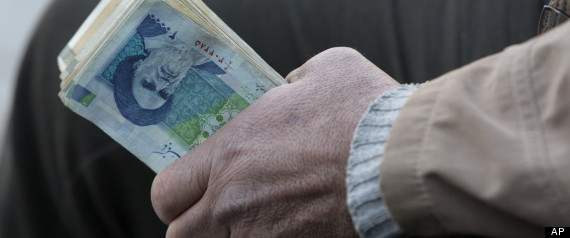
Upon his arrival from Turkey on January 21, Mazaheri was stopped and searched by German customs officials at the Dusseldorf airport. A check for 300 million Venezuelan Bolivars issued by the state-run Bank of Venezuela was found in his luggage.

According to customs authorities, visitors entering any of the European Union countries must declare incoming amounts above $13,580. Failure to disclose the funds is a civil offense punishable by a fine of up to $1 million. German authorities have not yet disclosed to whom the check was directed and are expected to decide later this month whether to press charges. In the meantime, local and international concern has emerged, sparking questions about how a former Iranian official ended up with a check of such a significant amount – in Venezuelan currency.

Iran’s ambassador to Venezuela, Hojattolah Soltani, told the Venezuelan media that the check was going to pay the expenses of the Kayson Company, an Iranian construction business that builds public housing for the Venezuelan government. According to the ambassador, Kayson has a contract to build approximately 10,000 low-income housing units. However, it remains unclear why Mazaheri misled German officials; declaring he was traveling with less than $13,580. When questioned by customs authorities, he failed to provide adequate explanation of the purpose and recipient of the funds, leading to further skepticism. Soltani claimed Mazaheri did not declare it because the check was not for him and was not destined for a German bank.

Reports confirm that Mazaheri has returned to Tehran, as officials launch an inquiry into possible impropriety and determine whether to return the check. But the controversy has given rise to the possibility that Venezuelan banks are helping Iran evade the economic sanctions imposed against it as a result of its nuclear development program. According to sources, the discovery has prompted a further investigation by the international community into the ties between the Venezuelan financial system and Tehran.

Such actions mirror the ongoing U.S. investigations into some of the largest European banks for violating sanctions against Iran. The investigations resulted in billions in fines between 2010 and 2012.

Members of the Venezuelan opposition alleged that the Kayson Company is on Canada and the United Kingdom’s list of undesirable companies, largely due to its links with illegal businesses.

United by their public condemnation of the U.S., Iran and Venezuela have built a strong alliance since Iranian President Mahmoud Ahmadinejad assumed office in 2005. They have reportedly signed over 70 joint venture agreements in housing, agriculture and energy, among other areas. The deals are valued at up to $17 billion, though neither country has much to show in terms of progress.

Mazaheri was personally involved in one of those projects back in 2008, when he became president of the International Development Bank (IDB), opened in Caracas as an independent subsidiary of the Export Development Bank of Iran (EDBI). Nine months after its opening, the U.S. Treasury Department imposed economic sanctions on both entities for financing Iran’s nuclear programs.

Citing the irresponsible handling of funds money by the Venezuelan government, the country’s opposition is demanding an explanation. Venezuelan officials have yet to comment on the matter. And with Hugo Chávez’s condition unknown to any except his Cuban medical team – now two months after his cancer surgery – the world remains wanting for answers.