Apr
13
2012
Posted by
admin
Comments

US President Barack Obama takes a stance on Venezuelan election

El Universal
April 13, 2012

The comments were made during an exclusive interview with Grupo Diarios de América (GDA), a cluster of 11 leading newspapers in the Western Hemisphere
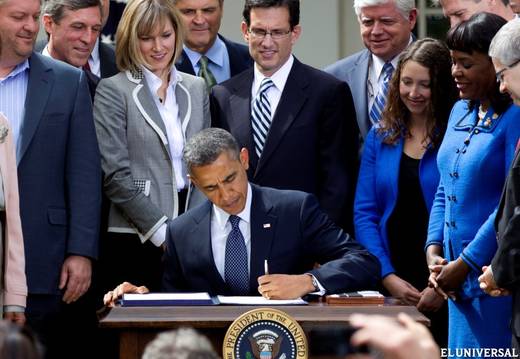
obama14.jpg.520.360 US President Barack Obama takes a stance on Venezuelan election

US President Barack Obama would like to witness in Venezuela “free and fair elections where the people’s will is respected.”

His comments were made during an exclusive interview with Grupo Diarios de América (GDA), a cluster of 11 leading newspapers in the Western Hemisphere. Venezuela, “like all sovereign nations, ought to set its own destiny, but the Venezuelan people are the ones who should determine their democratic way.”

President Obama recounted that the countries of the Americas have a duty to protect their right to self-determination, as set forth in the Inter-American Democratic Charter, to which all of them are parties.

All of the Americas, for many generations, have suffered to give freedom and justice a real meaning, the US Head of State underscored.

However, he stressed that nowadays, universal rights, such as freedom of expression, and liberties, such as Independence of judges, are under siege.

He vowed that his country would continue “advocating the people’s right everywhere to choose their own future.”

His remarks came ahead of the upcoming Summit of the Americas, to be held this weekend in Cartagena de Indias, Colombia.

To read the original article on El Universal, please click here.

 
Aug
24
2010
Posted by
admin
Comments

Chavez’s socialist populism perpetuates inequality

Getty Images 300x168 Chavez’s socialist populism perpetuates inequality This article was originally posted by The Globe and Mail

Venezuela’s escalating crime rate reflects the failure of President Hugo Chavez to address the glaring disparities between the rich and the poor.

When “el Comandante” came to power in 1998, he promised to use the country’s oil wealth to benefit the poor. But his Bolivarian socialist model has not alleviated the long-term problem of income inequality, and the attendant social ills it perpetuates.

Ironically, this runs counter to the overall trend in the region. Latin America used to be known for its acute and persistent income inequalities. But 12 of the largest economies in the Americas – including Brazil, Chile, Argentina and Mexico – actually saw a reversal of this pattern in the past decade. A new study shows that the average decline in the Gini coefficient – a measure of income inequality – was 1.1 per cent a year from 2000 to 2007. Venezuela improved the least of the 12 countries, conclude the authors, the economists Luis Lopez-Calva, of the United Nations Development Program, and Nora Lustig, of Tulane University.

Read More