May
31
2013
Posted by
admin
Comments

In Case You Missed It… Articles Roundup Week of 5/31/13

s1.reutersmedia.net  In Case You Missed It… Articles Roundup Week of 5/31/13

Courtesy of: Reuters


This week: Venezuelan president reacts with fury to meeting between Colombian President Juan Manuel Santos and Venezuelan opposition leader Henrique Capriles, even recalling an envoy to Colombia’s peace process; two U.S. embassy officials are shot in a Venezuelan strip club, exemplifying the Venezuelan government’s inability to combat violence; the shooting prompts the State Department to describe the crime level in Venezuela as ‘critical’; and Nicolás Maduro accuses CNN of working to promote a coup. Capriles plans to ‘set off the alarms’ before international bodies due to the state of Venezuelan political institutions; Globovisión, the lone voice of dissent among Venezuelan TV stations, lowers the critical tone under new owners, firing popular talk show host and denying live coverage of opposition leaders; Maduro orders the creation of a new workers’ militia to defend the country’s ‘Bolivarian revolution’ at a time of economic problems and political turmoil; and Venezuela plans to hold local elections on December 8. The head of Venezuela’s main business group sees a dire economy in 2013 due to the decade-long weakening of domestic industry; 93.52 percent of respondents in a poll blame the government for shortages in Venezuela; Venezuelan police seize 2,500 rolls of toilet paper in overnight raid, in another sign of growing shortages; the Confederation of Industries estimates Venezuela’s domestic industries are working at only half their capacity; and Venezuela’s Catholic Church experiences the country’s scarcity of basic supplies, ‘running out of wine’ to celebrate Mass.

Venezuela furious at Colombia’s meeting with opposition leader, Reuters

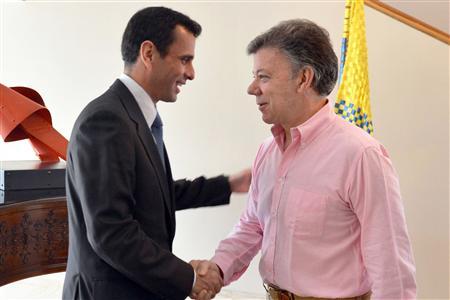
Venezuela reacted with fury to Wednesday’s talks between Colombian President Juan Manuel Santos and Venezuelan opposition leader Henrique Capriles, saying it was a “bomb” in ties and recalling an envoy to Colombia’s peace process.

2 American Embassy Officials Are Shot in Venezuela Strip Club, El Universal

Two staff members of the American Embassy in Caracas, Venezuela, were shot and wounded at a strip club there early Tuesday, according to officials.

State Dept. report for Caracas personnel: Crime level ‘critical’, Washington Post

Two U.S. embassy personnel were wounded by gunfire outside a Caracas night spot early Tuesday morning, according to the State Department.

Venezuela accuses CNN of seeking to foment coup, AFP

Venezuela’s President Nicolas Maduro on Monday accused US-based news network CNN en Espanol of working to promote a coup d’etat as part of a wider media war against his socialist government.

Henrique Capriles to set off the alarms before international bodies, El Universal

Venezuelan opposition leader Henrique Capriles said Wednesday from Colombia that the situation facing Venezuelan institutions is forcing him to “set off the alarms” before international organizations and report on the state of affairs in his country.

Globovision, lone voice of dissent among Venezuela TV stations, lowers volume under new owners, Associated Press

Venezuela’s only TV channel that has been openly critical of the socialist government was in turmoil Monday after a popular talk show host was fired and the opposition’s leader said he was being denied live coverage.

Venezuela to Create New Workers Militia, Associated Press

Venezuela’s president has ordered the creation of a new workers’ militia to defend the country’s “Bolivarian revolution” at a time when the government faces economic problems and political turmoil.

Venezuela to hold local election next December 8, El Universal

In a brief press conference late on Thursday at the headquarters of the National Electoral Council (CNE), its president, Tibisay Lucena, said Venezuela will hold local elections on December 8, after they were put off for various reasons.

Venezuela business group sees dire economy in 2013, Reuters

Venezuela is slipping into high inflation and economic stagnation this year due to a shortage of hard currency and a decade-long weakening of domestic industry, the head of the country’s main business group Fedecamaras said.

Venezuelans blame Government for widespread shortage, El Universal

The Venezuelan Government is accountable for shortage in the country, said 93.52% of respondents in a poll conducted by daily newspaper El Universal.

Venezuela police seize 2,500 rolls of toilet paper in overnight raid, Associated Press

Police in Venezuela say they have seized nearly 2,500 rolls of toilet paper in an overnight raid of a clandestine warehouse storing scarce goods.

Venezuelan industries running at half capacity, El Universal

Venezuela’s domestic industries are working at half their capacity. The Venezuelan Confederation of Industries (Conindustria) reported that the manufacturing sector worked at 52.82% of its installed capacity in the first quarter of the year.

Venezuela Catholic Church ‘running out of wine’, BBC News

The Catholic Church in Venezuela has said it is running out of wine to celebrate Mass because of nationwide shortages of basic supplies.

 
Sep
28
2012
Posted by
admin
Comments

Henrique and Hugoliath: Even if he wins, the Chávez aura is gone

The Economist
September 28, 2012

20120929 LDP003 0 Henrique and Hugoliath: Even if he wins, the Chávez aura is gone

Courtesy of: Reuters

IMAGINE an election in which the incumbent routinely commandeers the nation’s airwaves for endless campaign broadcasts while his opponent gets just three minutes a day. The incumbent uses all the resources of the state—money, vehicles, buildings—for his campaign, and he has branded state social-welfare programmes as his own personal gift. He controls the courts and the electoral authority. His opponent’s supporters fear that the ballot is not secret, and that for those of them who work in the public sector, voting against the incumbent could cost them their jobs. That is Venezuela’s presidential ballot on October 7th. No wonder that Henrique Capriles, the opposition candidate, calls the contest between himself and Hugo Chávez, who has ruled Venezuela for almost 14 years, one of David against Goliath, and that one of his allies says that the election will be “free but not fair”.

Yet despite all these unfair advantages, Goliath is threatened. Although he rules as an autocrat and has hollowed out Venezuela’s democracy, Mr Chávez’s legitimacy derives from the ballot box. That is both his greatest strength—and his biggest potential weakness. Unlike his idol, Fidel Castro, Mr Chávez has regularly held himself accountable to the voters, and so far always prevailed. There are two main reasons for that. Even his biggest detractors would have to concede that the president is a political communicator of genius, who enjoys a unique rapport with many poorer Venezuelans. Second, he has been fortunate that his rule has coincided with an unprecedented rise in the price of oil, his country’s main export. That has allowed him to shower tens of billions of dollars on social programmes, and to deploy largesse in order to pose as the champion of the downtrodden throughout Latin America. Had it not been for the oil boom, Mr Chávez would surely have long since become a footnote in Venezuelan history.

A convincing challenger

But there are clear signs that Mr Chávez’s appeal is finally fraying (see article). And so it should: by any objective standard, he has squandered his extraordinary oil windfall. His regime is corrupt and incompetent. His hounding of the private sector has made the country ever more dependent on the state oil company, which he has turned into a bloated all-purpose development agency. Venezuela’s infrastructure is decaying. Unchecked violent crime has made it one of Latin America’s most dangerous places.

For its part, the opposition has learned from its travails. It has put aside past squabbles and united behind Mr Capriles. He is sensibly trying to close Venezuela’s partisan divide by promising to maintain and improve most of Mr Chávez’s social programmes, while pledging to crack down on corruption and boost the economy by seeking the foreign investment the president has shunned.

For all these reasons, Mr Capriles deserves to win, and he just might do so. Although most opinion polls give the president a five-to-ten-point lead, many voters say they are undecided. And although the campaign has been unfair, the electronic voting system itself seems tamper-proof.

If Mr Capriles does win, it will be up to the army and the rest of Latin America to ensure that the result is respected. The unpicking of Mr Chávez’s Bolivarian Revolution would make for a difficult transition. Even if Mr Chávez prevails once more, he is unlikely to enjoy the sort of landslide he got in 2006. His health is uncertain and his pre-election spending binge will force him to tighten the purse-strings later this year. Win or lose, Latin America’s most controversial autocrat is a diminished figure.

To read this article on The Economist, please click here.

 
Sep
28
2012
Posted by
admin
Comments

ICYMI: Henrique and Hugoliath: Even if he wins, the Chávez aura is gone

The Economist
September 28, 2012

20120929 LDP003 0 ICYMI: Henrique and Hugoliath: Even if he wins, the Chávez aura is gone

Courtesy of: Reuters

IMAGINE an election in which the incumbent routinely commandeers the nation’s airwaves for endless campaign broadcasts while his opponent gets just three minutes a day. The incumbent uses all the resources of the state—money, vehicles, buildings—for his campaign, and he has branded state social-welfare programmes as his own personal gift. He controls the courts and the electoral authority. His opponent’s supporters fear that the ballot is not secret, and that for those of them who work in the public sector, voting against the incumbent could cost them their jobs. That is Venezuela’s presidential ballot on October 7th. No wonder that Henrique Capriles, the opposition candidate, calls the contest between himself and Hugo Chávez, who has ruled Venezuela for almost 14 years, one of David against Goliath, and that one of his allies says that the election will be “free but not fair”.

Yet despite all these unfair advantages, Goliath is threatened. Although he rules as an autocrat and has hollowed out Venezuela’s democracy, Mr Chávez’s legitimacy derives from the ballot box. That is both his greatest strength—and his biggest potential weakness. Unlike his idol, Fidel Castro, Mr Chávez has regularly held himself accountable to the voters, and so far always prevailed. There are two main reasons for that. Even his biggest detractors would have to concede that the president is a political communicator of genius, who enjoys a unique rapport with many poorer Venezuelans. Second, he has been fortunate that his rule has coincided with an unprecedented rise in the price of oil, his country’s main export. That has allowed him to shower tens of billions of dollars on social programmes, and to deploy largesse in order to pose as the champion of the downtrodden throughout Latin America. Had it not been for the oil boom, Mr Chávez would surely have long since become a footnote in Venezuelan history.

A convincing challenger

But there are clear signs that Mr Chávez’s appeal is finally fraying (see article). And so it should: by any objective standard, he has squandered his extraordinary oil windfall. His regime is corrupt and incompetent. His hounding of the private sector has made the country ever more dependent on the state oil company, which he has turned into a bloated all-purpose development agency. Venezuela’s infrastructure is decaying. Unchecked violent crime has made it one of Latin America’s most dangerous places.

For its part, the opposition has learned from its travails. It has put aside past squabbles and united behind Mr Capriles. He is sensibly trying to close Venezuela’s partisan divide by promising to maintain and improve most of Mr Chávez’s social programmes, while pledging to crack down on corruption and boost the economy by seeking the foreign investment the president has shunned.

For all these reasons, Mr Capriles deserves to win, and he just might do so. Although most opinion polls give the president a five-to-ten-point lead, many voters say they are undecided. And although the campaign has been unfair, the electronic voting system itself seems tamper-proof.

If Mr Capriles does win, it will be up to the army and the rest of Latin America to ensure that the result is respected. The unpicking of Mr Chávez’s Bolivarian Revolution would make for a difficult transition. Even if Mr Chávez prevails once more, he is unlikely to enjoy the sort of landslide he got in 2006. His health is uncertain and his pre-election spending binge will force him to tighten the purse-strings later this year. Win or lose, Latin America’s most controversial autocrat is a diminished figure.

To read this article on The Economist, please click here.