May
10
2013
Posted by
admin
Comments

In Case You Missed It… Articles Roundup Week of 5/10/13

Maduro In Case You Missed It… Articles Roundup Week of 5/10/13

Courtesy of Reuters

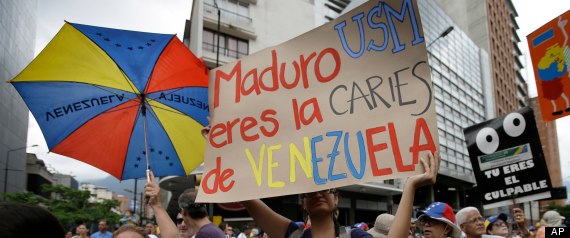
This week: The Venezuelan government starts an expanded audit of the disputed April 14 presidential election as Henrique Capriles files a legal challenge of the results; the Obama administration continues to monitor Venezuela’s crackdown on political opposition; Nicolás Maduro reacts angrily to Barack Obama’s comments about the political crisis in Venezuela; the family of Timothy Tracy, the American filmmaker held in Venezuela on charges of alleged espionage, calls the situation a “nightmare”; and U.S. diplomats are finally granted access to Tracy in Venezuela. Senior Venezuelan banking official is held on charges of accepting at least $5 million in bribes to funnel business to two Miami broker-dealers; the U.S. Treasury punishes Iran-Venezuela Binational Bank for helping the Iran government evade international sanctions; the Venezuelan government scrambles for answers to the country’s homicide rate, creating concerns about possible human rights abuses; and representatives of 130 countries believe Venezuela fails to meet the minimum democratic requirements. Venezuelan inflation soars toward 30 percent, the highest since August 2010, as the central bank’s scarcity index reaches a record high; according to mathematicians, the tally in Venezuela’s disputed election presents logical and numerical inconsistencies; Venezuela falls to seventh place in scientific research in Latin America, ranking below Cuba; and Venezuela’s only opposition TV station announces management changes after being taken over by the government.

Venezuela Starts Election Audit, The Wall Street Journal

Authorities on Monday began an expanded audit of the disputed April 14 presidential election even though the opposition candidate who called for the review has since withdrawn his support and instead filed a legal challenge of the results.

U.S. Monitoring Venezuela’s Political Crackdown On Opposition, Obama Says, Reuters

The United States is watching “crackdowns on the opposition” in Venezuela, President Barack Obama said in a television interview aired on Friday when asked if he considered newly elected Nicolas Maduro to be the country’s legitimate president.

Venezuela’s Government Condemns Obama’s Comments, The Associated Press

Venezuela’s government on Saturday angrily rejected comments made by U.S. President Barack Obama about the South American country’s political crisis and accused Washington of being behind violence that has followed its recent presidential election.

Family of American held in Venezuela says experience ‘a nightmare;’ embassy has had no access, The Associated Press

U.S. diplomats have been given no access to a California man held in Venezuela for nearly two weeks in what his family on Monday called a “nightmare” that unfolded after he was accused of being a spy fomenting postelection unrest.

US officials are granted access to American detained in Venezuela, Associated Press

Venezuela’s government has granted U.S. diplomats access to a California man who is being held while he awaits trial on charges of espionage and fomenting unrest.

Venezuelan banking official and 2 Miami broker dealers charged in $5 million NY bribery case, The Associated Press

A senior Venezuelan banking official is being held in Miami on charges that she accepted at least $5 million in bribes to funnel business to two Miami broker-dealers, federal authorities in Manhattan announced Tuesday.

US punishes Venezuelan-Iranian bank for helping Tehran, El Universal

The US Department of the Treasury punished on Thursday the Iran-Venezuela Binational Bank (IVBB) for helping the Iranian government to “sort out” international sanctions because of its controversial nuclear program.

Justice minister says Venezuela’s military to form part of anti-crime initiative, The Associated Press

Venezuela’s top security official announced Sunday the government of President Nicolas Maduro will use the military to fight rampant violent crime, raising concerns among activists who warned the initiative could lead to human rights violations.

No democracy in Venezuela, according to 130 countries, El Universal

Representatives of 130 Foreign Offices of countries viewed as democratic met last week in Mongolia, at the Summit of the Community of Democracies.

Venezuela Inflation Soars Toward 30% as Maduro Cuts Dollar Sales, Bloomberg

Venezuelan consumer prices soared the most in three years last month as President Nicolas Maduro’s government reduced dollar sales to importers and the central bank’s scarcity index reached the highest on record.

Mathematicians claim that election numbers in Venezuela do not match, El Universal

The results released by the board of the Venezuelan National Electoral Council (CNE) in several bulletins about the presidential election of April 14 exhibit “logic and numerical inconsistencies.”

Venezuela ranks below Cuba in scientific research, El Universal

Venezuela ranked seventh in scientific production in Latin America in 2011, according to international indicators such as SCImago Institutions Rankings (SIR).

Sole Opposition TV Channel in Venez Makes Changes, The Associated Press

Venezuela’s only opposition television channel says it is bringing in new management after its sale to new owners, but pledges to maintain its critical line against the government.

 
Jan
3
2013
Posted by
admin
Comments

An Ailing Chávez Hides From View As A Constitutional Crisis Looms

hugo chavez campaign stump An Ailing Chávez Hides From View As A Constitutional Crisis Looms

Courtesy of: Reuters

In Venezuela, the significance of events during the last several weeks cannot be overstated. After promising the Venezuelan people that he was “totally free” of the abdominal cancer that plagued him for more than a year, Hugo Chávez won re-election on October 7. Two months later, however, a visibly weak Chávez announced that his cancer had returned. He was rushed to Cuba for surgery on December 11; reports later surfaced that he had suffered serious “complications” after his fourth operation in 18 months.

Before leaving the country, Chávez designated newly-named Vice President Nicolas Maduro as his successor. According to Venezuela’s constitution, if a president dies or is unable to serve, a new election must be called within 30 days. A pallid Chávez, speaking on December 8th at the presidential palace, asked Venezuela to “elect Nicolás Maduro” if a special election occurs.

Though the special election requirement seems unambiguous, any transition of power is likely to be protracted and – because to several confusing provisions in Venezuela’s constitution – perhaps quite contentious. Chávez is due to be re-inaugurated on January 10th. As Foreign Policy explained this week, Chávez’s inability to be sworn in will pose significant problems for his party and thereby, the future of his self-styled socialist revolution:

“The problem for Maduro is that his term as vice president expires January 10th, when the current presidential term ends and a new one begins. Chávez, who is also president-elect, may not be healthy enough to be sworn in and appoint him vice president again. If that doesn’t happen, Maduro will be out of a job, even though he would remain the ruling party candidate in any follow-up election.”

If Chávez misses his inauguration, National Assembly president Diosdado Cabello would then assume control of the government until the President is finally sworn in or declared by the Assembly to be “totally absent.” Such a declaration, however, is unlikely to occur unless the President actually dies. Indeed, some of his socialist allies have suggested postponing the inauguration to accommodate Chávez’s health – a constitutionally dubious step that has drawn criticism from opposition leaders.

Even within the ruling socialist party there are divisions. Maduro and Cabello have emerged as the figureheads in a behind-the-scenes battle over the future of the party. Already faced with a slumping economy, a much-needed currency devaluation and a cancer-stricken president, Venezuelans may well have a full-blown constitutional crisis on their hands to start 2013.

If recent reports are to be believed, the country draws ever closer to such a scenario. Multiple outlets report that Chávez, his immune system ravaged by the cancer, suffered a severe respiratory infection following his most recent surgery. News also emerged that the infection was so serious it prevented Chávez from breathing, requiring doctors to perform a tracheotomy. Last month, Maduro sped to Havana to speak with the ailing president, sparking rumors that Chávez was on his deathbed.

For their part, members of the Venezuelan opposition have demanded the government tell ‘the whole truth’ about the president’s health. So far, the information released has lacked much needed specifics to determine the likelihood of Chávez’s survival.

For Venezuelans seeking clarification from the president himself, it may be a long wait. Chávez has not been seen or heard from since his statement nearly a month ago on December 8th. And this week, a source inside the Cuban hospital claimed that Chávez has been put in an induced coma, is “only kept alive by life support,” or may have even died. Chávez’s end may indeed be near, but we can be sure this is only the first chapter of a critical period for the future of Venezuelan’s government.

 
Oct
17
2012
Posted by
admin
Comments

REPORT: CHÁVEZ EXPROPRIATES 1,168 COMPANIES IN A DECADE; JAUA SAYS THERE’S MORE TO COME

agropatria1210 REPORT: CHÁVEZ EXPROPRIATES 1,168 COMPANIES IN A DECADE; JAUA SAYS THERES MORE TO COME

Courtesy of: Jack Bocaranda / AVN

During the last 13 years, Hugo Chávez has earned his reputation as a fierce opponent of private industry. Even as inflation soared and Venezuelans experienced shortages of even the most basic goods, Chávez held true to his socialist ideology, nationalizing huge swaths of the nation’s economy – from farming to oil production to the media. A report from the analysis firm Conindustria indicates that from 2002 to 2012 Chávez’s government nationalized 1,168 private companies. From the seizure of private oil operations to the expropriation of millions of hectares of farmland to the takeover of vacation homes on Los Roques, Chávez has shown that no sector of the economy is beyond his grasp.

However, the pace of expropriations slowed drastically in the months before the election. It seemed that even Chávez recognized his crusade did not represent sound economic policy. The trend began late last year, when Chávez slowed the rate of expropriations and began striking deals with companies he once derided – part of an effort to prop up Venezuela’s economy in an election year.

But now, having been granted the political cover of a new six-year term, Chávez has vowed to deepen his socialist revolution. A reinvigorated opposition can challenge the president on many fronts, but on his bread and butter policy of expropriations, Chávez will likely have free rein. Former Vice President Elias Jaua said in an interview last week that Chávez plans to take full advantage of that power. He told media that the “strategic expropriation” of companies is again on the agenda for Chávez’s next term. Since that time, Jaua has been replaced by Foreign Minister Nicolas Maduro and now stands as a candidate for Governor of Miranda state against Henrique Capriles.

Economists agree that Chávez’s policies have made Venezuela one of the hardest countries on the world in which to do business.  And Venezuela’s people have felt the consequences: foreign direct investment has fallen to less than $1 billion per year from $3.9 billion the year before Chávez took office. Meanwhile, government policies have kept arable farmland idle, forcing Venezuela to raise imports by more than 400 percent to make up for the losses.

Unfortunately for Venezuelans, the situation seems unlikely to improve in the immediate future.