Oct
3
2013
Posted by
admin
Comments

ICYMI: To Venezuelans, Heir of Chavez Is a Poor Copy

The New York Times
October 2, 2013
By William Neuman
VENEZUELA articleLarge e1380753017255 ICYMI: To Venezuelans, Heir of Chavez Is a Poor Copy

Courtesy of: The New York Times

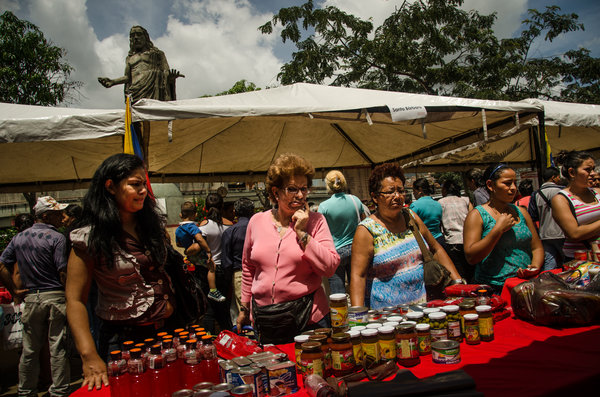
CARACAS, Venezuela — The start of the season for two premier teams in this baseball-loving nation was thrown into doubt after thieves stripped vast amounts of copper wire from the lights in this city’s main stadium. Basic items are often so hard to find that when a truck driver slumped dead at the wheel after a highway accident last week, motorcycle-riding looters swarmed in to grab the cargo: tons of red meat.

Prices are soaring, the country is plagued by electrical blackouts, some neighborhoods go days without water, and protests tangle the already stifling traffic. To top it all off, the cheap beer that helps people let off steam at many a weekend party has suddenly become scarce, too.

Nearly seven months after the death of Hugo Chávez, the country’s longtime leftist president and father figure, there is a growing sense that things are falling apart.

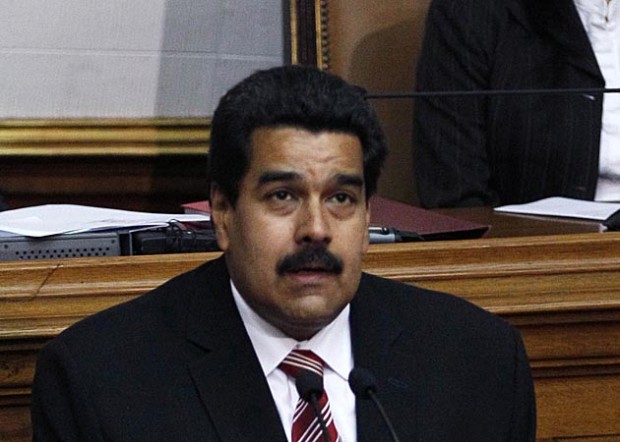
The new president, Nicolás Maduro, has revived a longtime scapegoat for the country’s woes, accusing Washington of conspiring with other enemies of the government in waging an “economic war” that has subjected the populace to blackouts, chronic shortages and other ills. Borrowing from Mr. Chávez’s script, Mr. Maduro on Monday expelled the top American diplomat here and two other embassy officials, contending that they were plotting to destabilize the country.

But while Mr. Chávez skillfully portrayed the United States as an imperialist bully and cast himself in the role of underdog hero, many Chávez supporters are finding Mr. Maduro’s attempts to imitate his mentor unconvincing.

“This is the biggest mistake Chávez ever made,” said Axel Ortiz, 20, a student, referring to Mr. Chávez’s choice of Mr. Maduro as his successor. Mr. Ortiz still defines himself as a Chavista — a loyal Chávez supporter — but he questioned Mr. Maduro’s ability to solve the nation’s problems. “Chávez was the only one who was qualified, the only one who could keep things here under control.”

The country’s economic problems have become acute. Inflation in the first eight months of this year was more than triple the rate in the same period last year. When measured over the 12 months that ended in August, it exceeded 45 percent. A government indicator that measures the scarcity of basic goods is close to its highest level in more than five years.

Many stores allow customers to buy only a limited number of scarce items like corn flour and cooking oil. People complain of having to stand in line for hours, often in vain, and many are losing patience with the government’s explanation that unsavory conspirators are to blame for the nation’s problems.

“The government is resorting to more and more outrageous and extravagant actions and statements to control the agenda,” said Andrés Cañizalez, a communications professor at Andrés Bello Catholic University.

All of this would be a lot to handle for any neophyte president, but the gaffe-prone Mr. Maduro has come under withering criticism for regularly tripping over his words, eliciting cringes from supporters and jeers from opponents. When he fell off his bicycle on live television recently, the event threatened to become a metaphor for a struggling presidency.

“People laugh at him,” said María López, 32, a mother of two on a recent morning in the Terrazas del Alba slum in the center of Caracas. She voted for Mr. Maduro, and said she still supported him. But she fought back a smirk when asked about Mr. Maduro’s bicycle accident, which occurred during a ride to promote his party’s youth movement. “We don’t want a president who’s a joke,” she said.

The blunders have piled up, much like the entourage of politicians and bodyguards who screeched to a halt in a tangle behind the president’s fallen bicycle.

In one of his most infamous verbal flubs, in August, Mr. Maduro sought to make a reference to the biblical story of Jesus’ multiplying the loaves and fishes — only to have it come out of his mouth as “the multiplication of the penises.” Mr. Maduro apparently conflated “peces” (fish) and “panes” (loaves) to produce “penes” (penises). He quickly apologized and corrected himself, but the damage was done.

“A person who doesn’t know how to speak will never know how to run a country,” said Jorge Flores, 30, a messenger at a government-run hospital, who voted for Mr. Maduro but now bitterly regrets doing so.

“This is the worst government I’ve ever seen,” Mr. Flores said. “The best government we’ve ever had here was with Chávez.”

Mr. Maduro calls his critics elitists and once said he had misspoken on purpose to bait his detractors.

Mr. Chávez, a fiery socialist, had a connection with ordinary Venezuelans that was so strong they often refused to blame him for many of the same problems that continue to bedevil the country. Mr. Maduro does not have the same charisma, and at least some of Mr. Chávez’s followers seem to be tuning him out.

“The government does these things to distract us from our real problems,” said Cristian Nivela, 24, a Chávez loyalist who voted for Mr. Maduro, referring to the expulsion of the American diplomats.

On Tuesday, Mr. Maduro used a special national television broadcast to present what he said was evidence that the diplomats had been conspiring with the extreme right in Venezuela to destabilize the country.

He showed a video, accompanied by ominous music, contending that the top diplomat at the United States Embassy, Kelly Keiderling, and the other two expelled diplomats had met in recent weeks with elected officials — including a state governor and a mayor — who belong to the Venezuelan opposition. The video also showed them leaving a meeting at the office of a pro-democracy group.

“These officials are meeting, well, in a shameless manner, and talking about strikes, sabotage, talking about the internal affairs of Venezuela, offering money,” Mr. Maduro said.

Such accusations resonate here because of the United States’ history of intervention in Latin America, including its tacit support of a 2002 coup that briefly ousted Mr. Chávez.

But a State Department official called the accusations absurd.

“Our diplomats were doing what they do all over the world,” said the official, Roberta S. Jacobson, assistant secretary of state for Western Hemisphere affairs. “They were visiting parts of the country and talking to all kinds of different people. They were doing nothing covert or out of the ordinary for diplomats.”

She said that in response, the United States was expelling the top Venezuelan diplomat in Washington and two other Venezuelan Embassy officials. The United States and Venezuela do not maintain an ambassador in each other’s capital.

On Tuesday night the State Department identified the Venenezuelan diplomats, who were given 48 hours to leave the country, as the charge d’affaires, Calixto Ortega Rios, and Second Secretary Monica Alejandra Sanchez Morales, both of whom are assigned to the country’s embassy in Washington, and Marisol Gutierrez de Almeida, the consul in Houston,

“It is regrettable that the Venezuelan government has again decided to expel U.S. diplomatic officials based on groundless allegations, which require reciprocal action. the State Department said in a statement. “It is counterproductive to the interests of both our countries.”

With the diplomatic tussle in the background, officials said the burglarized stadium — home to the Caracas Lions and the La Guaira Sharks, roughly equivalent to the Yankees and Mets in Venezuelan baseball — would be ready for the start of the season on Oct. 10.

They said workers had finally finished repairs to the lighting system after thieves stripped out much of the wiring, in a very public example of the crime, corruption and disarray in this country.

But the looting of the meat truck on Friday was shocking even to many who have become inured to the high levels of violence here. The truck became stuck under a barrier meant to block oversize vehicles. Part of the cargo crushed the top of the cab.

Denny Medina, 44, the owner of a fleet of trucks, said that he had tried to rescue the driver, but that he could not open the door. Instead of helping, he said, looters clambered over the vehicle.

“What made me feel powerless was to see the people carrying off the boxes of meat, and no one was showing any concern for the driver right below them,” Mr. Medina said. “It was terrible. I hope that we don’t get used to this.”

To read this article at The New York Times, please click here.
 
Jun
5
2013
Posted by
admin
Comments

Nicolas Maduro’s Embarrassing Week

Nicolas Maduro1 620x442 e1370466156876 Nicolas Maduro’s Embarrassing Week

Courtesy of: Associated Prses

The presidency of former bus driver Nicolás Maduro began inauspiciously, his government using intimidation and threats to consolidate power.  Now, two months after he claimed victory in an election fraught by irregularities, things have only gotten worse for Maduro. The aftermath of Venezuela’s election controversy have caused Maduro to lose support and popularity among his own people. And as violence and a sinking economy continue to take their toll on Venezuelans, Maduro is now coming face-to-face with the consequences of years of Chávez’s failed socialist policies.

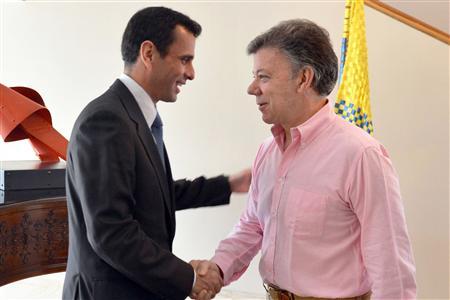
Maduro reacted like a spurned child when news emerged that opposition leader Henrique Capriles had traveled to Colombia and had been received there by President Juan Manuel Santos. As Venezuela’s socialist policies have kept the country in economic squalor, Colombia is one of Latin America’s success stories, and a strong U.S. ally in the region. Capriles met with President Santos, along with members of the Colombian parliament, where the leaders discussed Venezuela’s narrow presidential election along with the country’s dire economic situation.

“We are taking the voice of millions of Venezuelans beyond our borders,” Capriles said in Colombia. “The fight for democracy has to be everyone’s fight.” Indeed, news emerged this week that voter rolls indicate that deceased Venezuelans had “voted” in recent elections – the latest in a series of disturbing revelations about the state of democracy in Venezuela.

Economically, the situation is perilous and getting worse. With inflation near 30 percent and Venezuelans struggling to find basic goods like toilet paper, the country’s economy is heading for a recession sure to make matters worse. The Venezuelan government plans to institute restrictions on the sale of 20 basic items subject to price controls in Zulia, the country’s most populous state. Starting next week, the state will issue computer chip cards that will limit consumer purchases of certain products. Though the government has spun the move as a fight against contraband on the Colombian border, it is another clear sign that Venezuela’s shortages are worsening.

Meanwhile Venezuela’s bonds have bottomed out; Moody’s now rates them as junk status, a sign that the financial community has lost faith in Maduro’s government.

Indeed, criticism from the international community and from watchdogs continues to ratchet up. The meeting between President Santos and Capriles embarrassed Maduro on the world stage; the shootings of two U.S. embassy officials only further underscored the dreadful violence that plagues Venezuela. Desperate to quell the concerns of the international community, Venezuela has requested a meeting with top U.S. Diplomat John Kerry. Kerry will meet with Foreign Minster Elías Jaua at the ongoing Organization of American States General Assembly session in Guatemala. The meeting – the first at the cabinet level between the nations in several years – will explore ways to improve fractured relations between the two nations.

The only hope for Venezuela’s economy and her people lies in moderation, yet the signs often point in the opposite direction. Maduro has grasped for scapegoats, blaming Venezuela’s scant remaining private industry for the problems caused by the government. Venezuela’s last independent television station, Globovisión, was recently purchased by a group of businessmen with ties to the country’s ruling party. Now, as if on cue, the station has pledged to curb criticism of the government on its airwaves.

With Venezuela’s media already almost entirely controlled by the government, Globivision represented the last semblance of free media in the country. Its sale “appears to represent a new extension of the Venezuelan government’s control over broadcast media,” write Latin America experts Hugo Pérez Hernáiz and David Smilde.

All in all: it paints an embarrassing picture for Venezuela’s new president. Lacking in legitimacy before the international community and his own people, his government unable to reverse the economic calamity it caused, Nicolas Maduro’s first months in office started poorly, and have only gotten worse. And the Venezuelan people are feeling the consequences.

 
May
31
2013
Posted by
admin
Comments

In Case You Missed It… Articles Roundup Week of 5/31/13

s1.reutersmedia.net  In Case You Missed It… Articles Roundup Week of 5/31/13

Courtesy of: Reuters


This week: Venezuelan president reacts with fury to meeting between Colombian President Juan Manuel Santos and Venezuelan opposition leader Henrique Capriles, even recalling an envoy to Colombia’s peace process; two U.S. embassy officials are shot in a Venezuelan strip club, exemplifying the Venezuelan government’s inability to combat violence; the shooting prompts the State Department to describe the crime level in Venezuela as ‘critical’; and Nicolás Maduro accuses CNN of working to promote a coup. Capriles plans to ‘set off the alarms’ before international bodies due to the state of Venezuelan political institutions; Globovisión, the lone voice of dissent among Venezuelan TV stations, lowers the critical tone under new owners, firing popular talk show host and denying live coverage of opposition leaders; Maduro orders the creation of a new workers’ militia to defend the country’s ‘Bolivarian revolution’ at a time of economic problems and political turmoil; and Venezuela plans to hold local elections on December 8. The head of Venezuela’s main business group sees a dire economy in 2013 due to the decade-long weakening of domestic industry; 93.52 percent of respondents in a poll blame the government for shortages in Venezuela; Venezuelan police seize 2,500 rolls of toilet paper in overnight raid, in another sign of growing shortages; the Confederation of Industries estimates Venezuela’s domestic industries are working at only half their capacity; and Venezuela’s Catholic Church experiences the country’s scarcity of basic supplies, ‘running out of wine’ to celebrate Mass.

Venezuela furious at Colombia’s meeting with opposition leader, Reuters

Venezuela reacted with fury to Wednesday’s talks between Colombian President Juan Manuel Santos and Venezuelan opposition leader Henrique Capriles, saying it was a “bomb” in ties and recalling an envoy to Colombia’s peace process.

2 American Embassy Officials Are Shot in Venezuela Strip Club, El Universal

Two staff members of the American Embassy in Caracas, Venezuela, were shot and wounded at a strip club there early Tuesday, according to officials.

State Dept. report for Caracas personnel: Crime level ‘critical’, Washington Post

Two U.S. embassy personnel were wounded by gunfire outside a Caracas night spot early Tuesday morning, according to the State Department.

Venezuela accuses CNN of seeking to foment coup, AFP

Venezuela’s President Nicolas Maduro on Monday accused US-based news network CNN en Espanol of working to promote a coup d’etat as part of a wider media war against his socialist government.

Henrique Capriles to set off the alarms before international bodies, El Universal

Venezuelan opposition leader Henrique Capriles said Wednesday from Colombia that the situation facing Venezuelan institutions is forcing him to “set off the alarms” before international organizations and report on the state of affairs in his country.

Globovision, lone voice of dissent among Venezuela TV stations, lowers volume under new owners, Associated Press

Venezuela’s only TV channel that has been openly critical of the socialist government was in turmoil Monday after a popular talk show host was fired and the opposition’s leader said he was being denied live coverage.

Venezuela to Create New Workers Militia, Associated Press

Venezuela’s president has ordered the creation of a new workers’ militia to defend the country’s “Bolivarian revolution” at a time when the government faces economic problems and political turmoil.

Venezuela to hold local election next December 8, El Universal

In a brief press conference late on Thursday at the headquarters of the National Electoral Council (CNE), its president, Tibisay Lucena, said Venezuela will hold local elections on December 8, after they were put off for various reasons.

Venezuela business group sees dire economy in 2013, Reuters

Venezuela is slipping into high inflation and economic stagnation this year due to a shortage of hard currency and a decade-long weakening of domestic industry, the head of the country’s main business group Fedecamaras said.

Venezuelans blame Government for widespread shortage, El Universal

The Venezuelan Government is accountable for shortage in the country, said 93.52% of respondents in a poll conducted by daily newspaper El Universal.

Venezuela police seize 2,500 rolls of toilet paper in overnight raid, Associated Press

Police in Venezuela say they have seized nearly 2,500 rolls of toilet paper in an overnight raid of a clandestine warehouse storing scarce goods.

Venezuelan industries running at half capacity, El Universal

Venezuela’s domestic industries are working at half their capacity. The Venezuelan Confederation of Industries (Conindustria) reported that the manufacturing sector worked at 52.82% of its installed capacity in the first quarter of the year.

Venezuela Catholic Church ‘running out of wine’, BBC News

The Catholic Church in Venezuela has said it is running out of wine to celebrate Mass because of nationwide shortages of basic supplies.