Oct
1
2012
Posted by
admin
Comments

Capriles Rally Draws Thousands Against Chavez Ahead of Vote

Bloomberg News
October 01, 2012
By Nathan Crooks and Jose Orozco
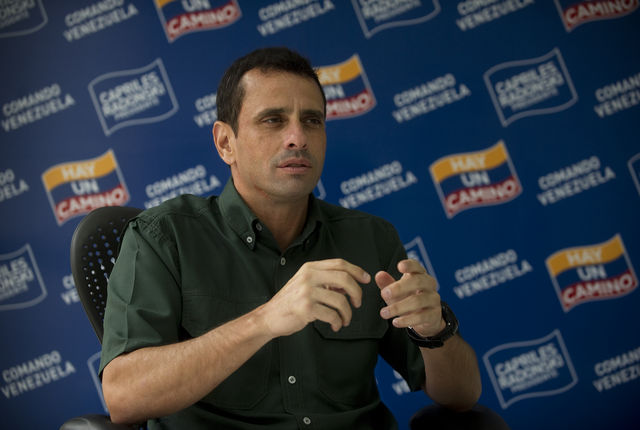
henrique capriles radonski Capriles Rally Draws Thousands Against Chavez Ahead of Vote

Courtesy of: Juan Barreto / AFP / Getty Images

Venezuelan opposition candidate Henrique Capriles Radonski symbolically closed his Caracas campaign against President Hugo Chavez yesterday with a march attended by tens of thousands of supporters.

Capriles, dressed in a shirt styled with the three colors of Venezuela’s flag, promised to confront growing violence in the South American country after he said three supporters were shot and killed over the weekend in Barinas state. He asked voters to judge Chavez’s priorities after 13 years in power and decide if they were happy with their lives today.

“This government gives away resources to every other country,” Capriles said. “There is no gauze in the hospitals here, but they give money away to sponsor samba dancing at the carnival in Rio.”

Capriles, 40, has held large rallies across Venezuela over the past month to close his campaign and build momentum after making house-to-house visits to offer what he described as a message of unity, progress and private investment. He filled the stadium used by Chavez’s favorite baseball team on Sept. 27 in a rally to close his campaign in the central state of Carabobo.

“This has to be one of the largest marches in the history of Caracas,” Capriles said yesterday to a throng filling the length of Bolivar Avenue in downtown Caracas, a symbolic space often used by Chavez for campaign rallies, waving party flags, chanting, dancing to campaign music and blowing vuvuzelas.

Leopoldo Lopez, a member of Capriles’ campaign team, said on the Globovision television network Sept. 28 that he hoped as many as a million people would attend the march. The campaign didn’t provide an estimate on the size of the march afterward.

Three Dead

Shots were fired at a caravan of cars in eastern Barinas state on Sept. 29 when Capriles supporters tried to pass a checkpoint, the Primero Justicia political party said in a statement, adding that the barricade had been set up by “presumed” Chavez supporters.

Police have detained three suspects, the Venezuelan government said yesterday in an e-mailed statement, without providing additional details. Chavez, who spoke at a rally yesterday in western Zulia state, said the incident was “regrettable” and urged his supporters not to fall into “provocations.”

Chavez, who also spoke at a rally on Sept. 29 in central Miranda state, said he himself is one of the biggest critics of his government and that there were reasons for some people to be “discontent.”

Insecurity, Crime

“There have been failures and problems, but what is at stake on Oct. 7 is not about the small or medium problems including water or electricity problems,” said Chavez. “We’ll solve the problems of insecurity and crime.”

Andrea Thadino, who lives in Caracas slum of San Agustin where a cousin was killed by a gunfight three years ago, said she works at a street nail salon because she can’t get a job teaching at a public school after signing a petition against Chavez.

“Despite studying for five years, I have to work as a street vendor to survive,” she said in an interview at yesterday’s march while carrying her 2-year-old son. “I voted for Chavez the first time but not anymore. I think Capriles is a sincere man who is going to make a change.”

Fitness for Office

Capriles, a former governor of Miranda state, has played up his youth and fitness to offer a stark contrast to the condition of his 58-year-old opponent, who is coming off three operations related to an unknown cancer in the past 15 months. He is ahead in several polls while trailing by as much as 15 percentage points in others.

“There are two options here. One we already know and has been in power for 14 years,” Capriles said. “I lead the other option that aims to solve your problems.”

Capriles, who arrived on a truck with “Progress” written on its windshield, said Chavez had dashed the hopes of many Venezuelans.

“There was a lot of hope, wherever you went, there were rivers of people full of hope,” said Capriles, referring to the period after Chavez was first elected. “Almost 14 years later, you be the judge of who is in the process of change and who is sick with power. Because the man in Miraflores defrauded the Venezuelan people.”

After his speech, Capriles hugged his mother and tossed his trademark baseball caps with the Venezuelan colors into the crowd.

Middle Class Votes

Chavez, a self-professed socialist who is traditionally supported by the country’s poor, has spent his final days on campaign trying to attract middle class and rich voters.

“Those with a big house and two or three cars in the garage, a good job, their kids in a good school, the ones who go to the club on Friday night and take their plane to Miami or Margarita Island on Saturday, those people should vote for Chavez,” the former paratrooper said in an interview broadcast yesterday on the Televen television network. “We are the guarantee of tranquility. Think about it well. It’s not for me, it’s for you.”

Armando Briquet, head of the Capriles campaign, said the government is trying to make the vote difficult for the opposition with actions including the closing of Venezuela’s Miami consulate, which will require thousands of voters to travel to the nearest voting center in New Orleans.

“Even with all that, we are going to win by more than 10 percentage points,” Briquet said backstage after the rally, citing the campaign’s polling numbers.

“On Oct. 7, Chavez wins!” Chavez told supporters yesterday in Zulia state. “It will be a grand victory, I don’t have a doubt.”

To contact the reporters on this story: Nathan Crooks in Caracas at [email protected]; Jose Orozco in Caracas at [email protected].

To contact the editor responsible for this story: Joshua Goodman at [email protected].

To read this article on Bloomberg News, please click here.

 
Sep
20
2012
Posted by
admin
Comments

ICYMI: Venezuela crime out of control, imperiling Chavez re-election

Venezuela crime out of control, imperiling Chavez re-election

USA Today
September 20, 2012
By Peter Wilson

violence in venezuela 300x203 ICYMI: Venezuela crime out of control, imperiling Chavez re election

Courtesy of: AP / Fernando Llano

EL JUNQUITO, Venezuela — Margarita Hernandez has been waiting more than a year for someone to pay for the murder of her 18-year-old son, killed by thugs a few blocks from his home.

“He was visiting friends when three men approached and shot him without warning,” said Hernandez, who works in a drug store. “The police know who the killers are as my son’s friends identified them — but one of the killers has an uncle in the police, so no arrests have been made,” she says.

Venezuela under President Hugo Chávez has the fourth-highest murder rate in the world and an abysmal crime-solving rate. Police in Venezuela make arrests for only eight of every 100 murders committed in the country of 28 million.

Crime is an issue that has enabled challenger Henrique Capriles Radonski to pull closer to upsetting Chávez in his attempt to win a third term Oct. 7. Some experts blame Chávez for allowing the country to become a transit point for the South American drug trade.

“Venezuela has become a criminalized state,” said Vanessa Neumann, a senior fellow at the Foreign Policy Research Institute. “You have drug traffickers and Colombian guerrillas operating in the country, and government officials have become involved with them. That makes it difficult to combat crime.”

Crime is common in Latin America. The Mexico-based Citizen Council for Public Safety and Criminal Justice, a non-government entity that compiles homicide statistics, found that 40 of the world’s 50 most dangerous cities last year were in Latin America.

Venezuela stands apart in two important areas, said Roberto Briceño León, who heads the Observatorio Venezolano de Violencia, a non-government group that monitors crime in the country.

“First, crime here is increasing unlike most Latin countries that are experiencing a decline,” he said. “And secondly, the government isn’t making it a priority or taking the right steps to combat it.”

Instead, Chávez has made it worse by arming groups who support his presidency and taking over state and city police forces, León said.

Murders and kidnappings have soared since Chávez took office in 1999. Last year, the Observatorio, estimates 18,850 people were murdered, up from 4,550 in 1998. There were almost 16,000 kidnappings, up from a few hundred in 1998.

Venezuela now has more murders annually than the U.S. and European Union combined, and that is despite 18 government anti-crime initiatives that Chávez has introduced.

More than 9,500 murders were committed in the first six months of this year, compared with 8,830 a year agoin the year-ago period, the Observatorio reported. Most of the victims are poor, male and between the ages of 18 and 30. More than 60% are shot five times or more.

Venezuelan newspapers are full of gruesome crimes that go unsolved. Criminals have committed armed robberies in hospital operating rooms and held hostage an entire movie theater audience.

Even high-ranking government officials have been targeted with relative impunity. The father of the pro-Chávez governor of the eastern state of Delta Amacuro was kidnapped earlier this month, while the governor of the eastern state of Monagas was assaulted in January.

Several diplomats assigned to Caracas, including the Mexican Ambassador, have been kidnapped or robbed. Caracas’ once thriving nightlife has gone quiet because many people are afraid to leave their homes after dusk.

Chávez has blamed the upsurge in crime on capitalism, poverty, the breakdown of families and American culture, which he says glorifies violence. His Interior and Justice minister, Tareck El Aissami, said earlier this month that the government has spent more than $500 million in the past few years on crime-fighting measures. A newly created police force, for example, has had marked success in zones where it has been deployed, he claimed.

Briceño disagrees, saying Chávez’s own revolutionary and socialist rhetoric has made things worse.

“The government is confused as to how to respond to the upswing in crime,” he said. “They view using the police as a bourgeois and repressive measure that was used by their predecessors. They want to use new solutions, but they just aren’t working.”

Capriles has capitalized on the crime issue, which surveys show is the voters’ most pressing issue this election.

Besides promising to fire corrupt police officials and deploy more than 20,000 more officers throughout the country, Capriles said he would launch an immediate campaign to disarm the country.

“Whoever has an illegal weapon will have to turn it in, or we will come for it,” he told cheering supporters at a recent rally. He also promised to clean up the country’s prisons, from which criminals direct kidnappings and robberies.

Hernandez voted for Chávez in each of his presidential campaigns. She said she will vote for Capriles this time.

“We deserve better than to live like this,” Hernandez said. “We deserve to live in peace. My son deserved better.”

To read this article on USA Today, please click here.

 
Sep
17
2012
Posted by
admin
Comments

Venezuela’s Capriles slams Chavez for blocking broadcast

Reuters
September 17, 2012
Girish Gupta and Brian Ellsworth

download 300x200 Venezuelas Capriles slams Chavez for blocking broadcast

Courtesy of: Reuters

Venezuela’s opposition candidate Henrique Capriles slammed President Hugo Chavez on Monday for blocking a live broadcast of an opposition rally, highlighting criticism the leftist leader abuses state resources to guarantee his re-election.

Shortly after Capriles began speaking to thousands of supporters in a Caracas park, Chavez launched a “chain broadcast” across all public access television in which he celebrated his government’s achievements and extolled the virtues of socialism.

“Another radio and television chain broadcast to continue lying to Venezuelans just 20 days before the election,” Capriles said via his Twitter account.

Capriles has accused Chavez of using state institutions to tilt the October 7 election in his own favor, from giving supporters cash and apartments, to using state media to glorify his image.

Government officials dismiss those charges, saying the social programs are aimed at helping the poorest, not buying votes.

Chavez says he only uses “chain” broadcasts for state business, not to boost his re-election campaign, but they often last for hours, during which he usually berates his opponents.

Local broadcasters in the South American nation are forced to halt their programming to carry the speeches, although the system was originally designed for brief emergency messages.

After Capriles was told his rally had been taken off the air, he told the crowd: “My friends, people are allowed to be afraid if they want.”

Supporters responded with thunderous applause. The rest of Capriles’ speech was screened by opposition TV station Globovision after Chavez finished talking.

The election campaign was already drowning in a flood of accusations and insults. Just days earlier, Capriles fired a top aide who had been seen accepting an envelope of cash in a video made public by Chavez’s allies.

Chavez remains popular in the OPEC nation after 14 years in power, thanks largely to his self-styled revolution’s liberal spending of oil revenue on social programs ranging from free health clinics to subsidized supermarkets.

‘MY REVOLUTION’

He leads the election race in most of the best-known polls, which are notoriously controversial and divergent in Venezuela. One major polling firm has Capriles ahead and his numbers have been edging up.

Chavez spoke for almost two hours on Monday at a school inauguration about how education has improved under his government. During the broadcast, several children thanked him for giving them laptops and ensuring access to education.

“Chavez, you are the heart of the people,” said one toddler, echoing the government’s principal campaign slogan.

Chavez, who won fame through a failed 1992 coup, has built up a strong emotional connection with the country’s poor that has made him a formidable candidate.

On Saturday, he tugged at supporters’ heart-strings by weeping during a speech at a campaign rally in which he lamented that he could no longer roam the country as in years past.

That may have been a reference to his cancer diagnosed last year. He says he is cured, but it has apparently limited his ability to campaign in the streets.

Opposition leaders described the scene as histrionic crocodile tears, saying he should have cried for the victims of delinquent violence rather than for himself.

On Monday, Capriles mocked Chavez’s triumphalist rhetoric in a swipe at the government’s struggle to control blackouts, rampant crime and deterioration of public services.

“My revolution is that the people will have water, power and good jobs,” Capriles told supporters. A day earlier, he led a rally through the Petare slum that was for years a bastion of Chavez support but in 2008 backed an opposition mayor.

Chavez has spent more than 70 hours in “chain” broadcasts since the start of the campaign on July 1, according to opposition activists that track the broadcasts.

The head of the National Electoral Authority has said that such broadcasts cannot be regulated by elections officials because they are used to inform the public about government projects and do not constitute campaign activity.

To read this article in Reuters, please click here.