Mar
22
2013
Posted by
admin
Comments

In Case You Missed It… Articles Roundup Week of 3/22/13

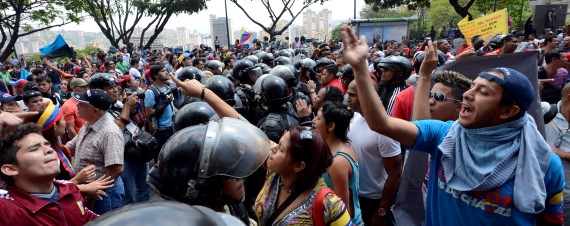
r CHAVEZ SUPPORTERS CLASH WITH STUDENTS large5702 e1363978984713 In Case You Missed It… Articles Roundup Week of 3/22/13

Courtesy of: Agence France Presse

This week:  With the April 14 election approaching, the “David and Goliath contest” between opposition candidate Henrique Capriles and acting president Nicolás Maduro begins; Capriles launches a nationwide tour as part of his campaign to replace the late President Hugo Chávez; Maduro’s launches anti-U.S. accusations as part of his campaign rhetoric and propaganda; and the Venezuelan government cuts off the last remaining direct line of communication with the U.S. Supporters of the government attack protesting students; as violence continues to spread through Venezuela, many hope for a change post-Chávez; Chávez’s funeral procession offers a harsh reminder of the bleak Venezuela he left behind; and despite having the largest oil reserves in the world, economists predict Venezuela’s inflation will continue to rise in 2013. New Venezuelan foreign exchange system released by Maduro offers little detail and skirts key issues; Schlumberger Ltd. (SLB), the world’s largest oil-services company, reduces work in Venezuela because of difficulties getting paid by state-owned Petroleos de Venezuela SA; by mentioning Chávez’s name around 3,500 times in just 16 days, Maduro continues to use the late president to ramp up support; and the Venezuelan government turns ordinary events like book fairs into de facto campaign rallies for Maduro.

Venezuela’s election: Battling it out, The Economist

On April 14th, Venezuelans will elect a new president. The choice, if one believes what the two main candidates say about each other, is between “a son of the parasitical bourgeoisie” and “a lying, incompetent usurper”.

Henrique Capriles Launches Venezuelan Campaign Tour, The Huffington Post

Venezuelan opposition candidate Henrique Capriles has launched a nationwide tour as part of his campaign to replace the late President Hugo Chavez.

Anti-US Accusations in Venezuela Seen as Campaign Rhetoric, Voice of America

Venezuela’s Acting President Nicolas Maduro has been making unsubstantiated accusations against Washington, also accusing the United States of plotting to kill Venezuela’s opposition candidate for president.

Venezuela Halts Communication With US Diplomat, ABC News

Venezuela’s government has halted lines of communication established by a top U.S. diplomat to protest what it says has been U.S. interference in the country’s internal affairs ahead of an election set next month to replace the late President Hugo Chavez.                                                                                                            

Chavez Supporters Clash With Student Protestors During Demonstration, Huffington Post

Supporters of the late President Hugo Chavez hurled rocks and bottles Thursday in an attack on student protesters who were marching against perceived bias by Venezuela’s electoral council.

Venezuela plagued by violent crime, The Associated Press

On their daily cable car rides to and from home in Venezuela’s capital, Maria Gonzalez and Jose Rafael Suarez soar in a bubble of safety far above the deadly, trash-strewn streets below.

Hugo Chavez Coffin Parades Past Venezuela’s Ills, ABC

The road from the military academy where Hugo Chavez’s body has been lying in state to the hilltop museum where he’ll be displayed indefinitely is lined with some of the most dangerous slums on the planet.

Venezuela to face high inflation in 2013, Global Times

Among the economic challenges facing Venezuela, the country with the largest oil reserves in the world, experts say the worst is sustained high inflation.

Venezuela gives few details of new forex system, Reuters

Venezuela vowed on Tuesday to provide more dollars to importers through a new foreign exchange system, but officials gave only vague details of how it will work and skirted around key issues including what the rate would be.

Schlumberger to Reduce Venezuela Work on Unpaid Bills, Bloomberg

Schlumberger Ltd. (SLB), the world’s largest oil-services company, is reducing work in Venezuela because of trouble getting paid by state-owned Petroleos de Venezuela SA.

How to keep Chavez memory alive? Name him 200 times a day!, Reuters

Hugo Chavez’s protege and the new flagbearer of socialism in Venezuela has lost no time proving his loyalty in public – in fact, 3,456 times in just 16 days.

Venezuelan government turns book fair into another celebration of Hugo Chavez’s legacy, The Washington Post

Near the entrance to Venezuela’s national book fair, an image of the late Hugo Chavez holding a can of paint in one hand and a brush in the other greets visitors.
 
Mar
14
2013
Posted by
admin
Comments

Capriles Prepares for a Tough Fight Against the Memory of Chávez

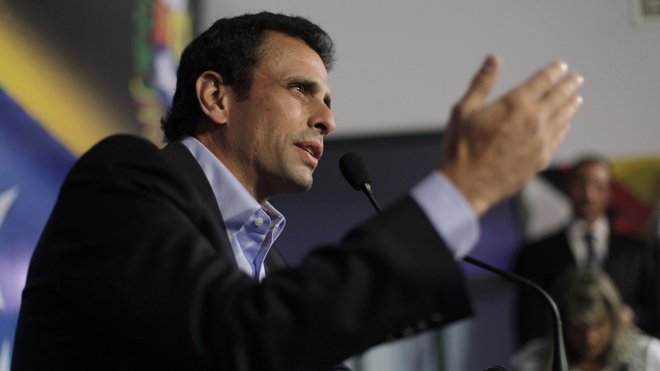
31013 capriles1 e1363269277543 Capriles Prepares for a Tough Fight Against the Memory of Chávez

Courtesy of: Associated Press

On Monday, interim president Nicolás Maduro and opposition leader Governor Henrique Capriles formally registered as candidates for Venezuela’s special presidential election, to determine who will succeed the late Hugo Chávez. The former vice president Maduro was sworn in just three days earlier – merely three days after the government announced Chávez’s death.

Even by the standards of an electoral system already skewed to the PSUV’s benefit, April’s special election is hardly a fair fight. The candidates are only permitted to campaign during an official 10-day campaign period from April 2-11, but the timing of the April 14 election already sets the opposition at a distinct disadvantage. While both candidates are prohibited from campaigning until April 2, Maduro has been riding the wave of grief over Chávez’s death to bolster his own image. Currently, state-run TV is saturated with 24/7 coverage of Chávez’s life and legacy, and the government has bused in thousands of supporters to wait in hour-long lines to view his casket. In addition, like Chávez, Maduro has not been timid about using his “cadena” powers, which require mandatory national broadcasts at the discretion of the president. Similar to Chávez, Maduro has made these a daily occurrence; even using one to take the oath of office in front of Chávez’s casket. While the official campaign will not begin for weeks, Maduro’s presence on the airwaves is virtually ubiquitous.

Although the campaign period officially ends on April 11, the days in between are fraught with symbolism that is sure to benefit Maduro. April 13 – the day before the election – is the anniversary of Chávez’s return to power after the April 11, 2002 coup that briefly ousted him from power. In the years following, the anniversary has been marked with widespread celebration by Chavistas – led by Chávez himself. This year will likely see that celebration further intensified – allowing Maduro to carry out de facto campaign events through official government celebrations of Chávez’s memory.

Capriles has spent much of his political career criticizing the Chávez administration for its expropriations, centralization of power, and corruption. He is currently serving as the Governor of Miranda, one of the largest states in Venezuela—the latest stage in his fast political rise. At the age of 26, he became the youngest elected member of the National Congress before winning two consecutive mayoral elections in Baruta, a division of the Greater Caracas municipality. Last year, he became the first candidate in 14 years to unite the opposition parties and seriously challenge Chávez in the October presidential election. Capriles traversed Venezuela for months, seeking to rally Venezuelan’s behind his vision for the country’s future. Although he lost the election, his quest was hardly unsuccessful: Capriles won an unprecedented 44 percent of the vote (over 6 million people).

Meanwhile, Maduro has risen far from his origins as a bus driver, becoming Chávez’s Vice President and handpicked successor. As a former Foreign Minister, he strengthened the Venezuelan government’s ties with Cuba and with the Castros. During Chávez’s absence in June 2011 and last winter, he worked to shore up his power as acting president and his political clout within the PSUV. Maduro lacks Chávez’s charisma and popularity, a weakness he has sought to counteract by currying favor with the late president and the Cuban government through a fierce commitment to PSUV’s principles of socialism.

The presidential campaign has not even officially begun, but Capriles has already been subjected by his rival to a malicious smear campaign. In a speech responding to Capriles’ candidacy, Maduro called him a “fascist” and used racist and homophobic slurs against the governor, a descendant of Polish Jews who escaped the Holocaust. The Venezuelan government is also threatening the opposition candidate with legal action for the defamation of Chávez and his family after Capriles raised questions about the government’s lack of transparency regarding the circumstances of the former president’s death.

Capriles has taken a tougher tone against Maduro than he did against Chávez in last year’s presidential election. Capriles has accused Maduro of exploiting Chávez’s memory for political gain. Indeed, Capriles’ chance at victory will likely hinge on his ability to demonstrate to Venezuelans that Maduro is not Chávez’s “second coming,” but is instead a lifelong political operative and puppet of the Castros, wholly complicit in the PSUV government’s economic mismanagement.

With only 10 days to campaign, Capriles will be fighting an uphill battle. Maduro will leverage every facet of Chávez’s finely-tuned political machine to secure a victory: at his disposal are a formidable (and corrupt) voter turnout program, unobstructed access to government resources, and the hysterical grief of Chávez’s devoted followers. It is little surprise that Maduro has already christened his campaign the “Comando de Campaña Hugo Chávez Frías” (Hugo Chávez Campaign Command). The month ahead will combine elements of a political rally and funeral march, as Maduro looks to ride a wave of Chávez sympathy and nostalgia into power.

Nevertheless, Capriles has defeated Chávez’s top deputies before. Just two months after his strong showing against Chávez in the presidential elections, Capriles held on to his Miranda governorship against Chávez’s close friend and former Vice President, Elías Jaua. He originally defeated Diosdado Cabello, the current head of the National Assembly, to first assume the governorship of Miranda in 2008. Capriles will capitalize on his youthful energy and the strong support of his base to do everything possible to obtain a victory.

 
Mar
8
2013
Posted by
admin
Comments

In Case You Missed It…Articles Roundup Week of 3/8/13

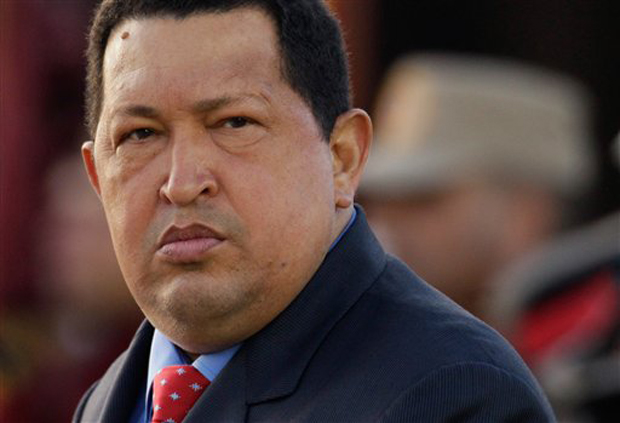
hugochavezobit e1362779431348 In Case You Missed It...Articles Roundup Week of 3/8/13

Courtesy of: Associated Press

This week: Nicolás Maduro announced Tuesday that President Hugo Chávez had succumbed to cancer, leaving behind a sharply divided country; with Chávez’s passing and subsequent funeral comes the question of his contradictory legacy, highlighted by his socialist policies; undoubtedly, Chávez will be remembered as a leader who transformed and shaped Venezuela; as Venezuela adjusts and evaluates its economy under Chávez, it becomes clear that his socialist agenda fell short of his promises; and like other socialist leaders, Chávez will be embalmed and put on permanent display inside a military museum. With Chávez’s death and upcoming elections, Venezuela’s interim leader Maduro is thrust into the spotlight; with Chávez gone, the U.S. reacts cautiously, weighing the prospects for a diplomatic thaw; a transition in Venezuela opens the path for eventual investment and expertise opportunities from oil companies; and Cuba mourns Chávez’s passing, while worrying about what the future may hold for the Cuba-Venezuela relationship. Finally, concern emerges over armed Chávez supporters poised to defend the revolution; the Venezuelan government plans to expel a U.S. Embassy official for allegedly meeting with military officers and planning to “destabilize the country”; Brayan Villarreal, a pitcher for the Detroit Lions, says his family was attacked in their home near Caracas; and the homicide rate in Venezuela between January and February reveals escalating violence in the country.

Chávez Dies, Leaving Sharp Divisions in Venezuela, The New York Times

President Hugo Chávez of Venezuela died Tuesday afternoon after a struggle with cancer, the government announced, leaving behind a bitterly divided nation in the grip of a political crisis that grew more acute as he languished for weeks, silent and out of sight, in hospitals in Havana and Caracas.

On Eve of His Funeral, Debating Chávez’s Legacy, The New York Times

Heads of state from around Latin America flocked to Venezuela for the funeral on Friday of Hugo Chávez, a tribute to the undiminished drawing power of the charismatic leftist leader, although perhaps not to the lasting influence of his socialist-inspired policies.

Obituary: Hugo Chavez – socialist showman who transformed Venezuela, Reuters

At two defining moments of his rule, Venezuela’s theatrical leader Hugo Chavez took a small silver crucifix from his pocket and held it above his head.

Venezuela’s Economy Under Chavez, by the Numbers, The Wall Street Journal

Many Venezuelans, mainly among the poor, are intensely mourning the passing Tuesday of President Hugo Chávez, whom they viewed as their “champion”, a father figure who after 14 years in power is taking on near saint-like meaning for them.

Like Lenin and Mao, Hugo Chavez’s embalmed body to be put on permanent display in Venezuela, Washington Post

Vladimir Lenin, Mao Zedong, Ho Chi Minh, and now Hugo Chavez.

Venezuela’s interim leader thrust into spotlight, CNN

He began his career as a bus driver in Caracas, and then rose through the ranks to become a member of Venezuelan President Hugo Chavez’s inner circle.

U.S. Hopes Chavez’s Passing Could Smooth Relations with Venezuela, TIME

U.S. officials are cautiously optimistic that the death of Venezuela’s Hugo Chavez could improve relations between the two countries, but they aren’t holding their breath.

Chavez Death Could Open Up Venezuela Oil, Wall Street Journal

The death of Hugo Chavez may have plunged Venezuela into political uncertainty. But oil markets have remained calm so far.

Cubans mourn Venezuela’s Chavez, worry about the future, Reuters

In many cities and towns, people filed through government-arranged memorials to pay tribute to the man who poured oil and money into the island nation to help revive its economy after a near-collapse in the 1990s.

The Wild Card in Venezuela: Armed Chavistas, ABC News

The banner just inside the poor neighborhood in western Caracas reads, “Loyal to Comandante Chavez.” The guard at the gate ensures no one enters without permission — not even the police.

Venezuela to expel U.S. Embassy official, Associated Press

Venezuela’s vice president, Nicolas Maduro, says the government of President Hugo Chavez plans to expel a U.S. Embassy official for meeting with military officers and planning to destabilize the country.

Brayan Villarreal’s family attacked, ESPN

Brayan Villarreal’s family home in Venezuela was attacked by three armed robbers who threatened to kidnap his relatives in the future, his agent told ESPNDeportes.com.

Number of homicides in Venezuela hits 2,576 in January-February, El Universal

Venezuela’s homicide rate in the first two months of the year dropped one percent with respect to the same period in 2012, according to figures recorded by the Scientific, Criminal and Forensic Investigation Agency (Cicpc).