Mar
22
2013
Posted by
admin
Comments

In Case You Missed It… Articles Roundup Week of 3/22/13

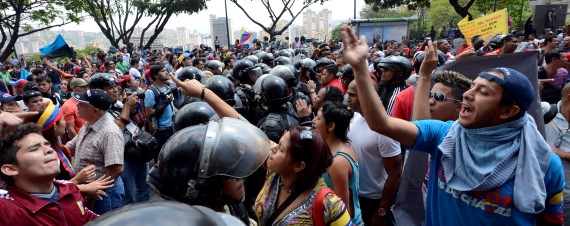
r CHAVEZ SUPPORTERS CLASH WITH STUDENTS large5702 e1363978984713 In Case You Missed It… Articles Roundup Week of 3/22/13

Courtesy of: Agence France Presse

This week:  With the April 14 election approaching, the “David and Goliath contest” between opposition candidate Henrique Capriles and acting president Nicolás Maduro begins; Capriles launches a nationwide tour as part of his campaign to replace the late President Hugo Chávez; Maduro’s launches anti-U.S. accusations as part of his campaign rhetoric and propaganda; and the Venezuelan government cuts off the last remaining direct line of communication with the U.S. Supporters of the government attack protesting students; as violence continues to spread through Venezuela, many hope for a change post-Chávez; Chávez’s funeral procession offers a harsh reminder of the bleak Venezuela he left behind; and despite having the largest oil reserves in the world, economists predict Venezuela’s inflation will continue to rise in 2013. New Venezuelan foreign exchange system released by Maduro offers little detail and skirts key issues; Schlumberger Ltd. (SLB), the world’s largest oil-services company, reduces work in Venezuela because of difficulties getting paid by state-owned Petroleos de Venezuela SA; by mentioning Chávez’s name around 3,500 times in just 16 days, Maduro continues to use the late president to ramp up support; and the Venezuelan government turns ordinary events like book fairs into de facto campaign rallies for Maduro.

Venezuela’s election: Battling it out, The Economist

On April 14th, Venezuelans will elect a new president. The choice, if one believes what the two main candidates say about each other, is between “a son of the parasitical bourgeoisie” and “a lying, incompetent usurper”.

Henrique Capriles Launches Venezuelan Campaign Tour, The Huffington Post

Venezuelan opposition candidate Henrique Capriles has launched a nationwide tour as part of his campaign to replace the late President Hugo Chavez.

Anti-US Accusations in Venezuela Seen as Campaign Rhetoric, Voice of America

Venezuela’s Acting President Nicolas Maduro has been making unsubstantiated accusations against Washington, also accusing the United States of plotting to kill Venezuela’s opposition candidate for president.

Venezuela Halts Communication With US Diplomat, ABC News

Venezuela’s government has halted lines of communication established by a top U.S. diplomat to protest what it says has been U.S. interference in the country’s internal affairs ahead of an election set next month to replace the late President Hugo Chavez.                                                                                                            

Chavez Supporters Clash With Student Protestors During Demonstration, Huffington Post

Supporters of the late President Hugo Chavez hurled rocks and bottles Thursday in an attack on student protesters who were marching against perceived bias by Venezuela’s electoral council.

Venezuela plagued by violent crime, The Associated Press

On their daily cable car rides to and from home in Venezuela’s capital, Maria Gonzalez and Jose Rafael Suarez soar in a bubble of safety far above the deadly, trash-strewn streets below.

Hugo Chavez Coffin Parades Past Venezuela’s Ills, ABC

The road from the military academy where Hugo Chavez’s body has been lying in state to the hilltop museum where he’ll be displayed indefinitely is lined with some of the most dangerous slums on the planet.

Venezuela to face high inflation in 2013, Global Times

Among the economic challenges facing Venezuela, the country with the largest oil reserves in the world, experts say the worst is sustained high inflation.

Venezuela gives few details of new forex system, Reuters

Venezuela vowed on Tuesday to provide more dollars to importers through a new foreign exchange system, but officials gave only vague details of how it will work and skirted around key issues including what the rate would be.

Schlumberger to Reduce Venezuela Work on Unpaid Bills, Bloomberg

Schlumberger Ltd. (SLB), the world’s largest oil-services company, is reducing work in Venezuela because of trouble getting paid by state-owned Petroleos de Venezuela SA.

How to keep Chavez memory alive? Name him 200 times a day!, Reuters

Hugo Chavez’s protege and the new flagbearer of socialism in Venezuela has lost no time proving his loyalty in public – in fact, 3,456 times in just 16 days.

Venezuelan government turns book fair into another celebration of Hugo Chavez’s legacy, The Washington Post

Near the entrance to Venezuela’s national book fair, an image of the late Hugo Chavez holding a can of paint in one hand and a brush in the other greets visitors.

 
Sep
23
2012
Posted by
admin
Comments

Venezuela’s Capriles says he’ll fix country’s problems, not world peace

Reuters
September 23, 2012
Daniel Wallis

venezolano Henrique Capriles simpatizantes Maracay 300x160 Venezuelas Capriles says hell fix countrys problems, not world peace

Courtesy of: Reuters

CARACAS, Sept 22 – Venezuela’s opposition standard bearer Henrique Capriles mocked President Hugo Chavez’s grandiose campaign pledges two weeks before the election, and vowed to fix voters’ daily problems if he wins.

Capriles, a 40-year-old state governor, said the socialist leader was more interested in promoting his self-styled revolution around the globe than in addressing local issues such a power cuts, unemployment and high crime rates.

Speaking on Saturday at a rally in southern Bolivar state, Capriles brandished the proposals by Chavez’s campaign in a leaflet bearing the slogan “The Candidate of the Fatherland.”

“I invite you all to read this. This is what the government is interested in: … ‘guarantee world peace, preserve the life of the planet and save the human species,’” he said to laughs and jeers from the crowd.

“They want to take this revolution, this political project, to other countries, and use our resources to finance it. … I don’t see anything about solving the problems with electricity, the problems with water, with public services.”

Chavez, whose oil-fueled largesse has helped support leftist governments around Latin America, is seeking another six-year term in a close race ahead of the Oct. 7 election for control of the OPEC member with the world’s biggest oil reserves.

The 58-year-old, who has undergone cancer surgery three times since June 2011, remains very popular with many in the country’s poor majority thanks to heavy state spending on social development projects, as well as his own humble roots.

For the first time, he is facing a particularly energetic candidate backed by a united opposition coalition who has waged a tireless campaign, criss-crossing Venezuela for months.

CHAVISTAS’ MARCH IN CARACAS

Chavez leads the majority of the best-known opinion polls, but polls are notoriously controversial and divergent in Venezuela and one major survey has Capriles ahead.

Both sides discount unfavorable polls and insist their candidate is ahead. Late on Friday, Chavez said the opposition planned to cry fraud and would try to destabilize the country – whatever the result of the vote.

“They are getting ready to cry fraud and reject the people’s triumph. I advise them not to dare,” he told a rally in the western mountain city of Merida. “I urge the rational, serious, democratic members of the right to take control.”

The campaign has so far been more peaceful than some Venezuelans had feared, but there remains the risk of a more serious confrontation – possibly over a count contested by either side.

The president routinely accuses the opposition of plotting to scrap his signature social “missions,” including the Mercal chain of subsidized food stores, if Capriles wins the election.

“Who believes the loser’s government would continue the social missions?” Chavez asked in Merida. “Nobody! Would they eliminate Mercal? Of course they would eliminate it!”

In the capital, Caracas, thousands of red-shirted “Chavistas” marched on Saturday in support of the missions, which also include projects to build thousands of homes, as well as make cash payments to pensioners and to poor families with children.

Capriles denies he would cancel any of the programs, but would launch his own and improve the ones the opposition says have been mismanaged by Chavez’s government and are wasteful.

Speaking at the rally in Bolivar state on Saturday, Capriles said he had heard the same stories everywhere he traveled in Venezuela: power cuts, lack of opportunities, fears about crime.

On Friday, Chavez’s government signed a deal with a Chinese company to develop Venezuela’s biggest gold mine, Las Cristinas, in the jungle of Bolivar state. Capriles said he had nothing against the Chinese, or “brothers” from any other country.

“But I want to tell our miners: prepare yourselves. We have enough talent here, these resources belong to Venezuela and will stay here,” he said. “There are just 15 days left (until the election) … 14 years are enough, 20 years are too many.”

To read this article in Reuters, please click here.

 
Jun
17
2011
Posted by
admin
Comments

Venezuela Government Ranked “Least Accountable Government in the World”

A new report released this week concludes that Venezuela is “the worst performer in the world in accountability and effective checks on the executive power.” The 2011 Rule of Law Index, which surveyed 200 experts from 66 countries, also found that Venezuela is one of the countries that least respect fundamental human rights, including freedoms of opinion and expression and the right to privacy. In addition, the Index states that the Venezuelan government offers very weak protections of property rights. In terms of crime prevention, the report says that often Venezuela does not prosecute or convict perpetrators of burglaries. Security is one of the top-of-mind concerns for most Venezuelans, who increasingly find themselves victims of crime.

Out of 66 countries studied, Venezuela ranked:
•    54th in corruption
•    64th in crime and violence
•    Dead last (66th) in transparency of government institutions and strength of the criminal justice system, which is often influenced by politics

Among the 12 countries surveyed in Latin America, Venezuela received the lowest scores in the region, ranking either last or second to last in six of the variables.

The Rule of Law Index was developed by the World Justice Project – an organization partly funded by the Bill and Melinda Gates Foundation. The Index regularly reviews countries’ compliance with the rule of law and access to independent justice in the world. The full report can be found at: www.worldjusticeproject.org.