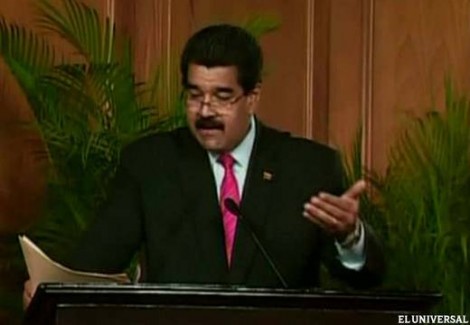
Courtesy of: VTV
This week: Reports emerge that Snowden may be headed to Venezuela via Havana, though his whereabouts remain unconfirmed; the US urges Ecuador, Cuba and Venezuela not to grant asylum to Snowden, yet Maduro expresses support for Snowden; Roberta Jacobson, US Deputy Secretary of State for Latin America, meets with the Venezuelan chargé d’affaires in a sign that the two countries may normalize relations; Maduro makes his first official visit to Haiti; Venezuela plans to make its foreign currency system more flexible by reviving a stalled dollar auction scheme in July; in a further attempt to boost alleviate growing debt, Venezuela looks to devalue the Bolivar by “stealth”; Standard & Poor lowers its long-term currency credit ratings on Venezuela from ‘B+’ to ‘B’; the Venezuelan government illegally records conversation between an opposition lawmaker and a local academic; the consultancy IHS Jane’s releases a report stating that Venezuela was the main purchaser of weapons in 2012; Maduro upsets Venezuelan journalists by giving Chavez a posthumous journalism award; During the celebration of the 192th anniversary of Battle of Carabobo, Maduro claims that “Corruption is going to engulf [Venezuela],” yet he continues to neglect enforcing rule of law.
Snowden heads to Venezuela via Moscow, Havana: airline source, Reuters
Former U.S. National Security Agency contractor Edward Snowden will fly from Moscow to Cuba on Monday and then plans to go to Venezuela, a source at the Russian airline Aeroflot said on Sunday. The source said Snowden was already on his way to Moscow from Hong Kong and would leave for Havana within 24 hours. The South China Morning Post also reported that Snowden had left Hong Kong for Moscow and that his final destination might be Ecuador or Iceland.
US urges Ecuador, Cuba and Venezuela not to grant asylum to Snowden, El Universal
The US government on Sunday urged Ecuador not to grant political asylum to Edward Snowden, a former National Security Agency contractor who sought refuge at the South American country after revealing Internet surveillance programs implemented by the US authorities, CNN reported. According to a source consulted by CNN, Washington also requested Venezuela and Cuba not to grant asylum to Snowden, which are other two likely destinations for Snowden, DPA reported.
Maduro: Venezuela ‘would consider asylum for Snowden’, BBC
Venezuela’s President Nicolas Maduro has said his country would consider an asylum application from fugitive US whistleblower Edward Snowden. “We say and advocate that someone in the world should stand with this young man and protect him, the revelations he has made with courage serve to change the world,” he said. Mr Maduro said that Venezuela had not received any such request, but would evaluate any application for asylum from Mr Snowden, because “every case is a humanitarian protection”. He was speaking from Port-au-Prince, during his first official visit to Haiti.
Venezuela voices solidarity with Ecuador for support to Snowden, El Universal
Once again, Edward Snowden, a former agent and expert of the CIA, was on the agenda of Venezuelan President Nicolás Maduro, who said Thursday night that, if requested humanitarian support or asylum for Snowden, Venezuela would not hesitate to grant it. In this regard, hailing Snowden for his revelations, Maduro said he supported President of Ecuador Rafael Correa for taking a firm stance vis-à-vis Washington’s warnings against Ecuador if it granted asylum to the former agent.
Venezuelan chargé d’affaires meets with US Deputy Secretary of State, El Universal
The chargé d’affaires of Venezuela in Washington, Calixto Ortega, met on Tuesday with the US Deputy Secretary of State for Latin America, Roberta Jacobson, three weeks after the respective foreign ministers took a first step towards rapprochement at the Assembly of the Organization of American States (OAS) in Guatemala. At the headquarters of the Department of State, Jacobson received the top diplomat of Venezuela in the United States, as both countries withdrew their ambassadors in 2010.
US interested in maintaining high-level dialogue with Venezuela, El Universal
The United States has a “strong interest” to continue high-level contacts to bring relations with Venezuela back to normal, with the exchange of ambassadors among the main goals, said on Thursday the State Department. That was the message the Deputy Secretary of State for Latin America, Roberta Jacobson, conveyed on Tuesday during her meeting in Washington with Calixto Ortega, the Venezuelan chargé d’affaires, William Ostick, a US State Department spokesperson, told Efe.
Venezuelan Leader Nicolas Maduro Visits Haiti, ABC News
Venezuelan President Nicolas Maduro made his first official visit to Haiti on Tuesday as the countries began negotiations to figure out ways to renew a special fund that uses oil money on mostly infrastructure projects. Maduro and Haitian President Michel Martelly met privately for several hours on the grounds of where the National Palace stood before it collapsed in the 2010 earthquake. Venezuela is one of the biggest donors to help impoverished Haiti rebuild from the catastrophic 2010 earthquake.
Venezuela to ease foreign exchange regime: source, Reuters
Venezuela will make its foreign currency system more flexible by reviving a stalled dollar auction scheme in July and after that allowing a revival of a free-floating secondary currency mechanism, a source in the government’s economic team said on Sunday. Venezuela has operated currency controls for a decade, and restricted access to dollars at the official rate of 6.3 bolivars are a major gripe for local businesses and a cause of the OPEC member’s slowing growth rate.
Venezuela to Devalue Bolivar by Stealth: Analyst Survey, Bloomberg
Venezuela will look to weaken the Bolivar this year without making an official devaluation of the currency, as it tries to boost revenue and narrow the budget deficit, according to a survey of analysts. South America’s biggest crude producer will step back from formally devaluing the Bolivar for the sixth time in nine years, said eight out of 11 analysts surveyed by Bloomberg.
S&P Lowers Venezuela Ratings to ‘B’ from ‘B+’, Latin American Herald Tribune
Standard & Poor’s Ratings Services said on Monday it lowered its long-term foreign and local currency sovereign credit ratings on the Bolivarian Republic of Venezuela to ‘B’ from ‘B+’. The outlook on the long-term ratings is negative. At the same time, the agency affirmed its ‘B’ short-term foreign and local currency sovereign credit ratings on Venezuela. S&P also downgraded its transfer & convertibility (T&C) assessment to ‘B’ from ‘B+’.
Venezuelan government says recording proves opposition plots, Reuters
Venezuela’s government released a recording on Wednesday of a well-known opposition lawmaker apparently criticizing the head of the opposition coalition and accusing him of meeting U.S. officials to provoke a crisis in the OPEC nation. In the latest of a string of secretly-made recordings that have roiled politics in the South American country in recent months, the new tape was of female legislator Maria Corina Machado talking to a local academic.
Venezuela main purchaser of weapons in 2012, but Brazil has largest defence budget, Mercopress
The report said Venezuela imported some 1.2bn in 2012, surpassing Brazil, the country with the largest defence budget in the region. The document highlighted that the trend may continue even after the demise of former President Hugo Chávez. IHS Jane’s analyst Ben Moores said that Venezuela was halfway in its rearmament program and that it would be very costly to drop it. The US remains the top defence supplier in the region, with 758.52 million dollars in 2012. But Russia, particularly thanks to sales to Venezuela, stood behind the US with 730.8 million.
Journalists upset as Venezuela’s late president Hugo Chavez given posthumous journalism award, ABC
The decision “was unanimous” to grant the award “with extraordinary mention to the comandante president Hugo Chavez,” said the head of the awards jury, Milagros Perez. “The history and practice of journalism can only be divided in two moments – before and after comandante Chavez,” Mr Perez said. A journalists’ association cried foul, saying Chavez had made a habit of closing down media outlets.
Tal Cual: And Where Are Venezuela’s Most Corrupt Politicians?, Tal Cual
“Corruption is going to engulf our country,” claimed President Nicolás Maduro on Monday. Such grandiloquent phrase couldn’t have been said anywhere else but at Campo de Carabobo, in the northern central coast of the country, during the celebration of the 192th anniversary of Battle of Carabobo, a fight that led Venezuela to its independence. We are sure this is not the first time and, regretfully, will not be the last, either, that such a harangue against corruption is said on that venue.