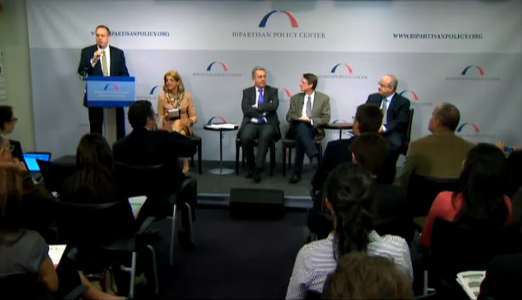
Screen Capture: Bipartisan Policy Center - South Americas October Surpise
Venezuela under Chávez does not meet the standards for a real democracy, according to statements made by former Colombian President Álvaro Uribe. The former leader told an audience at Washington’s Bipartisan Policy Center (BPC) that Chávez has failed to protect the security and freedoms of Venezuelan citizens during his rule and has not allowed their active participation in government.
Uribe participated in a BPC panel last week focusing on recent developments in Venezuela and Colombia, which include Venezuela’s tight presidential election, entitled “South America’s October Surprise?” The former Colombian president was joined by Dan Fisk of the International Republican Institute and Michael Shifter of the Inter-American Dialogue.
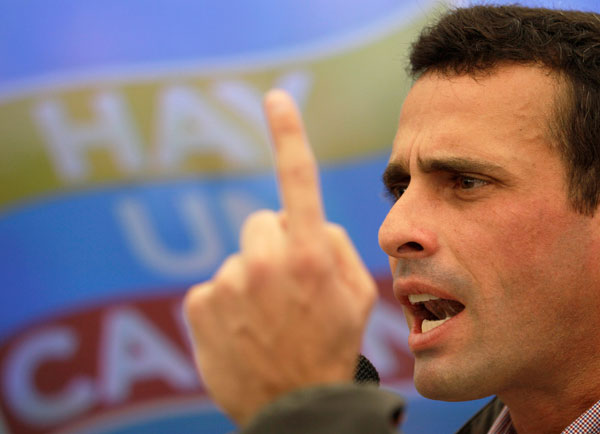
The panel discussed whether Venezuela’s upcoming elections can be considered fair as well as the likelihood that opposition candidate Henrique Capriles will defeat Chávez. Participants also tried to predict how the president will respond if he loses.
“There was a hemispheric consensus that elections [are] how you judge a democracy,” Fisk said of Venezuela’s upcoming vote. But he added that Chávez has manipulated the system to provide the appearance of a democracy while suppressing citizens’ democratic rights. “A lot of people have given [Chávez] credit that you can take away people’s freedom through a series of democratic processes.”
Uribe, though, had much stronger words. “I am against the Chávez dictatorship with or without elections,” he said. He further criticized the Chávez administration for failing to pursue the narco-terrorist organization FARC in Venezuelan territory. That failure has bled across Venezuela’s borders, undermining the stability of Colombia that the government of president Uribe worked hard to attain.
Fisk said that while the technical voting process in Venezuela appears to be fair, the real disparity – and the threat to democracy – lies in the campaign itself.
“The problem is not the machinery, it is the campaign process,” Fisk said. Venezuelan law allows the president to call mandatory national broadcasts, known as cadenas, at any time, and Chávez has abused this power to saturate Venezuela with campaign propaganda. Meanwhile, Capriles must pay for airtime, and lacks the resources to match the reach of the state media.
Chávez has also used the resources of the government, supplied by the country’s vast oil reserves, to finance his campaign. “In many ways PDVSA is the lubricant of the Chávez campaign,” Fisk said. Chávez has increased social spending, and then trumpeted that increased spending in his campaign rhetoric, giving Venezuelans the impression that it is he, not the government, who is giving them these benefits.
Despite all of this, Fisk says that this is the most competitive race that Chávez has ever faced. It remains to be seen if all of the electoral advantages Chávez enjoys can blunt the impact of his economic mismanagement, which has led to severe shortages and skyrocketing inflation, or make Venezuelans forget the recent refinery fires and one of the world’s highest crime rates.
Shifter added that the opposition has run an excellent campaign, and Capriles has refused to fall for tactics and provocations of Chávez. The opposition has stumbled in the past and has its best chance yet, in part because it has unified itself into one group. In addition, he did join the concerns of the other panelists, adding that “there is not a level playing field.”
In an encouraging bit of consensus, the panelists for the most part dismissed worries that Chávez would reject the results if the opposition wins. “It would be very hard in terms of politics in Venezuela and international pressure to deny [an opposition victory],” Shifter said. He warned, however, that the process may not be smooth. “We should be prepared for some amount of violence and instability. We have seen that in campaign stops in the past couple of days,” alluding to recent Chavista-incited violence at Capriles rallies.
Fisk added that the United States should be prepared to accept the results if the election appears credible, and that he believes that Venezuelans will peacefully accept the results as well.