May
17
2013
Posted by
admin
Comments

In Case You Missed It…Articles Roundup Week of 5/13/13

This week: Shortages prevent Venezuelans from buying basic foodstuffs, from milk to flour to cooking oil. Foreign direct investment plummets The widespread shortages caused by Maduro’s socialist policies have now choked off the supply of a new household item: toilet paper; To address rampant crime, Maduro sends Venezuela’s military into high-violence areas. Analysts worry that Venezuela, entirely dependent on oil revenues, may turn into a failed state when oil prices inevitably drop. Desperate for a scapegoat on which to blame Venezuela’s economic woes, Maduro accuses Venezuela’s largest food company, Polar, of hoarding.  Polar’s CEO convincingly rebuts these allegations and offers advice on how the government might work with the private sector to combat shortages. A conciliatory Maduro begins to show signs of extending an olive branch to the private sector.


Eclac reports 15% drop in foreign investment in Venezuela in 2012, El Universal

Foreign investment in Venezuela fell 15% in 2012, said the Economic Commission for Latin America and the Caribbean (Eclac) of the United Nations in its report “Foreign Direct Investment in Latin America,” released on Tuesday. The regional agency report highlighted that in 2012, Venezuela received USD 3.21 billion versus 3.77 billion a year earlier. In this way, Ecuador joined Venezuela, Nicaragua, Mexico, Bahamas, Granada, Saint Kitts and Saint Lucia as the only countries in the region where foreign investment has dropped. Thanks to the positive performance of other countries, on average, Latin America and the Caribbean in 2012 hit a new record amount of direct foreign investment of  USD 173.36 billion (6.7% higher than in 2011), despite the external context of declining capital flows, Eclac reported in a press release.

How food shortages are dividing Venezuela, BBC News

Some 30 people are queuing outside a state-run supermarket in the 23 de Enero neighbourhood in Caracas. A woman walks out with a bag in her hands. “There is milk!” she says enthusiastically, much to the delight of the other customers. Milk is one of the products that are not easily available in Venezuela. Others include toilet paper, sugar, cooking oil and the cornflour used to make arepas, Venezuela’s national dish. According to data from Venezuela’s Central Bank, the scarcity index rose to 21% last month, the highest since the bank started tracking the measure in 2009. This means that out of 100 goods, 21 are not available.

Roiled over rolls: No toilet paper has Venezuelans fuming, USA Today

Gil, a 43-year-old Venezuelan housewife, spent two days looking for toilet paper in this city of 150,000 in the central state of Aragua. She found paper towels and napkins but no toilet paper. Gil, a 43-year-old Venezuelan housewife, spent two days looking for toilet paper in this city of 150,000 in the central state of Aragua. She found paper towels and napkins but no toilet paper.”Call me a counterrevolutionary but there are certain things that are essential and toilet paper is one of them,” she says, staring at the bare shelves where toilet tissue used to be stocked at the Morichal supermarket, one of the city’s largest. “What do they expect us to use? Banana leaves?”


Venezuela’s military enters high-crime slums, Miami Herald

Stern-looking soldiers clutching assault rifles wave down the beat-up Chevy Caprice entering this sprawling slum on the outskirts of Caracas. Flashlights in his face, the driver steps out and places his hands on the roof while the soldiers frisk him for drugs and weapons. He’s clean, and a hand gesture from the commanding officer sends him off into the maze of ramshackle homes that is Petare, one of the most dangerous parts of Venezuela’s notoriously crime-infested capital.

The People of Venezuela Are in Dire Need of Toilet Paper, New York

The AP brings us news that Venezuela is having a serious humanitarian crisis, one with which anyone who’s ever made a frantic late-night run to the corner bodega can sympathize. Namely, the entire country is running out of toilet paper. Venezuela’s socialist government has promised to import 50 million rolls of toilet paper (or maybe 25 million double-rolls?) and 760,000 pounds of food to make sure all citizens can eat and poop in comfort once more. “The revolution will bring the country the equivalent of 50 million rolls of toilet paper,” the country’s commerce minister said. “We are going to

Venezuela remains mired in a political and economic crisis that shows no signs of letting up. But while street protests, soaring inflation, scarcity, and skyrocketing crime are massive headaches, the government can count on still-high oil prices to soothe the pain a bit. The question that begs asking is: How will Venezuela maintain stability if oil prices drop?

Venezuelan food firm tells Maduro government to boost output, Reuters

Venezuela’s top food producer, Empresas Polar, on Monday challenged the country’s socialist government to boost output of basic staples and ease nagging product shortages, rejecting accusations it is hoarding products to destabilize the economy. Food supplies have become increasingly unsteady since late last year. Shoppers struggle to find corn, wheat flour and basic medicines – a constant complaint that could become a political liability for President Nicolas Maduro. The president over the weekend said Polar, which makes products from beer to detergent, was intentionally cutting output to leave supermarket shelves bare and weaken his government through “economic war.” Polar President Lorenzo Mendoza, in a combative press conference, said the product shortages have been partly spurred by inefficiency of state-run companies nationalized during the 14-year-rule of late socialist leader Hugo Chavez.

Caracas Offers Peace to Private Sector, Wall Street Journal

New President Nicolás Maduro, trying to shore up Venezuela’s economy amid growing shortages of everything from corn flour to toilet paper, has extended an olive branch to the country’s private sector, in particular the country’s largest food maker. It is a surprising turnaround given the antics of his predecessor, the late populist Hugo Chávez, who regularly threatened to nationalize the food maker, Empresas Polar SA, and accused it of hoarding products in order to sabotage his self-styled revolution.
 
Jan
18
2013
Posted by
admin
Comments

ICYMI: 5 Ways Hugo Chavez has Destroyed the Venezuelan Economy

ABC News
January 17, 2013
By Stephen Keppel

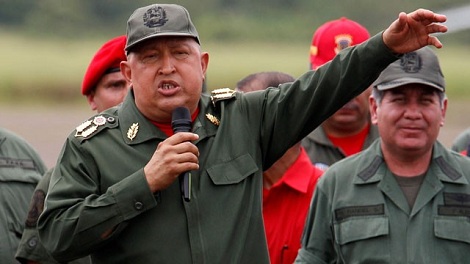
ap chavez military uniform wg ICYMI: 5 Ways Hugo Chavez has Destroyed the Venezuelan Economy

Courtesy of: Associated Press

It is unclear if Venezuelan president Hugo Chavez will make a full recovery from his most recent surgery in Cuba. Whatever happens, he always stirs a lot of passions. Certainly that is the case when thinking of what his lasting legacy in Venezuela will be.

On the left he is seen as a socialist hero who broke the Venezuelan “oligarchy” and defended the country against the “American Empire.” On the right he is the socialist anti-Christ who “brought Afghanistan to South America.” But perhaps one of the simplest ways to judge his reign, is to remove the politics and look closely at his economic record.

Take gross domestic product, or GDP. In that case the record is certainly mixed. There was strong economic growth from 2004 to 2008 but GDP fell in 1999, 2002, 2003, 2009 and 2010. From the time Chávez took office in 1999 to 2011 Venezuela’s economy grew by an average of 2.8% per year. During this same period Latin America as a whole grew by 3.3% per year and Brazil grew by 3.4% per year.

Others will argue that we must judge Chavez on his record of reducing poverty and inequality. According to the UN’s Economic Commission for Latin America, the percentage of the population living under the poverty line in Venezuela fell from 49.4% in 1999 to 27.8% in 2010. That is a pretty good record but there were similar trends across Latin America. In the region as a whole poverty dropped from 43.8% in 1999 to 31.8% in 2010. A few countries, like Peru, Brazil and Panama, faired even better than Venezuela. Poverty rates in Peru dropped sharply from 54.7% in 2000 to 31.3% in 2010—all three have solidly capitalistic economies.

Inequality has declined in Venezuela but it has across other parts of Latin America as well particularly in Brazil, Chile and Colombia.

When you take a closer look at the entire economy, and where Venezuela is headed, the record is not a good one. Here are five major ways that Chavez has really undone the Venezuelan economy:

1. Venezuela has gone from being dependent on oil to being extremely dependent on oil.

Former minister Gerver Torres points out that in 1998 oil represented 77 percent of Venezuela’s exports but by 2011 oil represented 96 percent of exports. That means today only around 4 percent of the goods that Venezuela exports are non-oil products! The Venezuelan economy relies almost exclusively on the price of oil and the ability of the government to spend oil revenues. This will take years to reverse because of item two below.

2. The Chavez government has crippled private businesses and national industry through expropriations and nationalizations.

The Chavez government has expropriated or nationalized numerous companies (no one seems to be able to count them all) involved in various sectors including aluminum, cement, gold, iron, steel, farming, transportation, electricity, food production, banking, paper and the media. The number of private companies in industry has dropped from 14,000 in 1998 to only 9,000 in 2011, according to Torres.

Companies need investment to grow and hire new workers. One of the biggest failures of the Chavez government has been to drive away both domestic and foreign investors. In 2011 Latin America enjoyed a record of more than $150 billion in foreign investment with Brazil receiving $67 billion. Venezuela’s neighbor Colombia received $13 billion while Venezuela received only $5 billion. To avoid expropriation and find investment a number of Venezuelan companies have moved to Colombia, Panama and the United States.

3. The Venezuelan currency is a mess.

The new currency, the Bolivar fuerte, is anything but strong. The Bolivar fuerte has lost nearly two-thirds of its value since it was launched in 2008. Many analysts expect Venezuela will have to go through a painful devaluation sometime this year or next. This will further reduce the value of wages and sharply increase the costs of imports of basic staple goods. Life will get tougher for most Venezuelans but Chavez probably won’t be around to see it.

4. Prices in Venezuela have gone up by 23 percent a year for more than ten years.

Inflation in Venezuela has averaged 23 percent during 1999-2011 compared to a Latin American average of 4.6 percent. Imagine what life would be like if the price of groceries went up 23 percent every year. This craziness combined with stringent price controls has completely distorted the economy, creating black markets and shortages. In 2012 Venezuela will again have one of the highest inflation rates in the world.

5.Under Chavez Venezuela has become one of the most violent countries on the planet.

The murder rate per 100,000 citizens has risen from 25 in 1999 to 45.1 in 2011. This is not an economic stat per se but violence has an economic impact. It is more challenging and dangerous than ever to do business and go to work in Venezuela. When you consider these points, it’s hard to call the economic legacy of Chavez and his band of 21st Century Socialists a good one.

To read this article on ABC News, please click here.


Oct
11
2012
Posted by
admin
Comments

After Sunday, What’s Next?

514473580 After Sunday, Whats Next?

Courtesy of: Luis Acosta / AFP / Getty Images

In the aftermath of Sunday’s vote, which saw Hugo Chávez elected to his fourth term as president, several things have become clear. Henrique Capriles, leading a unified and energized opposition, was the toughest challenger Mr. Chávez has ever faced. The Chávez government wielded its control of Venezuela’s media relentlessly, preventing Capriles’ message of unity to find pragmatic solutions to everyday problems from gaining any traction on the airwaves. Others have rightly pointed out the bias in Venezuela’s electoral authority, the CNE. Despite the unlevel playing field, Capriles, who doggedly marched through more than 250 towns, succeeded in turning nearly half the country to his cause.

Even though one’s initial impression of Sunday’s vote may yield a dreary sense of “more of the same,” the coming years promise to be crucial for Venezuela. Chávez’s victory brings with it none of the certainty of past triumphs. For one, the president’s cancer still looms over Venezuela’s future: despite his repeated denials, many believe that Chávez remains terminally ill. Given that Venezuela’s constitution stipulates that a new election be held if a president dies in the first four years of his term, the country’s rejuvenated opposition may have another chance to make its case before Venezuelans. Regardless of the president’s health, December’s gubernatorial and April’s mayoral elections give the opposition an opportunity to make further gains against Chávez’s socialist project.

And that opposition still has much to fight for. Chávez, ever the ideologue, is poised to direct his government to take over more of the private economy. The 2012 campaign has weakened Chávez’s political support, but it is unlikely to have shaken his commitment to his socialist project. After a few quiet months in the run-up to the election, we may see the pace of expropriations tick up again. In fact, just two days after Chavez’s election victory, Vice President Elias Jaua confirmed that the expropriation policy will indeed continue.

Venezuela’s stagnating economy may be in for a crushing blow, meanwhile, as Chávez’s election-year borrowing-and-spending may well lead to a currency devaluation. This borrowing, along with high global oil prices, has thus far papered over the cracks in Venezuela’s anemic economy. As Chávez poured millions into his populist reelection effort, he failed to address the fundamental weaknesses in the nation’s economy: food shortages, electrical outages and a crumbling public infrastructure.

But what goes up must come down: the poorly-managed state oil company PDVSA has continually operated under capacity; as prices fall, Venezuela’s leaders’ failure to plan for the future will redound upon the nation’s people. The fatal refinery explosion in Amuay is but a recent illustration of the consequences of PDVSA’s mismanagement.

Meanwhile, a fresh six-year term will shield Chávez from political consequences of the corruption within his government. Former judge Aponte Aponte shocked Venezuelans and, indeed, the hemisphere with his revelation that the government fed instructions to the nation’s judiciary. With Chávez no longer facing the public scrutiny of a campaign, the incentives for such corruption will only increase.

For those in the U.S. policy community, engagement in the future of Venezuela remains essential. Chávez, to be sure, is unlikely to curb Venezuela’s relationship with allies like China, Russia or Iran, or to liberalize Venezuela’s trade policy toward the United States. But the twin pressures of a possibly-fatal illness and a collapsing economy mean that, for Chávez’s Venezuela, the reckoning has yet to come.