Feb
19
2013
Posted by
admin
Comments

ICYMI: Chavez’s return to Venezuela raises questions

Associated Press
February 19, 2013
By Fabiola Sanchez and Ian James
38026estudiantes cub1 e1361304532483 ICYMI: Chavezs return to Venezuela raises questions

Courtesy of: TalCual

CARACAS, Venezuela — The announcement of President Hugo Chavez’s return to Venezuela after a 10-week silence in Cuba is raising questions about his cancer treatments, his delicate health, and the political purposes that motivated his homecoming.

Three messages appeared on Chavez’s Twitter account early Monday saying he was back, and the government announced that he had arrived at 2:30 a.m. and was taken to Caracas’ military hospital to continue with his treatments. The government released no images of the president, though, and while his supporters threw street celebrations to welcome him, some also said they wanted to see him to get a better idea of how he is doing.

The government has said Chavez is undergoing “complex and tough” treatments for his illness but hasn’t specified what sort of treatment. The government has said he is breathing through a tube inserted into his windpipe and therefore has difficulty talking, but officials haven’t given a detailed medical report despite demands by the opposition.

Even as Vice President Nicolas Maduro has increasingly stood in for Chavez since the president’s Dec. 11 surgery, he and other leading officials have insisted that Chavez remains in charge and has been signing off on government decisions.

Chavez’s announced return to Caracas came less than three days after the government released the first photos of the president in more than two months, showing him in a bed looking bloated and smiling alongside his daughters. The lack of any images of Chavez on Monday underlined the many unanswered questions about where he stands in his prolonged struggle with an undisclosed type of pelvic cancer.

Information Minister Ernesto Villegas broke into song on television early Monday, exclaiming: “He’s back, he’s back!”

“Bravo,” Villegas said, before state television employees joined him in the studio clapping and celebrating.

A giant inflated Chavez doll was placed beside a corner of the National Assembly building.

Villegas reiterated in an interview with Venezuelan radio station Union Radio that Chavez is going through a “difficult, hard and complex” recovery process, and that his return doesn’t change the “difficult circumstances he has been in.”

The vice president later presided over a televised Cabinet meeting at the presidential palace, though he didn’t offer additional details about Chavez. “He will live and he will triumph,” Maduro said at the end of the meeting, while on television an image of Chavez’s face was superimposed on the oval-shaped table.

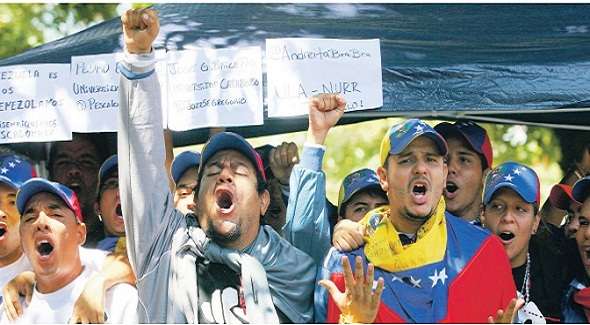
Hundreds of Chavez supporters celebrated his return in downtown Caracas, chanting his name and holding photos of the president in Bolivar Plaza. Supporters also gathered outside the hospital, wearing the red T-shirts of Chavez’s socialist movement and chanting: “He’s back!”

“I want to see my president,” said Alicia Morroy, a seamstress who stood outside the hospital on the verge of tears. “I’ve missed him a lot because Chavez is the spirit of the poor.”

Six hospital employees who were asked about the president said they hadn’t seen him. Yusmeli Teran, a waitress who serves food to patients, told The Associated Press that the area where Chavez was being treated on the 9th floor is a restricted area guarded by police and soldiers. “No one has seen him at all,” she said.

Chavez’s precise condition and the sort of cancer treatments he is undergoing remain a mystery, and speculation has grown recently that he may not be able to stay on as president.

Dr. Carlos Castro, scientific director of the Colombian League Against Cancer in Bogota, Colombia, said that given the government’s accounts that Chavez is undergoing “complex” treatment, he thinks he likely will have to step down.

“Unfortunately, the cancer he has isn’t going to go away, and he’s returning to continue his battle. But I think he’s conscious that he isn’t going to win his fight against cancer, as much as he’d like to win it,” Castro told the AP in a telephone interview.

The Venezuelan Constitution says that if a president dies or steps down, a new vote must be called and held within 30 days. Chavez raised that possibility before he left for Cuba in December by saying that if necessary, Maduro should run in a new election to replace him.

Chavez’s return could be used to give a boost to his would-be successor and gain time to “consolidate his alternative leader” ahead of a possible new presidential vote this year, said Luis Vicente Leon, a Venezuelan pollster and political analyst.

Leon said that even if Chavez isn’t seen in public, his presence will allow the government to keep up his emotional connection to his followers and rally support.

Even the state newspaper Correo del Orinoco referred to the possibility of a new election in its Monday edition. The top headline, published before Chavez’s announced return, said a poll found Maduro would win a possible election.

Maduro and other Cabinet ministers held hands and prayed in a televised gathering on Monday night in which a priest and a minister offered words of thanks for Chavez’s return.

Venezuela’s opposition responded to the news by saying that it’s natural for the president to be back in his own country and that creating a “spectacle” with his return serves no useful purpose.

“The government should tell the truth and dedicate itself to working to confront Venezuelans’ serious problems,” the opposition coalition said in a statement, citing problems such as violent crime, soaring inflation and worsening shortages of some foods.

The 58-year-old Chavez was re-elected to a new six-year term in October, and his inauguration, originally scheduled for Jan. 10, was indefinitely postponed by lawmakers in a decision that the Supreme Court upheld despite complaints by the opposition.

Some speculated that with Chavez back, he could finally be sworn in. But government officials haven’t yet addressed that possibility.

To read this article at the Associated Press, please click here.
 
Oct
26
2012
Posted by
admin
Comments

In Case You Missed It… Articles Roundup Week of 10/26/12

gold In Case You Missed It… Articles Roundup Week of 10/26/12

Courtesy of: El Universal

Last Sunday, former Venezuelan Vice President Elias Jaua visited Fidel Castro in Cuba, stating he “is doing very well” amidst speculation over his health. Despite Venezuela’s withdrawal from the Inter-American Court on Human Rights, it continues to hear human rights cases against the government; now that the Venezuelan presidential race is over, the pace of housing construction has slowed remarkably in Caracas. Meanwhile, Venezuela’s crime rate soars as Caracas has become one of the hemisphere’s most violent cities amid declining poverty; NGOs call for a debate on the government’s proposed cable TV regulation, which would restrict content and limit government criticism on cable networks in Venezuela. Recently, the World Bank’s “Doing Business” report ranked Venezuela 180 out of 185 countries among those most difficult for investment; the IMF confirms gold sales made by Venezuela’s central bank in August, leaving bullion reserves at 362.05 tons; the opposition criticized electoral authorities for allowing pro-Chávez candidates to switch voting districts to run in different states in the December gubernatorial elections. Lastly, a resolution by the Venezuelan Ministry of Education establishes education councils charged with bringing up “a new citizenship” in Venezuela’s youth. The councils have been criticized as being used by representatives of Chávez’s party to deepen his socialist revolution within the educational system.

Castro ‘doing very well,’ Venezuelan politician says, CNN

Havana (CNN) — Fidel Castro “is doing very well,” Venezuela’s former vice president said Sunday, showing reporters a snapshot of the former Cuban leader that he said was taken the day before. Speculation has surged over Castro’s health in recent weeks.

Despite Venezuela’s withdrawal, IACHR still hears cases against it, El Universal

If the government was under the impression that by initiating its withdrawal from the Inter-American Court on Human Rights that organization would cease their probes into cases involving Venezuela, it was wrong, as evidenced by the fifteenth ruling against the nation.

Sluggishness of housing works, El Universal

The frenzied pace of most government works is now in the past after the presidential election, as verified in a tour by El Universal. The construction pace plunged in a complex of more than one thousand dwellings on the Los Leones bridge, La Paz, west Caracas.

Venezuela crime soars amid declining poverty, Al Jazeera

Caracas, Venezuela – With some 19,336 murders last year, Caracas has become one of the western hemisphere’s most violent cities and one particular criminology expert had a front row seat the other day, experiencing the overwhelming insecurity first-hand when robbers stuck a gun in his face as he rode home on the bus.

NGO calls for debate on cable TV regulation in Venezuela, El Universal

Representatives from several organizations belonging to the NGO Monitor Legislativo (Legislative Monitor) discussed the upcoming Venezuelan legislative agenda.

Spending Jumps 33% in Venezuela’s 2013 Budget Proposal, Fox Business

Mr. Giordani presented to Venezuela’s national parliament the annual budget proposal, which set expenditures at VEF396.4 billion bolivars, or just over $92 billion at the official exchange rate.

Venezuela among the countries with more obstacles to investments, El Universal

Venezuela is among the countries featuring more obstacles for opening a business, according to a study prepared by the World Bank entitled “Doing Business 2013.”

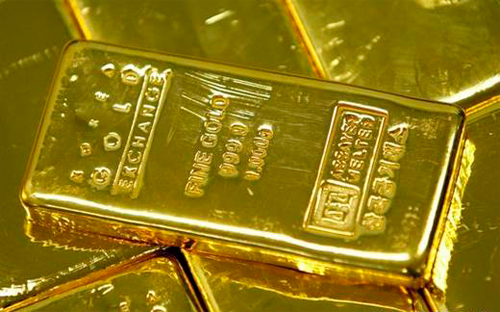
IMF confirms gold sales made by Venezuela’s central bank in August, El Universal

Venezuela sold 3.73 tons of gold bars in August, thus leaving its bullion reserves at 362.05 tons, according to figures disclosed by the International Monetary Fund (IMF), Reuters reported on Thursday.

Venezuela opposition criticizes movement of pro-Chavez candidates between voting districts, Fox News

CARACAS, Venezuela – Venezuelan opposition leaders complained Thursday that electoral authorities allowed some candidates allied with President Hugo Chavez to switch voting districts and run in different states in December’s gubernatorial elections.

Minister: education councils aim to bring up “the new citizen” in Venezuela, El Universal

Resolution 058 of the Venezuelan Ministry of Education provides for the establishment of education councils in the basic education subsystem. Such councils intend to bring up “a new citizenship,” which involves providing “integral education for the new man and woman, for the new republican,” according to Venezuelan Minister of Education Maryann Hanson.

 
Oct
3
2012
Posted by
admin
Comments

Will Venezuelans Oust Chavez? Miracles Do Happen

Bloomberg
October 3, 2012
By Enrique Krauze

i6afTBb119I8 Will Venezuelans Oust Chavez? Miracles Do Happen

Illustration by Forest

If Henrique Capriles Radonski triumphs in Venezuela’s elections on Oct. 7, it will be a democratic feat without precedent in Latin American history.

It is possible that an opposition candidate has never faced a force like that represented by Hugo Chavez. His government doesn’t employ physical violence as a state policy, but it exercises another kind of coercive and menacing violence, manifold and oppressive. Its power comes from the ballot box under the tight control of arms — his arms.

When democracy finally edged out dictatorships in Argentina, Uruguay and Chile, the military establishment — because of public repudiation of its genocidal acts — found itself in irreversible retreat.

At the other end of the ideological spectrum, perhaps the only case of an authoritarian leftist regime democratically overturned was that of the Sandinistas in Nicaragua in 1990. But the difficulties then weren’t as great as those involved in the Venezuelan process, for the very reason that the Sandinista government — already in decline at the end of the 1980s — wasn’t democratic, nor did it pretend to be.

Either way, whether against the militarist right or the revolutionary left, democracy wasn’t obliged to retrace a path, but to forge it.

Reclaiming Democracy

In Venezuela, the democrats must go back to before the beginning: They must restore true meaning to what has become a corrupted democracy. Chavez’s explicit aim has been to rule until at least 2030, when he will be 76 (and if he makes it to 76, there is no question he will want to continue). But unlike Fidel Castro of Cuba (and the Sandinistas or the old South American dictators such as Jose Gaspar Rodriguez de Francia of Paraguay or Juan Vicente Gomez of Venezuela), Chavez has astutely used democracy to do away with democracy.

He has accomplished this step by step, institution by institution, imposing his designs and spokesmen on the Legislature, the judiciary, the fiscal and electoral bodies. If he hasn’t finished his demolition work, it is because a broad sector of Venezuelan society hasn’t forgotten the meaning of freedom. In an unequal contest (because Chavez enjoys the private property of public resources, and uses them lavishly to his advantage), that sector has displayed an admirable spirit of unity, and it has in Capriles a young, sensitive and visionary leader. The possibilities of victory are real, but the adversary — despite (or thanks to) his illness — is formidable.

Chavez isn’t just a caudillo: He is a redeemer. To play up that twisted religious dimension, he has abused the media pulpit. For many years, he appeared on the Sunday program “Alo, Presidente,” a six-hour-long reality show in which Chavez delivered monologues, danced, sang, recited, read letters, declared his love for the people, railed at the empire and the “pitiyanquis” (or “little Yankees,” the purported allies of the U.S. within Venezuela), gave lessons on “21st-century socialism,” recalled scenes from his autobiography (which in his peculiar understanding of it is the incarnation of Venezuelan history) and issued thundering decrees.

Before his Cabinet members (all dressed in red, silent and as obedient as children in a classroom), he dictated expropriations, troop movements, diplomatic insults and public policies.

Many people in Venezuelan society rejected this spectacle. But more than half of the electorate celebrated it. For them, Chavez has been the reincarnation of Simon Bolivar and even Christ’s representative on earth, now more so than ever as Chavez has turned his grievous illness into a public calvary.

Chavez Loyalists

Beyond that incarnation is his social role. A considerable number of poor Venezuelans have been grateful to him for the “misiones” he established in 2003 (staffed mainly by Cubans, who have also taken charge of the security apparatus) with the aim of providing health care, food and education.

Though many of these programs have faced serious operational problems and are designed not to promote people’s autonomy, but rather their dependence on government, the “Chavistas” don’t see it that way. The near monopoly on public truth (which Chavez has enjoyed since he expropriated the major public-television channels) has masked reality. Millions of Venezuelans take his word as the mirror of truth, particularly if they are public employees whose income depends — or so they believe — on his munificence.

But the concealment of the truth has been massive. Will Venezuelans ever assess the incredible squandering of the almost $700 billion that passed through the coffers of Petroleos de Venezuela SA, the state-owned oil company that was once a bigger example of modernization than Brazil’s Petroleo Brasileiro SA? It’s impossible to know.

Many understand that Venezuela is in the midst of a crisis: Inflation and crime rates are among the highest in South America, and there are persistent shortages of goods. Basic services are also in chaos as a result of harassment in the private sector and because of inefficiency and corruption.

The Capriles campaign has been brave and conciliatory. His proposals seek to restore financial sense and protect social progress (real or perceived). Chavez has accused him of wanting to end the “misiones”; Capriles insists he will touch them only to improve them. Chavez points to him as the reincarnation of the political old guard of Venezuela; Capriles has shown how the bad practices of Chavismo are similar to those of the so- called Fourth Republic and pledged that his government will correct both.

Chavez has vilified him incessantly with crude insults and has committed the sacrilege of calling him a Nazi, knowing that Capriles’s great-grandparents were exterminated by the Nazis. Capriles, meanwhile, has remained unruffled.

Opposition’s Opening

Anything can happen, including an outbreak of the endemic violence that has plagued Venezuelan history. The fascination with a sick Chavez and his far-reaching control of the state apparatus may bring him victory.

If this is the case, the opposition must press on without pause or discouragement. Chavez may triumph, but it will be a hollow victory, and after his eventual death, divisions within his group as well as internal and international pressures may pave the way for a return to full democracy. Such a development would have the additional effect of precipitating the Cuban transition, drawing us nearer to the emergence — unprecedented in history — of an entirely democratic Latin America.

This outcome, which until recently would have seemed utopian, is at hand if Capriles wins. We have witnessed such a result before, in the December 2007 referendum, when Venezuelans, against all forecasts, voted down a plan for constitutional reform that would have turned the country into a new Cuba.

I have faith in that civic miracle. And I hope that such a victory will herald not only the return of democracy but something much more important and necessary: the reconciliation of the Venezuelan family, divided today by an ideological hatred that is alien to it, that has poisoned it for almost 15 years, and that has choked all possibility of harmony.

(Enrique Krauze is a historian and author of “Mexico: A Biography of Power” and of “Redeemers: Ideas and Power in Latin America.” The opinions expressed are his own. This article was translated from the Spanish by Natasha Wimmer.)

To contact the writer of this article: Enrique Krauze at [email protected].

To contact the editor responsible for this article: Katy Roberts at [email protected].

To read this article on Bloomberg, please click here.