Dec
21
2012
Posted by
admin
Comments

In Case You Missed It… Articles Roundup Week of 12/21/12

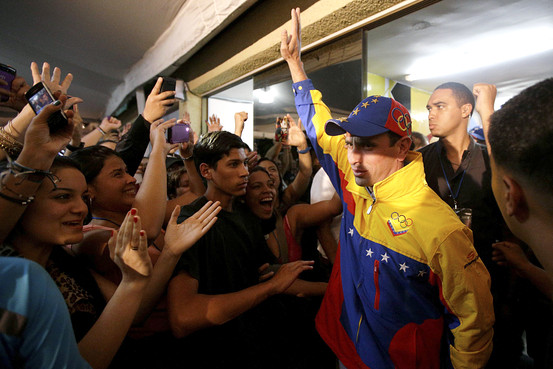
OB VS154 velect G 20121217024727 In Case You Missed It… Articles Roundup Week of 12/21/12

Courtesy of: Associated Press

This week: Capriles held on to his governorship of Miranda in Sunday’s state elections, solidifying his place as the opposition’s leader; power struggles between Chávez’s most influential allies begin to brew as the shadow of the president’s cancer looms; the budget for Venezuela’s states and communities will be less than it was in 2009; socialist communes will receive more funds in 2013 than mayor and governor’s offices. Meanwhile, Chávez suffers a respiratory infection and must remain in a state of “absolute rest”; Chavez’s battle with cancer and the possibility of a new presidential election will likely delay a needed currency devaluation; Venezuelan allies fear they will lose their socialist patron if Chávez dies or is forced to step down; Venezuela’s Supreme Court considers may decide whether  Chávez’s presidential swearing-in can be postponed. Lastly, Venezuela’s National Electoral Council (CNE) announces that the election of 335 mayors and municipal councils will be held next May 26.

Venezuela’s Capriles Solidifies Threat to Chávez, Wall Street Journal

Henrique Capriles held on to his governorship in state elections Sunday, solidifying his place as the opposition’s most likely candidate if President Hugo Chávez’s illness forces a new race for Venezuela’s presidency.

Behind appearance of unity among Chavez allies, some Venezuelans see power struggles brewing, Associated Press

Hugo Chavez’s most influential allies are projecting an image of unity while the president recovers from cancer surgery in Cuba, standing side-by-side and pledging to uphold his socialist movement no matter what happens.

Venezuela’s FY2013 budget below that of 2009, El Universal

During the presentation of the national budget for fiscal year 2013, Finance Minister Jorge Giordani stressed that next year the regions would be receiving more funds than in 2012. However, official data shows that the FY2013 budget will be actually below that in 2008-2009.

Venezuelan communes to get more funds than mayor’s offices, El Universal

Venezuela’s Budget Law for fiscal year 2013 provides that some USD 4.9 billion will be allocated by the Inter-territorial Compensation Fund (FCI) to the projects and plans of governor’s offices, mayoralties and communal councils.

Venezuela’s Chavez Suffers Respiratory Infection After Surgery, Businessweek

Venezuela’s President Hugo Chavez suffered a respiratory infection after cancer surgery in Cuba that was treated by doctors and controlled on Dec. 17, Information Minister Ernesto Villegas said yesterday. Chavez is currently in stable condition, Villegas said in a national address on television and radio.

Chavez’s cancer may put Venezuela devaluation on hold, Reuters

Venezuelan President Hugo Chavez’s battle with cancer and the possibility of a new presidential election look likely to delay key economic policy decisions including a sharp currency devaluation needed to shore up public finances.

Analysis: Allies to lose socialist patron if Venezuela’s Chavez goes, Reuters

Murals adorning a Caracas slum that has given militant backing to President Hugo Chavez over the years are a virtual pantheon of international radicals. From Colombia’s FARC guerrillas to the Palestine Liberation Organization and Ernesto “Che” Guevara, the images and slogans on teeming slopes above Chavez’s presidential palace hail socialist revolutionaries the world over.

Top Venezuela judge: court could decide if constitution allows delay of Chavez’s swearing-in, Washington Post

The president of Venezuela’s Supreme Court said Thursday that it could decide whether it’s constitutional to postpone the date of ailing President Hugo Chavez’s swearing-in as he recovers from cancer surgery in Cuba.

Venezuela’s electoral council: Local elections will be held on May 26, El Universal

The Venezuela’s National Electoral Council (CNE) announced on Thursday that the election of 335 mayors and municipal councils, in addition to two mayoralties in Caracas metropolitan area and their respective chambers will be held next May 26.
 
Nov
16
2012
Posted by
admin
Comments

In Case You Missed It… Articles Roundup Week of 11/16/12

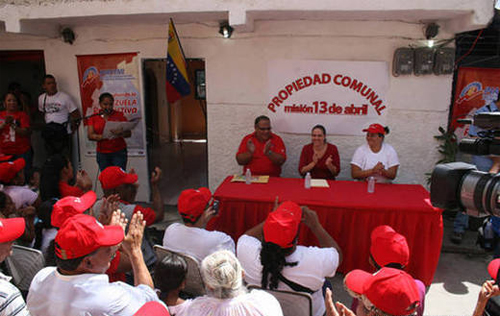
propiedad comunal In Case You Missed It… Articles Roundup Week of 11/16/12

Courtesy of: AVN

In the news this week, Venezuela won a seat on the United Nations Human Rights Council despite international criticism; regulators of the securities industry had tough questions for U.S. broker-dealers regarding practices used to mitigate money laundering and sanctions risks related to their involvement in a Venezuelan government-run exchange system; Venezuela’s crumbling infrastructure remains in the news as the electric energy minister admits the nation’s electrical system has been out of date for twenty years; and government takeovers continue as PDVSA seizes control of the Loma de Niquel mine from the Anglo American mining and natural resource company. Meanwhile, Chávez continues to lay the foundations for a communal state as forty communes await authorization by the Venezuelan government; Capriles looks to the regional December elections to legitimize the opposition coalition not only to a weary electorate but also to its own fractious members; problems persist in Venezuela’s industrial sector as the lack of raw materials reaches 83 percent; and the Venezuelan government continues to violate collective bargaining agreements, causing protests among workers. Lastly, the ADEN Competitiveness Institute ranks Venezuela among countries with the lowest competitiveness index, citing “problems of macroeconomic instability and institutional mishaps.”

Venezuela, the bane of human rights, The Washington Post

ON MONDAY, new members will be selected for the United Nations Human Rights Council, the top-level group for the protection and promotion of human rights. Its members have not always been paragons of respect for human dignity.

U.S. broker-dealers scrutinized for anti-laundering compliance in Venezuelan currency swaps, Reuters

NEW YORK, Nov. 13 (Thomson Reuters Accelus) -Securities industry regulators are beginning to ask U.S. broker-dealers tough questions about how they are mitigating money laundering and sanctions risks associated with their involvement in a 2-year-old currency exchange system run by the Venezuelan government, sources familiar with the issue said.

Some 71% of Venezuela’s electric energy system is outdated, El Universal

Venezuela’s Electric Energy Minister Héctor Navarro stated that 71% of the national electric system has been out of date for 20 years.

Venezuelan gov’t takes over Loma de Níquel mine, El Universal

Last Saturday, at 12 a.m., multinational Anglo American handed over to the Venezuelan State the control of Loma de Níquel mine, upon the expiration of the concession and failure to get a renewed term for the operation.

Communes await authorization by Venezuelan Government, El Universal

The Venezuelan National Assembly (AN) continues laying the foundations for the communal State. On October 20, during a meeting of ministers, President Hugo Chávez urged his cabinet to speed up the establishment of communes.

Capriles, Opposition Seek to Solidify Gains in Venezuela, World Politics Review

CARACAS — With campaigning for Venezuela’s December gubernatorial races now officially under way, the country’s political opposition finds itself in a tough spot. Still licking its wounds from its loss in October’s presidential election, the Democratic Unity Coalition (MUD) must get quickly off the mat to prove its credibility not only to a weary electorate but also to its own fractious members.

Lack of raw materials hits 83% of Venezuelan industries, El Universal

Obstacles are hitting the Venezuelan industrial sector, as lingering barriers continue to undermine their performance, according to data provided by the Venezuelan Confederation of Industries (Conindustria).

Government allegedly trying to uproot collective bargaining agreements, El Universal

In recent years, numerous labor protests by different sectors have sparked in Venezuela. Only in October, some 521 demonstrations were reported, 204 of which were labor-related, said the NGO Venezuelan Observatory of Social Unrest.

Venezuela among the countries with lower competitiveness index, El Universal

Chile is the leader of competitiveness among 18 Latin American countries, based on the Competitiveness Index established in October 2012 by the ADEN Competitiveness Institute. The information was disclosed by the higher studies institution based in Argentina, Efe quoted.

 
Nov
12
2012
Posted by
admin
Comments

Having Secured a Third Term, Chávez pushes Commune System

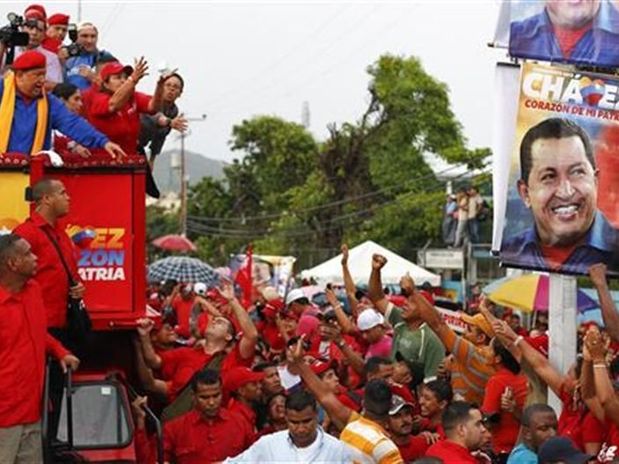
chavez Having Secured a Third Term, Chávez pushes Commune System

Courtesy of: Reuters

On the night of his reelection, Hugo Chávez said in his acceptance speech that he planned to advance his vision of “21st century socialism” in the next term of his presidency. Now, just one month later, it has become clear that the plan involves the massive expansion of the “commune” system, which experts say is a plot to diminish the power of the opposition.

Communes are a standard feature of the socialist model of government. Chávez touts them as essential to his agenda, as he claims they will give people the power to manage their own resources. But many believe that his renewed interest in them – following an election in which he was victorious by a narrower margin than ever before – is not as ideological as he claims. Instead, many characterize the push for communes as motivated by a desire to reclaim power for his own party on the state and local levels.

To date, Chávez has attempted to weaken the power of state and municipal authorities merely by withholding the share of the national budget they are guaranteed by the constitution. He’s effectively accomplished this by significantly underreporting oil revenue, which limits the amount paid to municipal leaders, many of which are his political foes. But the commune proposal now on the table has been criticized as an offensive to further destabilize the country’s pluralist constitution and decimate any remaining shreds of capitalism.

The implementation of communes could prove disastrous for the opposition by absorbing and ultimately diminishing much of the power of mayors and governors. Already, as part of its most recent budget proposal, Chávez’s party proposed a far greater increase (37 percent) in the amount of funding going to the communes than to either the state or municipal governments (22 and 23 percent, respectively). A logical next step could potentially involve the assignment of the few remaining political responsibilities from local authorities to the communes.

In 2007, the people of Venezuela rejected an amendment to the constitution that would have provided for the legal establishment of the communes. However, in December of 2010 the National Assembly passed the Enabling Law, which granted the president broad authority to mandate by decree following the flooding that left approximately 100,000 Venezuelans homeless. The law gave Chávez unchecked power for eighteen months, through which he created a ministry charged with setting up the communes. However, creation of communes had stalled until October 20 – just 13 days after his reelection – when he urged the National Assembly to implement of the Communes Law.

But implementation has been slow because the act is unconstitutional. It illegally changes the very nature of Venezuela’s government by shifting responsibilities from democratically-elected local officials to a central authority. According to the constitution, the deadline has passed for making such dramatic changes this year.

If realized, millions of Venezuelans would be affected by these changes. By the numbers, Chávez is looking to grow the communes at a record-breaking pace: 3,000 between 2013 and 2019 at the rate of 450 per year. Ultimately this will incorporate more than 21 million citizens – nearly 68 percent of the country’s population. By consolidating local power into the communes, the president is ensuring that these Venezuelans are largely controlled by the central government – not their locally elected officials.