Jun
13
2013
Posted by
admin
Comments

ICYMI: Venezuela gets a lifeline from the United States

The Washington Post
June 11, 2013
By Editorial Board
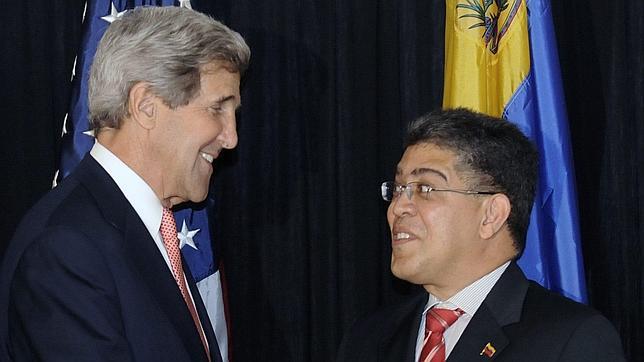
kerry jaua 644x362 e1371130314425 ICYMI: Venezuela gets a lifeline from the United States

Courtesy of: Agence France Presse

Nicolás Maduro, the former bus driver chosen by Hugo Chávez to lead Venezuela after his death, has been struggling to consolidate his position since being declared the victor in a questionable presidential election in April. With the economy stalling, inflation spiking and shortages spreading, the new president appears at a loss about how to respond, other than to blame domestic and foreign enemies. Nor has he been able to overcome a serious split in the Chavista movement between his own, Cuba-backed clique and another based in the military.

Perhaps most alarming for Mr. Maduro, an energized opposition has refused to accept the election outcome; its capable leader, Henrique Capriles, has been gaining sympathy around the region. The president of neighboring Colombia, Juan Manuel Santos, met with Mr. Capriles on May 29, prompting paroxysms of rage from Mr. Maduro and his aides. Other Latin American governments, while avoiding a confrontation with Caracas, have made it clear they regard the new leader’s legitimacy as questionable; the regional group Unasur called for an audit of the election results.

One government, however, has chosen to toss Mr. Maduro a lifeline: the United States. Last week Secretary of State John F. Kerry took time to meet Venezuelan Foreign Minister Elias Jaua on the sidelines of an Organization of American States meeting, then announced that the Obama administration would like to “find a new way forward” with the Maduro administration and “quickly move to the appointment of ambassadors.” Mr. Kerry even thanked Mr. Maduro for “taking steps toward this encounter” — words that the state-run media trumpeted.

What did Mr. Maduro do to earn this assistance from Mr. Kerry? Since Mr. Chávez’s death in March, the Venezuelan leader has repeatedly used the United States as a foil. He expelled two U.S. military attaches posted at the embassy in Caracas, claiming that they were trying to destabilize the country; he claimed the CIA was provoking violence in order to justify an invasion; and he called President Obama “the big boss of the devils.” A U.S. filmmaker, Timothy Tracy, was arrested and charged with plotting against the government — a ludicrous allegation that was backed with no evidence. Though Mr. Tracy was put on a plane to Miami on the day of the Kerry-Jaua encounter, Mr. Kerry agreed to the meeting before that gesture.

There’s nothing wrong, in principle, with diplomatic meetings or even in dispatching an ambassador to a country such as Venezuela. The State Department has also been meeting with senior opposition leaders and has yet to say it recognizes the presidential election results. But Mr. Kerry’s words amounted to a precious endorsement for Mr. Maduro — and the Obama administration appears bent on cultivating him regardless of his actions. Perhaps the increasingly desperate new leader has secretly promised concessions to Washington on matters such as drug trafficking. But with senior government and military officials involved in the transhipment of cocaine to the United States and Europe, he is unlikely to deliver.

In short, this looks like a reset for the sake of reset, launched without regard for good timing or the cause of Venezuelan democracy.

To read this article at The Washington Post, please click here.
 
May
15
2012
Posted by
admin
Comments

Jane’s: Venezuela’s Difficult Days Ahead

DSC 0754 150x150 Janes: Venezuelas Difficult Days AheadJosé R. Cárdenas served in several foreign policy positions during the George W. Bush administration (2004-2009), including on the National Security Council staff. He is a consultant with Vision Americas in Washington, DC.

The May 2012 issue of the venerable Jane’s Intelligence Review features an interesting and in-depth analysis of the political situation in Venezuela leading up to October’s presidential election and beyond. It takes as its starting point that the mystery regarding the severity of Hugo Chávez’s illness indicates that the months ahead are unlikely to be smooth. It then posits various scenarios for the possible course of events, systematically assessing how Venezuela’s stability across a range of fronts will be influenced by whatever direction those events take.

Jane’s concedes that the lack of official transparency about Chávez’s health complicates any effort to predict outcomes. That same obfuscation, however, raises the destabilization factor: the lack of a succession plan has led to Chávez’s PSUV party being “riven with factional divisions” — primarily breaking down along military and civilian lines.

The individual to watch is Diosdado Cabello, currently head of the National Assembly and a former Chávez military colleague. Jane’s believes he is the military’s preferred candidate. On the civilian side, the President’s brother, Adán, a true-blue Marxist and governor of Barinas, is thought to be favored by the Castros.

Complicating matters further is that Chávez over the past decade has so politicized the military and tolerated so much corruption that it has made the military as an institution “inherently more unstable and unpredictable.” Not helping matters are the number of armed militias prowling the country that answer only to Chávez, which could prove to be another destabilizing factor.

Another variable is Cuba, whose ties to the Chávez government Jane’s calls “the most important external relationship that has a bearing on the current and future risk situation in Venezuela.” Given the Castro regime’s precarious economic situation and its extensive intelligence and political ties to Venezuela, it is easy to assume it will take every action to ensure its preferential economic relationship with Venezuela is not threatened.

Against this backdrop, Jane’s offers three possible scenarios that could define Venezuela’s future in the coming months, assessing the likelihood of each and discussing how they could impact Venezuela’s stability across several fronts: political, economic, social, military/security, and externally.

Scenario one (probability: significant; country risk: high) is that Hugo Chávez is physically unable to stand for re-election; scenario two (probability: low; risk: significant) is that Chávez is able to run, but is defeated by opposition challenger Henrique Capriles; and scenario three (probability: high; risk: significant) is that Chávez wins re-election, but succumbs to his illness in late 2012 or into 2013.

Recent events, however, would seem to alter that calculus, with scenario one appearing now to be more likely than scenario three. Chávez today spends more time in Cuba (ostensibly receiving treatment) than in Venezuela, rarely appears in public, and recently appointed loyalists to a long-neglected “Council of State,” which many see as the first step toward the establishment of a junta to govern in Chávez’s absence or name a successor if Chávez is forced to step down.

Still, whether it is scenario one, two, or three, the bottom line remains that events in Venezuela are unlikely to proceed smoothly. How could it be otherwise? Twelve years of Chávez building his personality cult, sowing class warfare and social polarization, and gutting democratic institutions are all prescriptions for political turmoil in any kind of transition. Even if he dies an untimely death, Chávez will continue to wreak havoc on Venezuelan society.

Particularly troubling in this environment is the absence of the United States, which has considerable interest in what happens in Venezuela — from energy to counternarcotics and counterterrorism concerns. However, Jane’s points out that U.S. policy of attempting to contain Chávez’s influence from expanding regionally “has given way to a more benign view,” concluding “that Chávez may be now be best handled by leaving him alone to face his possibly terminal illness.”

This would be a huge strategic error. The U.S. government doesn’t need to cast itself as the running mate of Mr. Capriles, which would not help either. But it does have an interest in forestalling violence if Chávez’s successors try to strong-arm a transition or their candidate loses to Capriles in the fall. If anything, it should at least be pressuring regional governments like Brazil and Colombia to act in unison should events in Venezuela take a turn for the worse. Indeed, only preparing for the worst gives you the best chance of things turning out the best.